

Everything you wanted to know about trick-taking games but were afraid to ask
Maybe you’re quite new to board and card games and have heard people talking about trick-taking games. Maybe you’ve been into the hobby for ages and don’t know anything about trick-taking, but you’re too scared to ask at this point. Either way, I’ve got you covered.
What is a trick?
In the context of card games, a trick is usually a round of play in a card game. Most commonly in trick-taking games, each player plays a card ‘into the trick’ by choosing a card from their hand and playing it to the table. After every player has played a card into the trick, the winner is determined.
How to play a trick
One person is said to lead the trick. This person plays the first card of the trick, and usually, the suit of the card they play sets the suit for the rest of the trick. This is called the led suit. Play goes around the table, with each player playing a card into the trick. Which card you play depends on whether the game is a must-follow or a may-follow game.
As the name suggests, in a must-follow game, you have to play a card from the same suit as the led suit if you can. You have to follow. If the game is may-follow, then it’s up to you if you play a card of a matching suit.
Once all players have played a card into the trick, the trick is complete. So how do you determine who won the trick?
Most trick-taking games fall into one of two main categories. Games with trumps, and games without trumps.
In a game with trump suits, if a player plays a card from the designated trump suit, then it will win, regardless of its value, or whether it matches the led suit. If multiple cards of the trump suit are played into the same trick, then the highest value wins.
In a game without trump suits, the player who played the highest value card of the led suit usually wins the trick.
At this point, in most games, the winner collects the played cards – the trick – and keeps them beside them.
Why are trick-taking games so popular?
If you’ve read that previous section and find yourself left wondering “Why are trick-taking games so popular?”, then you’re not alone. When you look at the concept of them through a clinical lens, then let’s be honest, they sound pretty boring. Everyone plays a card; the highest card wins. Yawn.
What makes trick-takers so incredibly popular is the way the recipe is tweaked. It’s like saying “Potatoes are pretty bland”, and then trying crisps (chips), fries, jacket potatoes, mash, dauphinoise, hasselback, fondant, roast potatoes, rosti, hash browns, and those spiral delicacies from Essen.
Potatoes are awesome. And so are trick-taking games.
The originals
From tiny acorns, mighty oaks do grow. Some of the original trick-taking games are still massively popular today.
Whist
One of the originals. Whist is a partnership trick-taking game. Two teams of two players play normal, must-follow tricks, with the highest card winning the trick. After all thirteen tricks have been played, each pair gets a point for every trick above six that they won. It might sound pretty boring, a bit plain, but Whist is still really interesting and a lot of fun. It’s been around since the 18th Century and the foundation of many games since.
Bridge
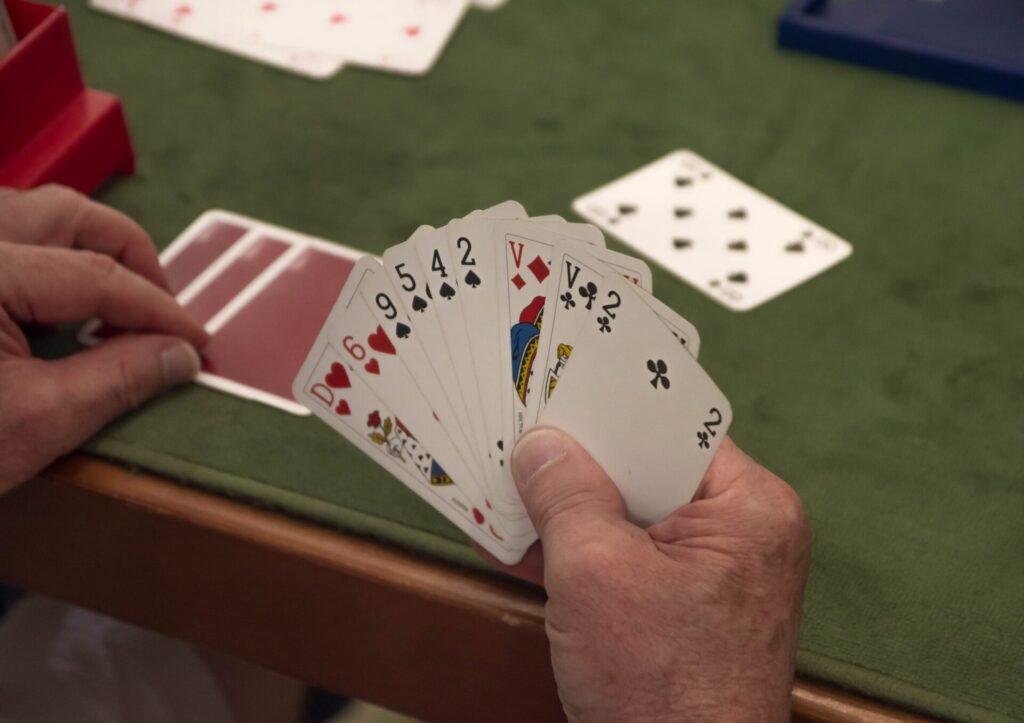
Contract Bridge (as it’s also known) takes the principles from Whist and turns them into a far more tactical game, which is massively popular all over the world. It’s still played in pairs, but there’s a nuanced bidding system where pairs, sitting opposite one another, aim to communicate what they think they can win without outright saying it.
Oh Hell! / Wizard
Oh Hell! takes the prediction dynamic from Bridge and cranks it up to 11. There are lots of variants, but the one I’m familiar with is called Wizard. In each round, the number of cards dealt to each player is different. You start with one, then two, then three, and so on. In each round, you predict how many tricks you’re going to win. If you hit exactly that number, you score big. If you’re even one higher or lower, it can be as bad as winning none at all.
Skat
It’d be remiss of me not to mention Skat. Skat is the result of constant refinement over the last couple of hundred years. It uses a reduced deck and is for three players. Skat has a seemingly alien bidding system when you first watch it being played, which results in a solo player playing against the other two. Trying to explain Skat in a paragraph is impossible, but it’s certainly worth finding out more about, because it’s a great example of traditional trick-taking with a very specific twist applied.
Vive la différence – modern trick-takers
Let’s take a look at some of the different ways tricks are used in games. Games where the base formula is tweaked to become something pretty special. I’ll list some of my favourite games which do something different and explain what they do.
Schadenfreude
Schadenfreude is one of my favourite games. It’s a Japanese game with a theme of European medieval knights. It does some clever things, but the one I specifically want to mention is the way tricks are won. You see, in Schadenfreude, the player who plays the second-highest card wins the trick.
Cat in the Box
The titular cat of Cat in the Box is Schroedinger’s Cat, because the game is (very loosely) based on quantum theory. Each value in each of the game’s suits can only be played once, which normally wouldn’t be a problem. There’s only one ten of Hearts in a deck of cards, right? Not so in Cat in the Box. Every card is the same suit, and it’s not until you play a card that you declare what colour it is.
Nokosu Dice
The clue is in the name. Nokosu Dice does a lot of things in the same way as any other trick-taking game, but there’s one big difference. Dice. During the game, you play with cards and dice, and both can win tricks. Trying to explain the whole game in a paragraph is impossible, but suffice to say there’s a reason people rave about it.
The Crew: The Quest for Planet Nine
The Crew does a few things differently, and it’s great for it. Firstly, it’s a cooperative game. Secondly, it’s a campaign game of sorts. Each time you play, you have to complete increasingly difficult missions. Thirdly, the game has limited communication. You cannot openly talk about which cards you do or don’t have, and in a game where you might be trying to make sure a certain player wins a certain card, things get tricky, quickly.
Stick ‘Em
Trick-taking games can get mean, and Stick ‘Em is probably the best example. Most of the game plays out like a normal trick-taker, but at the start of each round, you choose a card from your hand, which designates your ‘pain suit‘. At the end of the game, any tricks you’ve won with cards in from your pain suit are negative points! Tons of opportunities to dump pain cards into tricks you’re sure certain people are going to win.
Board yet?
Now we come to the really interesting part. When board games and trick-taking games collide. Some board games feel like someone has given a box of Lego to a chimpanzee and let them make something. All of the cool parts are there, they just don’t quite work together. When trick-taking and board games combine – and do it well – the results can be much greater than the sum of their parts.
Brian Boru: High King of Ireland
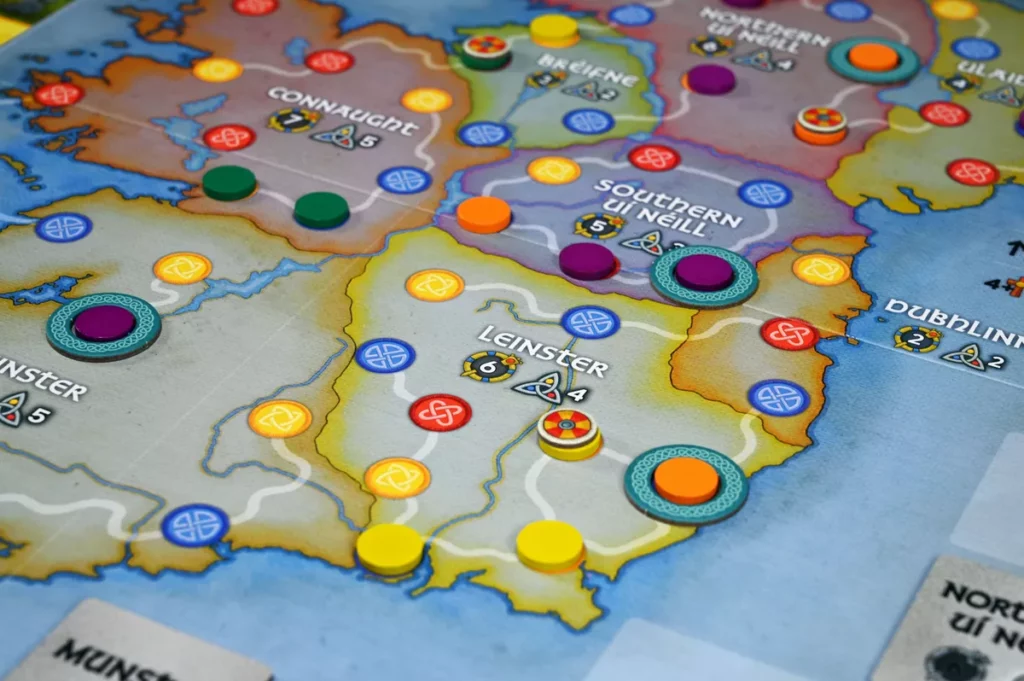
I actually reviewed Brian Boru a few years ago. You can read that review here. It’s a really clever game where you try to create networks of claimed towns across Ireland while simultaneously repelling marauding Vikings, gaining influence with the church, and trying to get married! It uses a really clever three-suit system of trick-taking where even the losing players get to take actions from their cards, but it’s always the lowest value card which takes its actions first. It’s great to have the intentional loss practice from games like Wizard and Stick ‘Em where sometimes not winning is the best way to play.
Joraku
There’ll be a full review of Joraku in the not-too-distant future. It’s a game of area control set in feudal Japan. Played over three rounds, players try to dominate areas with their pieces, while the points each area is worth changes each round, as they make their march on Kyoto. What Joraku does that makes it so much fun is that each card played, even if you lose a trick, contributes a number of action points you can spend to place and move your own pieces, and also remove other players’ pieces. Quick, clean, and incredibly clever.
Arcs
Before the “umm, ackshually” brigade gets started, yes, I know that strictly speaking, Arcs doesn’t involve taking any tricks. But the principles are all there. I reviewed Arcs right here. It’s a space 4X game in microcosm, where actions are determined by the types of cards played into each trick. Your first play of Arcs will feel like chaos, but repeated play rewards you with a dynamic, shifting game of on-the-fly tactical play that’ll make your head spin.
Power Vacuum
Power Vacuum is a riot. In each round, you’re competing for Power to accomplish hidden agenda cards. What’s really clever in Power Vacuum is that being the player with the lowest card in any trick allows you to adjust the Control Board, which in turn adjusts the power level of the different appliances in the game (yes, household appliances). It also has a cool feature where the colour of the back of each card shows the other players its suit, but a special fifth suit – the spies – masquerade as cards of other colours.
But I thought xxxxx was a trick-taking game?
While the popularity of trick-taking has ballooned recently, which is great, it’s also led to some misunderstandings. There are whole other sub-genres of card games which people refer to as trick-taking, but aren’t. Just because a bunch of cards are thrown onto the table and someone collects them, it doesn’t automatically make it a trick-taker. Here are some notable examples and some talking points the next time you want to appear irresistibly interesting at a dinner party.
Ladder-climbing
Ladder-climbing games are games where you try to beat the cards currently on the table. It’s called ladder-climbing because the rules generally ask you to play something better than what’s currently winning.
In some games, that means playing cards with higher values than the current cards. In some games, it means playing more cards than the currently winning cards. In some games, it’s both, or either.
Shedding
Shedding games are games where you try to get rid of – or shed – your hand of cards. Whatever it takes, you need to get rid of your cards in order to win, or at least not lose.
Aren’t they the same thing?
No. Ladder-climbing and shedding are not the same thing. They’re just both used in a lot of games with crossover. Think about Uno, for example. A game about getting rid of all of your cards, but you don’t have to play more or higher cards than the previous player. Then you’ve got games like Maskmen, which is a ladder-climbing game where the cards you capture matter more than getting rid of your cards.
Think of it this way. Ladder-climbing is the mechanism, whereas shedding is about the end result.

If you want another way of looking at the difference between trick-taking and ladder-climbing/shedding, think of it this way. Ladder-climbing games are about tempo and pace control. They’re about setting up future turns and predicting what the other players might do. Trick-taking games are wars of attrition. You will play all of your cards; the skill comes in deciding when to play them.
Notable non-trick-takers
Scout, Panda Spin, Ghost Lift, Tichu, 1 A.M. Jailbreak, Haggis, Odin, Linko, Rummikub, Dutch Blitz, Rummy, Cabanga.
All of them are great games. None of them is a trick-taking game.
Over to you
Do you enjoy trick-taking games? Do you have any favourites I missed out on? Let me know what you think in the comments below.
THANKS TO MY SUPPORTERS
Krissie  Craig Paul Brendan Brett Gary Becky
Gavin Chris Mark Johan Richard Simon Ben Sam (new!)
Help me keep Punchboard independent by joining the supporters

 Buy me a coffee
