

Hisashi Hayashi makes some amazing games. Yokohama, Trains, Bomb Busters, Metro X, and many more. He’s a clever chap. Ian O’Toole is one of, if not the best, board game illustrators in my opinion. So when I saw the new box art for the new version of Railway Boom ahead of this year’s Spiel Essen, and saw both their names along with Simone Luciani on board(!) as a developer, I had to have it. A friend of mine was in Essen and kindly agreed to pick a copy up for me, so a few weeks later it was in my eager little mitts, and boy, am I happy with my blind purchase.
Stock cubes?
Most train games released now fall into one of two categories: stocks & shares, or cube rails. Stock games are usually the 18xx series of games, which have a heavy emphasis on spreadsheet-like management of shares in rail companies and the investments and dividends from them. Cube rail games often take a similar approach, but with a much lighter touch, and with more emphasis on building the railways. I love cube rail games; take a look back at some of my reviews for games like Mini Express, Luzon Rails, and the amazing Ride The Rails. Railway Boom is neither.
Railway Boom is closer to a cube rail game than anything else, but it’s very different. There are no stocks at all, and the entire game revolves around trying to build a rail network across mainland Japan while managing your fleet of trains and carriages. Its hook, though, its something special, its little bit of ooh-la-la, is the bidding mechanism that underpins nearly everything that happens.
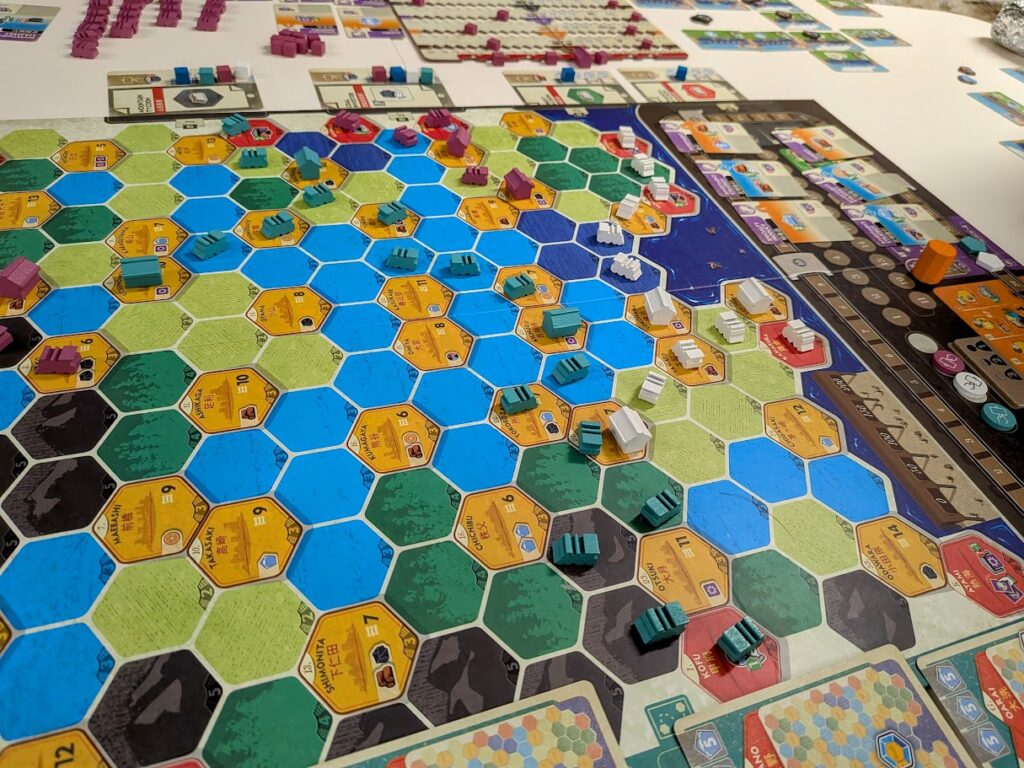
Each of the game’s four rounds has four bidding phases. Firstly, you bid for locomotives and carriages, using your wood as currency. Then comes bidding for station placement on the map, along with laying railways, paid for with cash money. Next comes Developments, which are bonuses. Instant one-offs, ongoing powers, or once-per-round tappable abilities – all paid for with technology. Handily, the next thing you do is get your income, which is useful for the next phase – running your trains. Finally, you bid again on game-end scoring cards, which offer multipliers for conditions like the number of red cities you reached, your position on an income track, or your longest straight line. The bidding currency for each round is listed on the card.
All of this happens with multiple rounds of bidding, and the bidding is so clever, so simple, and so engaging. You either bid into a free space on the bid track ahead of where your token currently is or pass. You go round and round until everyone passes. The winner (and 2nd place in a four-player game) pays their full bid. Next in turn pays half their bid, and the last player pays nothing. Combine this with the knowledge that you can never bid more than you have, and that your number of each resource is public knowledge, and there’s only one thing on the cards…
SHENANIGANS!
Train of thought
In the first round of the game, it’s like working with a blank canvas. Nobody has any particular plans, and you don’t know which cities will come out of the deck when it comes to the expansion phase. The only things steering you are the end-of-game scoring cards and some route bonus cards that reward you for connecting certain cities, a la Ticket To Ride. Once you get past that first round, though, the mists clear, and you start to realise not only what you want to do, but what the other players might be doing.
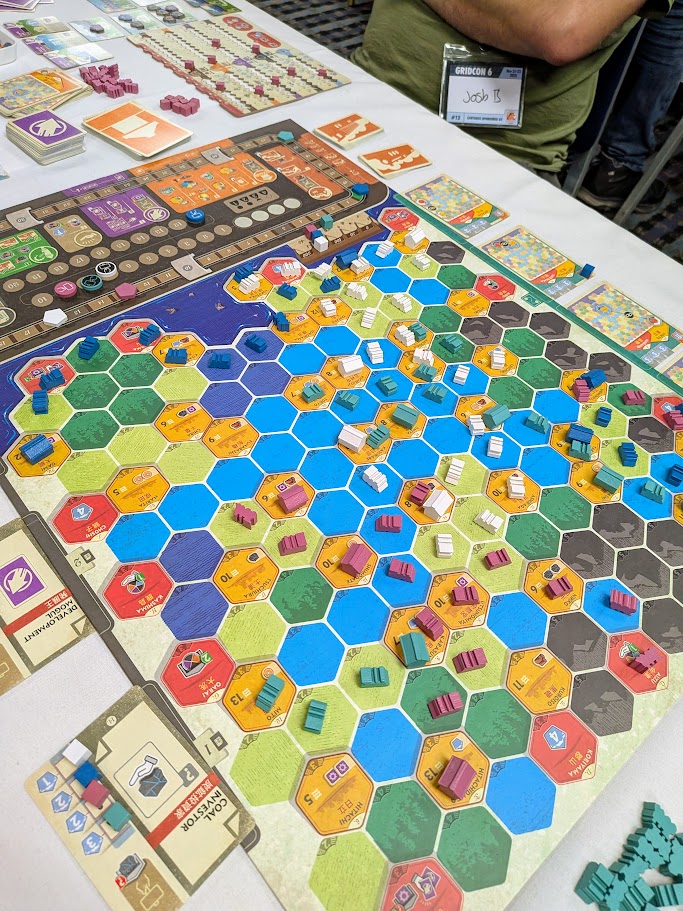
Armed with this corporate intelligence, plans start to form. The person sitting opposite you has a big ol’ network forming on the board don’t they? They’ve nearly finished that cross-board link that’ll score them points and lean into that straight-line scoring card condition. But look, they only have four coins for the Expansion phase to get first pick from the cities coming up. It’d be a real shame if someone were to bid six, right? Right?
There’s an anytime action you can take to trade any two goods for another good. Because you can never bid more of a resource than you have at any given time, it creates a really neat dynamic where you can almost force someone to trade in a lot of goods just to be able to outbid you. I can tell you from personal experience that when this happens, and when you end up a long way down the bidding track and only pay half of that bid, or even nothing at all, that’s a whole new level of satisfying. It’s like flipping your pillow to the cold side so you can peel the plastic off your new phone’s screen, just to watch a powerwashing compilation. Mmmm.
There’s a whole phase of the game where you run your trains, but this is probably the least interesting part. You organise your locomotive and carriage cards, which can carry goods tokens to score points and garner more resources, but it’s a heads-down, simultaneous affair.
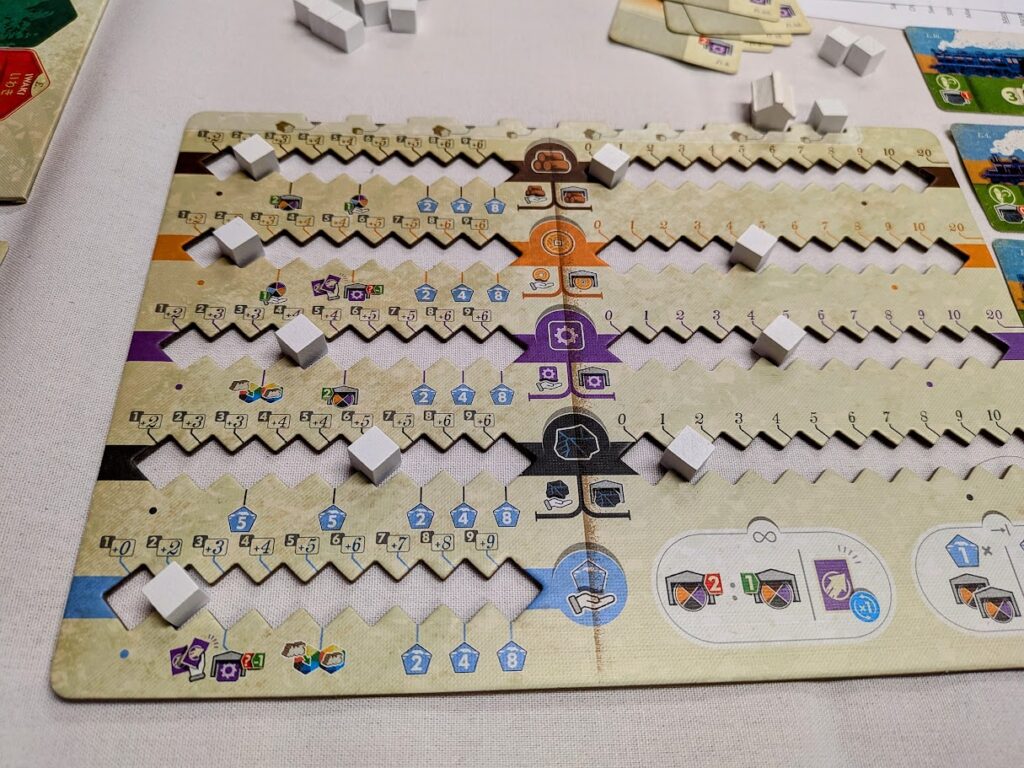
A word of warning about this phase. If you’ve got any – let’s call them competitive – players around the table, especially if their moral compass doesn’t point to true north, keep an eye on them. That’s the polite way of saying that if anyone’s going to cheat (or even make a mistake), it’s at this point of the game. It might even be worth going around the table one at a time, just to keep everyone honest.
Leaves on the line
So Railway Boom is perfect, right? Uh, no, I wouldn’t go that far. There are a few things that are more branch line than Shinkansen. Planning for your railways on the main map is difficult. There’s no way of knowing which cities are going to come out of the deck, and you’ll only go through 12 or 16 cities in three- or four-player games, respectively. In a three-player game, that means you’ll only see a third of the 36-card deck, so if you go for a Northern city in the first round then only see others in the South for the rest of the game, it can be infuriating to try to link them up, which is what you need to do to score well at the end of the game (2VP for each connected piece in your biggest network).
The same is true of the Route cards. Yes, you can earn a nice bump of points if you complete one of the four routes in each game (there are only seven route cards included in the game for some reason), but if the stations near the destinations on those cards never come out, the routes get forgotten and ignored, which is a shame. They feel like an afterthought, and I’d prefer it if they scored more points and had more impact on the scoring. It you trigger one incidentally, it’s nice, but otherwise it’s a lot of effort to go to for 5 or 11 VPs in a game with scores often over 150.
Enjoying this article? Consider supporting me.


The other issue I have, if that’s what you want to call it, is that the game is nowhere near as interesting with two players as it is with three, and it’s better still with four. With two players, in each round there are only two locomotives to choose from, two sets of developments to agonise over, and only two cities added to the map. Only having eight stations on the map at the end of the game, which is less than a quarter of the deck, makes completing routes very difficult. Most importantly, though, auctions with two players are really dull.
So yeah, three or four players is the way to go, preferably four to get the maximum variety from the map and decks of cards.
Final thoughts
Now, I know I’ve used the section above to have a bit of a grumble. I’m in my late forties, though, so having a bit of a grumble comes as naturally to me as groaning every time I sit down. Despite my grumblings, Railway Boom might just be my favourite game from 2025. I love a train game. I love Hisashi Hiyashi’s games. I love Ian’s artwork. The gameplay loop is simple, and I love how it takes what could have been a by-the-numbers Euro game and turned it into an interactive game full of groans and laughing.
The bidding and payment mechanism throws up so many interesting choices every step of the way. Debating whether it’s best to convert everything you own just to grab that perfectly placed station, or to save the money and use it to pay for extra track from an edge-of-the-board leftover station is great. The developments feel unimportant on your first play, but getting something that works early in the game can reap huge rewards. The competition for the end-of-game scoring card positions is great, too.
What I especially love about Railway Boom is how concise it is. The same bidding system drives the majority of the game, so once you understand it you can play the game. It doesn’t demand much mental overhead to understand the game, and it doesn’t take too much time to play. Even with four players, you’ll be done in a couple of hours. Even the box is small. It’s about the same size of Ride The Rails, which is amazing, because it can go in my cube rails stack.
Railway Boom isn’t going to be a hit with everyone. I can see that. There’s too much out of your control for some people, and obviously, if you don’t like auctions and bidding, you’re not going to suddenly love it. For the rest of us, though, Railway Boom is so good. If and when it gets a release in your part of the world, I highly recommend it.
Pros & Cons
Pros
- The auction mechanism works so well
- Interesting decisions to make at every point
- Surprisingly quick for such an involved game
Cons
- The route cards don’t really add much to the game
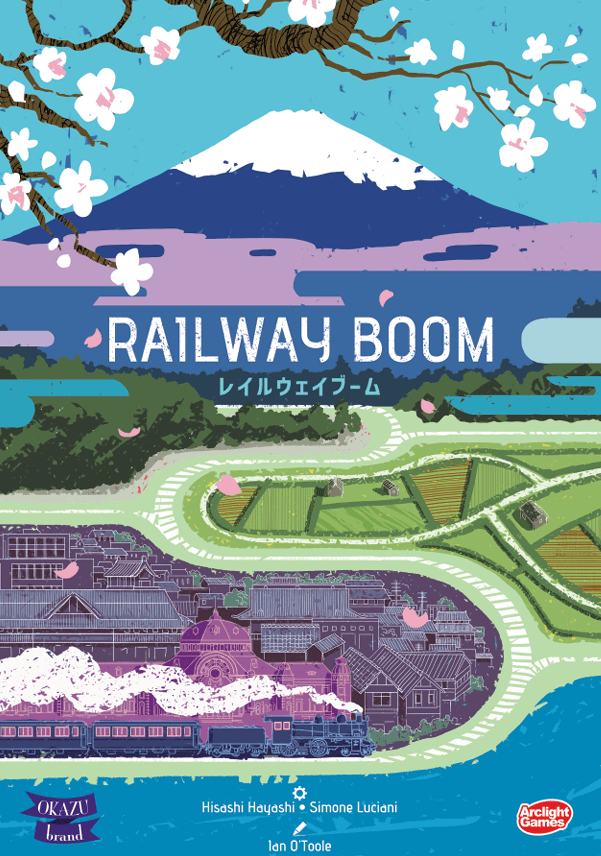
Railway Boom (2025)
Design: Hisashi Hiyashi, Simone Luciani
Publisher: Arclight Games, Cranio Creations
Art: Ian O’Toole
Players: 2-4
Playing time: 60-120 mins

Adam is a board game critic with over 15 years of experience in the hobby. A semi-regular contributor to Tabletop Gaming Magazine and other publications, he specialises in heavyweight Euro games, indie card games and transparency in board game media.