

A review copy of Stamp Swap was kindly provided by Stonemaier Games. Thoughts & opinions are my own.
Philately – collecting and studying postage stamps – is a hobby which I’m surprised isn’t better represented in board games. The only other game that springs to mind is Penny Black from a couple of years ago. It’s surprising, really, given that board game enthusiasts are often avid collectors too. You’d think there would be a big intersection in the hobby Venn diagram. Regardless, Stamp Swap is here now to help fill the gap, and it does a good job. It’s essentially a set-collection game with a bit of a tile-laying puzzle, and it’s a lot of fun. But it has something a bit different to offer.
There are already a ton of tile-laying and set-collecting games out there, so to stand out from the crowd, to make someone choose your game before any other, you need a hook. You need something to make your game different and make people want to play it. Stamp Swap’s hook is adding the ‘I cut, you choose‘ mechanism.
Of cake and cuts
If you’re not familiar with ‘I cut, you choose’, it’s a simple but engaging premise. Imagine you have a cake in front of you and you need to share it with someone else. You have the knife and have to cut it into two pieces, but the other person gets to choose which of the two pieces they have. So the instinct to make one piece more desirable than the other becomes difficult.
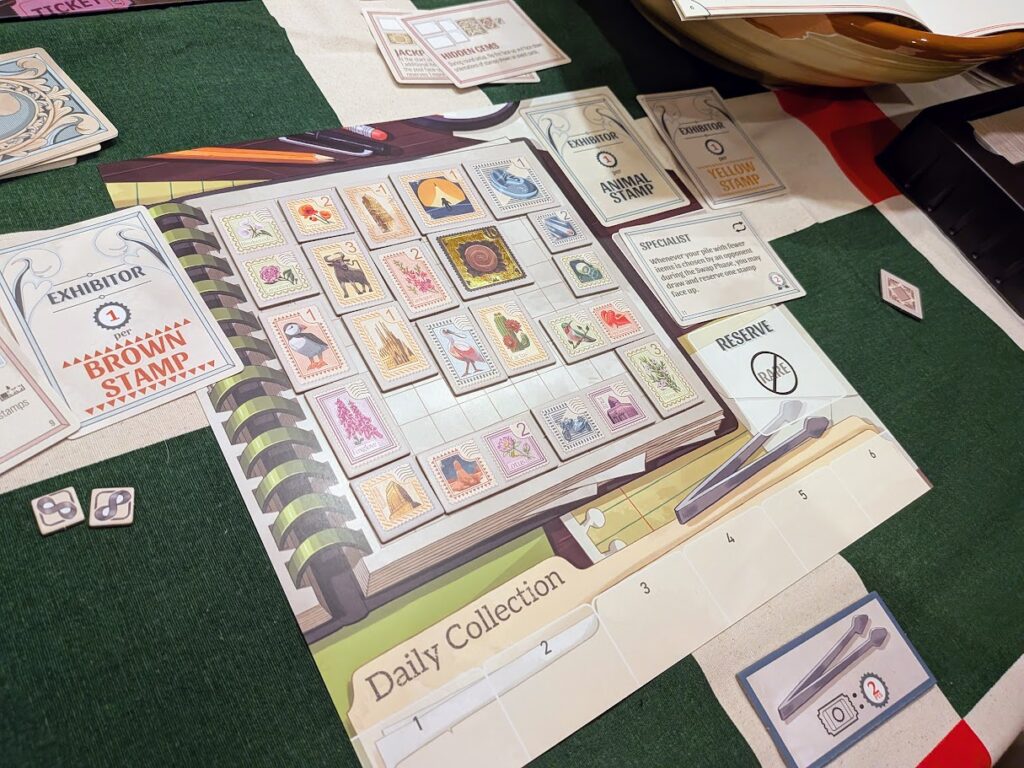
You could make a straight 50/50 split, but what if one side of the cake has more cream on it? More frosting. More cherries. Maybe now you can cut that part of the cake into a quarter and leave the other three-quarters as a choice. Quarter of a cake with goodies on top, or three-quarters of a cake with no goodies. Which is best?
Making other people make this decision is at the core of Stamp Swap, and it’s great. In each of the game’s three rounds a pile of stamp tiles and cards (along with the first player token) are pooled into a market in the middle of the table. The players take turns to draft cards and stamps, then the fun begins. You get to reserve one of the things you drafted, then you have to make two piles with the rest of the things, with a minimum of one item per pile. The first player chooses another player and takes one of their two piles, adding it to their own reserve. Then the player who had a pile taken does the same, and so on until all the piles of stamps and cards are sitting below each player’s board.
There are four randomly drawn scoring condition cards on the main board. During each of the three rounds you’ll choose one to score, but only once. This is where things get really interesting. Let’s say it’s the third round and one player is racing ahead on the score track. It looks like they’re collecting blue stamps to score the ‘1 Color’ category, but the rest of the players can see that. Those other players can make piles with a single blue stamp in, throwing everything else in the other pile. That leading player has some hard choices now. Is it worth taking those single blue stamps and forgoing everything else on offer? Are the cherries on those pieces of cake big and juicy enough?
Heads-up
Hopefully you can already see where the interest and fun comes from Stamp Swap’s design. It doesn’t just piggy-back on the standards set by games like Barenpark, Llamaland, and The Isle of Cats. There’s a lot more to consider than just “which tiles are available and where can I put them?”. I love that it only takes one round for people to start to watch what’s going on like hawks. You can almost feel the rest of the players agonising over what item goes in which pile.
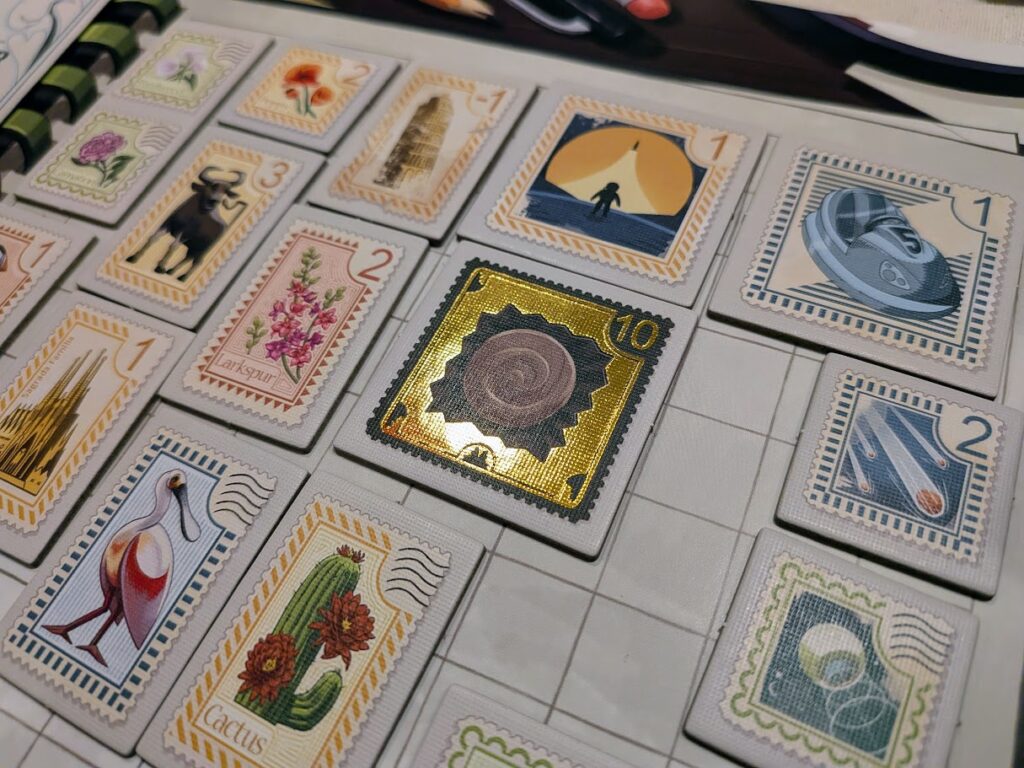
The dynamic that the piles add to the game is excellent. If you’ve ever been to a convention for something like stamps, trading cards, sneakers – or just about anything else that can be collected – you know how big the bartering is. Traders and collectors go back and forth over tables trying to come to agreements about which things are worth how much money or other items in trade. Stamp Swap does a decent job of conveying this sort of feeling, albeit without the direct bartering. It’s a constant battle between what you want to keep, what you want others to take, and what you can move from the keep pile to the trade pile to sweeten the deal.
Enjoying this article? Consider supporting me.


Stamp Swap fills a gap that I didn’t really know existed. A quick, social game, with a clever load of set-collection and tile-laying. It’s the sort of game that would be great to start or end a games night, or to play with a group at a board game café. Even with five players you’re talking about a game which is going to take you 45 minutes to play. The other thing I really appreciate about the Stamp Swap approach to interaction is taking the Personal out of it.
The capital P in the previous sentence was intentional. When we talk about direct player interaction in games we often talk about how it makes players bounce off of one another. Miniature (or sometimes much bigger) deals, alliances, and attacks. For some people that’s great. That’s what games nights are all about for them. For a lot of people though, interaction is scary. It’s worrying. It drives anxiety. The interaction in Stamp Swap is much softer, more hands-off. You use cunning to design piles, but you don’t push it on someone. You take a pile that benefits you massively, but you’re not depriving someone. It’s just the game. It’s just how it works, and I’m here for it.
Final thoughts
When I was offered Stamp Swap for review I was non-plussed. I wasn’t put off by it, but I wasn’t excited about it either. Even when I punched the game out and read the rulebook, I didn’t really get it. In fact, I still didn’t properly get it until just after the first round I played. This was with only three players, but even then, once I understood the whole ‘I cut, you choose’ thing and how it works within the context of the game, I got a big smile on my face.
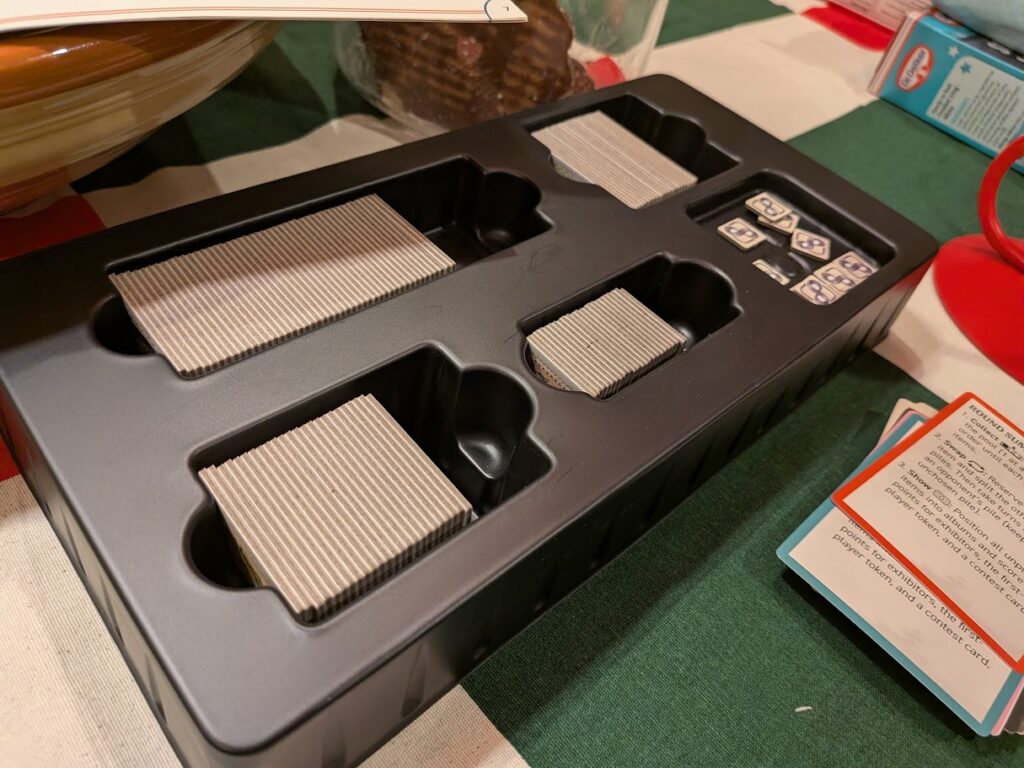
I really like how quickly the game plays out. I wonder how much testing went into the game length. At first I thought it was over too quickly and wanted to play another round, but with more games under my belt, I think it hits right where it needs to. It’s a game which takes a few minutes to set up, then an hour later you’re putting it back in the box having had a good time.
If your preferred games are heavy and strategic, Stamp Swap might not do it for you. It’s quick and light and only three rounds long. It’s probably not your big games night game. Not unless you plan to play three or four games of it back-to-back, but then I think you’d probably be missing the point. Stamp Swap instead fits into that same space as games like Splendor, Barenpark, and The Quacks of Quedlinburg (read my review here).
It’s available most places for around £25, and for that price it’s a great deal. Best with four or five players when that interaction at its busiest, try Stamp Swap if you get a chance, I think you’ll be pleasantly surprised.
Pros & Cons
Pros
- Super quick to play
- I cut, you choose mechanism
- Really nice components for the price
- Easy enough to teach to just about anyone
Cons
- More of a filler+ than a main game
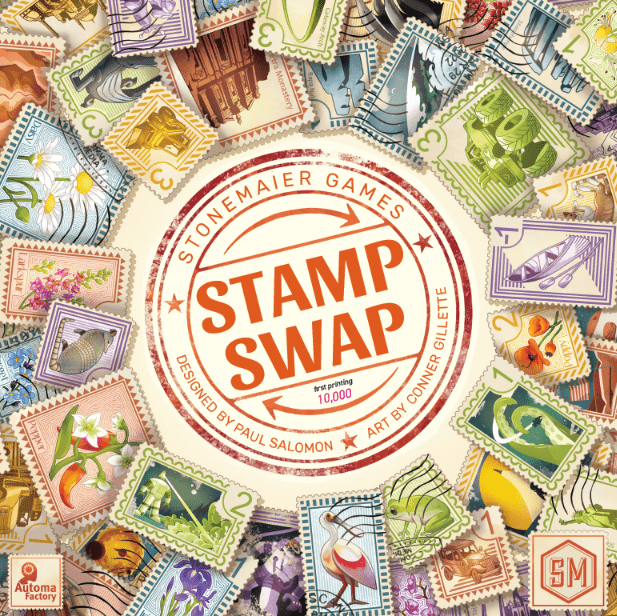
Stamp Swap (2024)
Design: Paul Salomon
Publisher: Stonemaier Games
Art: Conner Gillette
Players: 1-5
Playing time: 20-50 mins

Adam is a board game critic with over 15 years of experience in the hobby. A semi-regular contributor to Tabletop Gaming Magazine and other publications, he specialises in heavyweight Euro games, indie card games and transparency in board game media.