
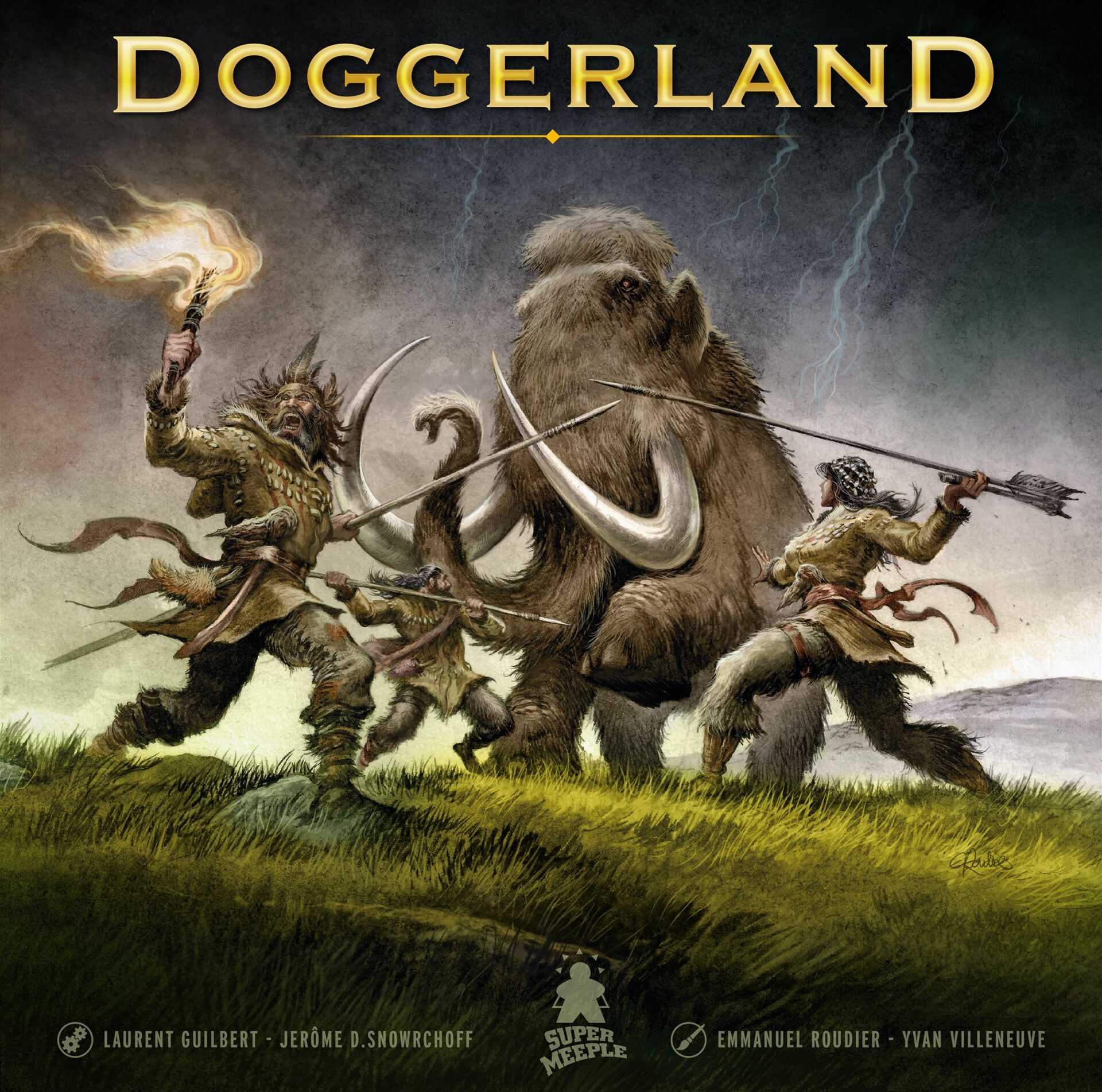

Yes, yes, the name is funny. Doggerland, right? Some background might help subdue the guffawing I guess. Doggerland was a large land mass which covered a lot of what we now know as the North Sea. It joined mainland Britain to France, Belgium, Germany, Denmark, and the Netherlands about 10,000 years ago. Doggerland, the board game, is a game about hunting, gathering, growing your tribe, and even finding time for some arts and crafts. My favourite way to describe it is Stone Age, but all grown up.
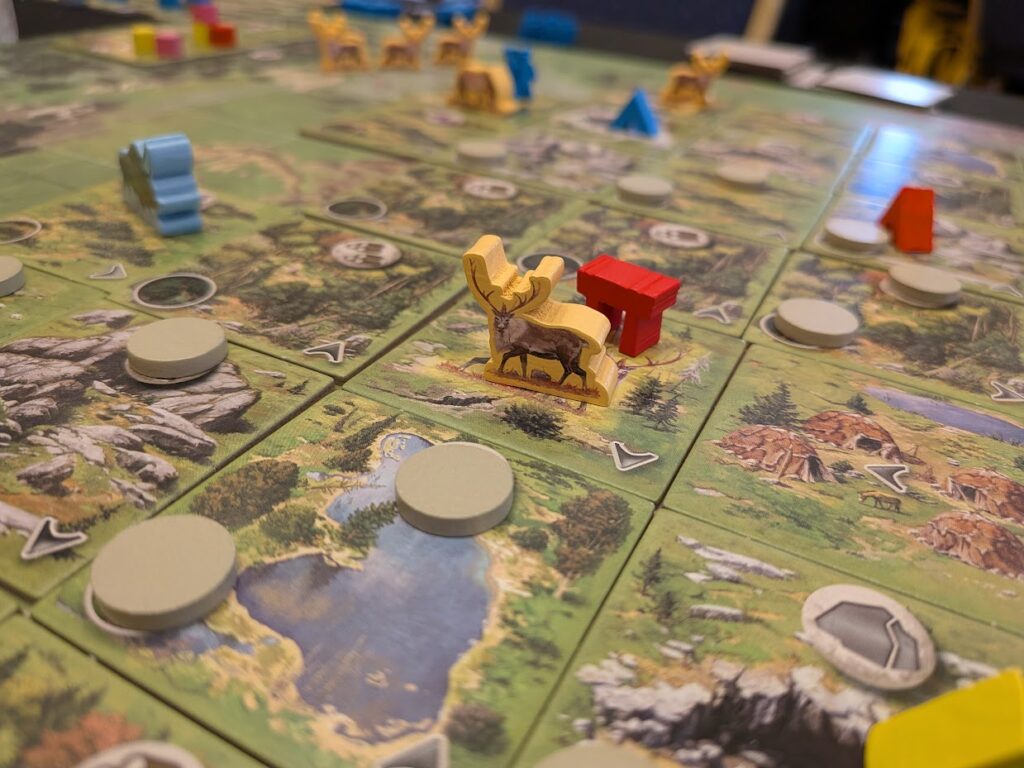
Stone Age was one of the first modern board games I ever bought, and it’s still in my collection. It’s a pure, gorgeous worker-placement game, which admittedly, feels a little light to me these days, but I still have a soft spot for it. Like a first love, it’s always going to be a bit special. Doggerland shares a lot of the bones of Stone Age, but adds on whole thick swathes of extra mammoth fur, making things feel much denser.
Click & collect
The core principles are the same. Each player has a player board with a number of tribes people, and the players take turns to place their little people on the board to later carry out various actions and to gather resources. Like I say, very Stone Age. The biggest difference comes in the board itself. Instead of a set, immutable map, the middle of the board is made up of square tiles. Each tile has something on it which your folk can gather or do. Fruit, small game, stone, wood, and other things are all up for grabs.
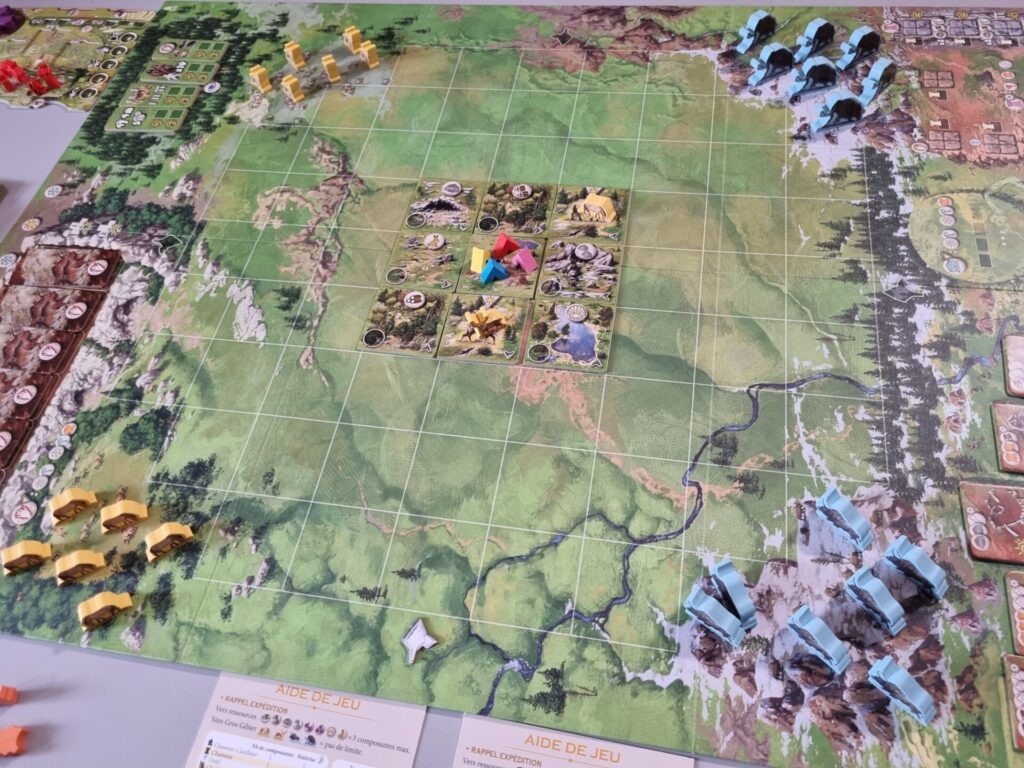
One of the biggest changes from its forebear, though, is that resources are scarce. In a three or four-player game, each spot can only be harvested twice, and in a two-player game, it’s only once. I think it’s a great way to do things because it encourages two things.
Firstly, it introduces some stiff competition. Not only are the resources limited, but only one player can be on one of the tiles at any given time. Being the first player becomes really important at times. Secondly, it encourages exploration. Any blank spaces adjacent to tiles with people on them get new tiles added to them each round, hopefully giving you more chances to get the things you need in later rounds.
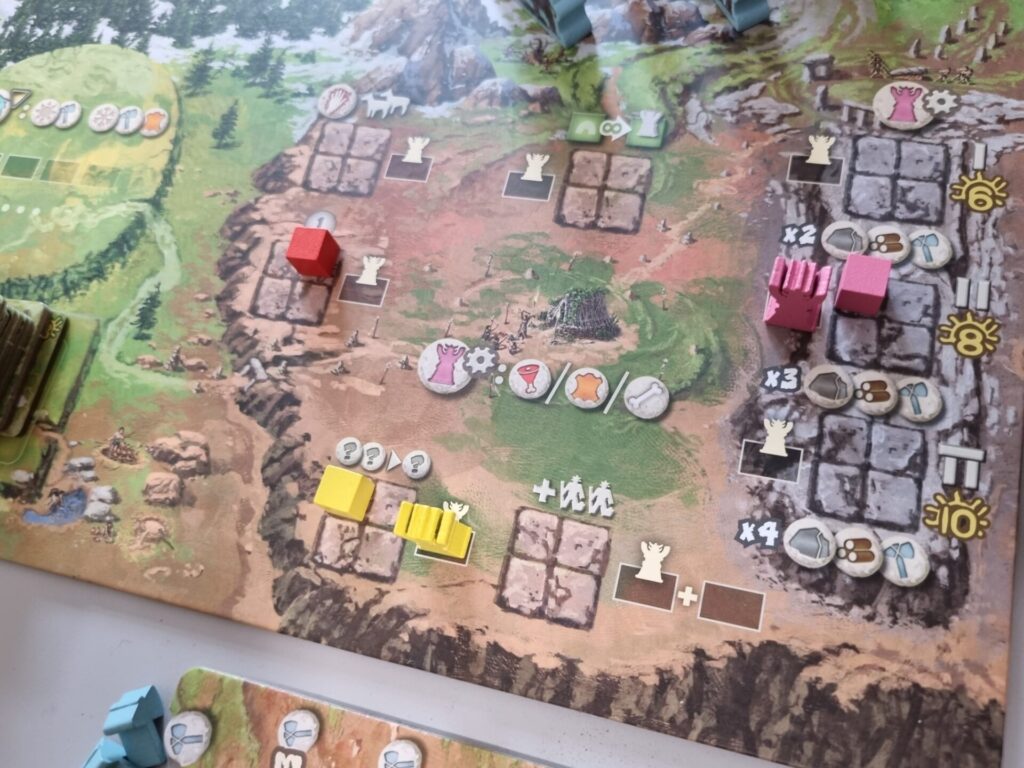
The other Stone Age concept that Doggerland shares is the idea of action programming. Although you take turns placing your people on the board, it’s not until you retrieve them that stuff actually happens. You can, for example, pop a person on a crafting spot knowing full well that you don’t have all the things you need yet, because you intend to collect those things with someone you place on a later turn.
Hunting high and low
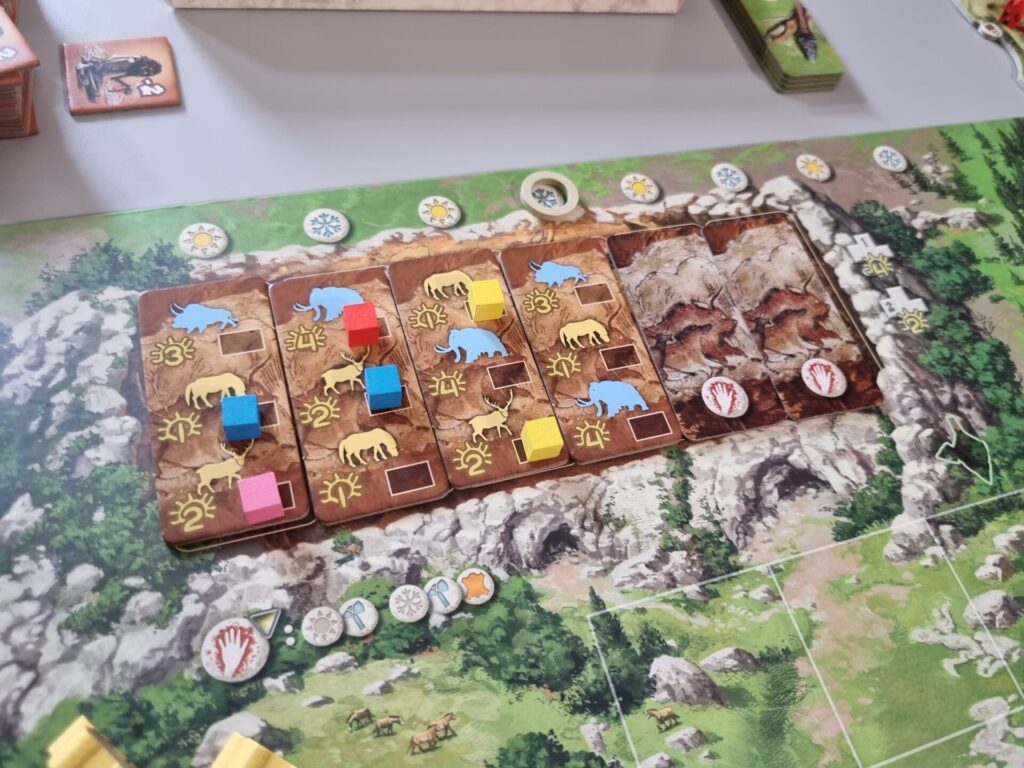
One of the biggest and best things Doggerland has to offer is the large animal hunting. During the game you get the chance to hunt. Horses, deer, bison and even woolly mammoths are roaming the board at different times during the game, and you can arrange to send a hunting party out for them. Hunting is tricky though, and needs planning. Each person you send adds +1 to your hunting power (Mastery, in the game’s parlance) with +2 for your chieftain. But there is a limit to the number of people you can send on hunts, meaning you need to send them out with tools/weapons sometimes too.
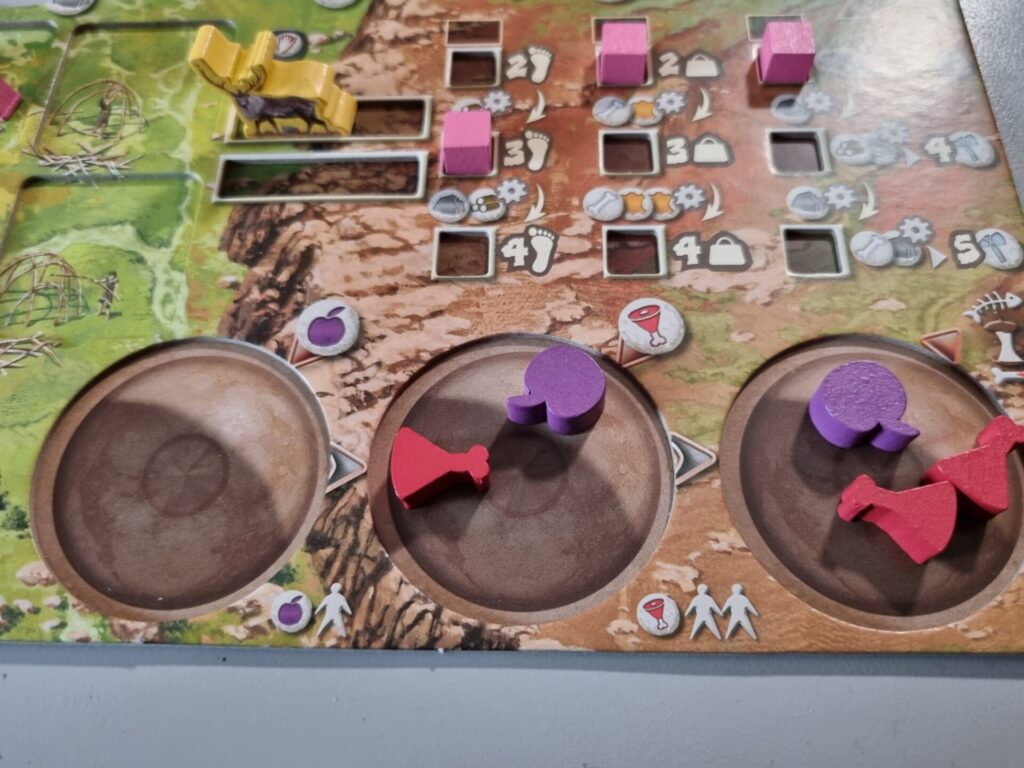
You make the tools by using certain action spaces, which again require more resources to craft in the first place. It’s worth the effort though, as not only do you get furs, bones, and meat to eat, but also your tribe gains the shared memory of the animal they gallantly fought. These memories (otherwise known as animal meeples on your player board) let you create cave paintings in a shared tableau where some majority scoring happens at the end of the game.
Everything in Doggerland is connected. You always need something to do another thing, and you can’t take the vegan option because you need furs to take actions in the winter rounds, which are every other round of the game. It’s worth mentioning that at this point, because some people aren’t cool with the idea of hunting in games, and that’s fair enough. Forewarned is forearmed.
Hurting your primitive brain
Doggerland’s biggest issue is its complexity. No action in isolation is particularly difficult. I mean, taking a turn is as difficult as picking up a person and putting them in a space. But choosing which space, and when you place them – that bit is hard.
There’s a lot of mental planning needed, and a whole lot of frontloading needed when learning the game too. It’s one of those games where you honestly need to understand what each thing does and how it related to everything else in the long term. You need to know how to upgrade things like your carrying capacity, or your movement range. You need to understand which direction large animals move if they’re not hunted. You need to know how the different Shaman actions work, how fresco scoring works. How food degrades over time, how much of each thing you can harvest. The list is endless.
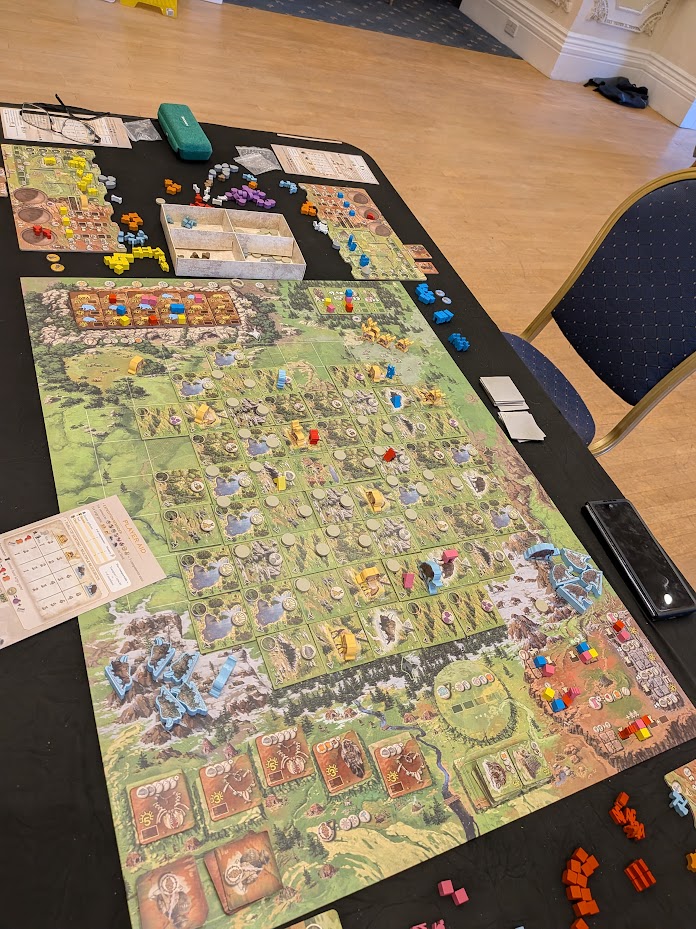
And just when you think you’ve wrapped your head around it, you have to factor in what the other players are doing too, and how to mitigate when someone takes the spot you were eyeing up, because they’re an utter bastard. There are a lot of different resources to manage, and a lot of different ways to use them.
It’s also a long game. There’s a shorter version of the game you can play, and I recommend it once you know the game, but in a way which feels counterintuitive, the long game is better for newbies. It gives them a round or two to find their feet, and more opportunities to use the once-per-game Shaman actions. The shorter game just gives everyone a bit of a head start, a bit like using Prelude for Terraforming Mars, or the revised rules for Abomination: Heir of Frankenstein.
Enjoying this article? Consider supporting me.


It’s not to say that any of this makes the game bad. Far from it. But there are plenty of people in our lives for whom Doggerland is probably a bridge too far. Start those people with Stone Age and see how they get on.
Final thoughts
Doggerland is one of the games that often springs to mind with people are looking for hidden gems. It didn’t arrive with a big fanfare, it didn’t get a ton of social media coverage, and you seldom see pictures of it being played. That’s all a real shame. Doggerland is a great game, and a game which more people need to know about.
If you played Stone Age and loved the theme, or wished there was a bit more to the game, then Doggerland was basically made for you. It might not have the Love Hut (you probably had a different name for this space in Stone Age…), but you do still get to breed and get new tribe members. The cycle of collecting and converting resources is deeply satisfying, the movement and geometric puzzle of the main map is trickier than you think, and I love teh asymmetry of how you can choose to upgrade your own tribe.
It’s a much stronger game in my opinion with three or four players than two, but it’s still good fun. I’d probably just choose something else for that heavy game fix for two. It’s definitly a bit too much for someone whose idea of complicated is Ticket to Ride, which might limit how often you get to play it. Other than that though, Doggerland is a strong recommend for me. The game is great, the production values are really high, and it all ties together really nicely. The hidden, heavy gem you’ve been looking for.
Pros & Cons
Pros
- It’s basically Stone Age for heavy gamers
- A great sandbox to play in and try things out
- Production values are great
Cons
- A complicated game to learn and teach
- It can drag a little in the long game mode
- The included resource boxes love to mix the resources up!
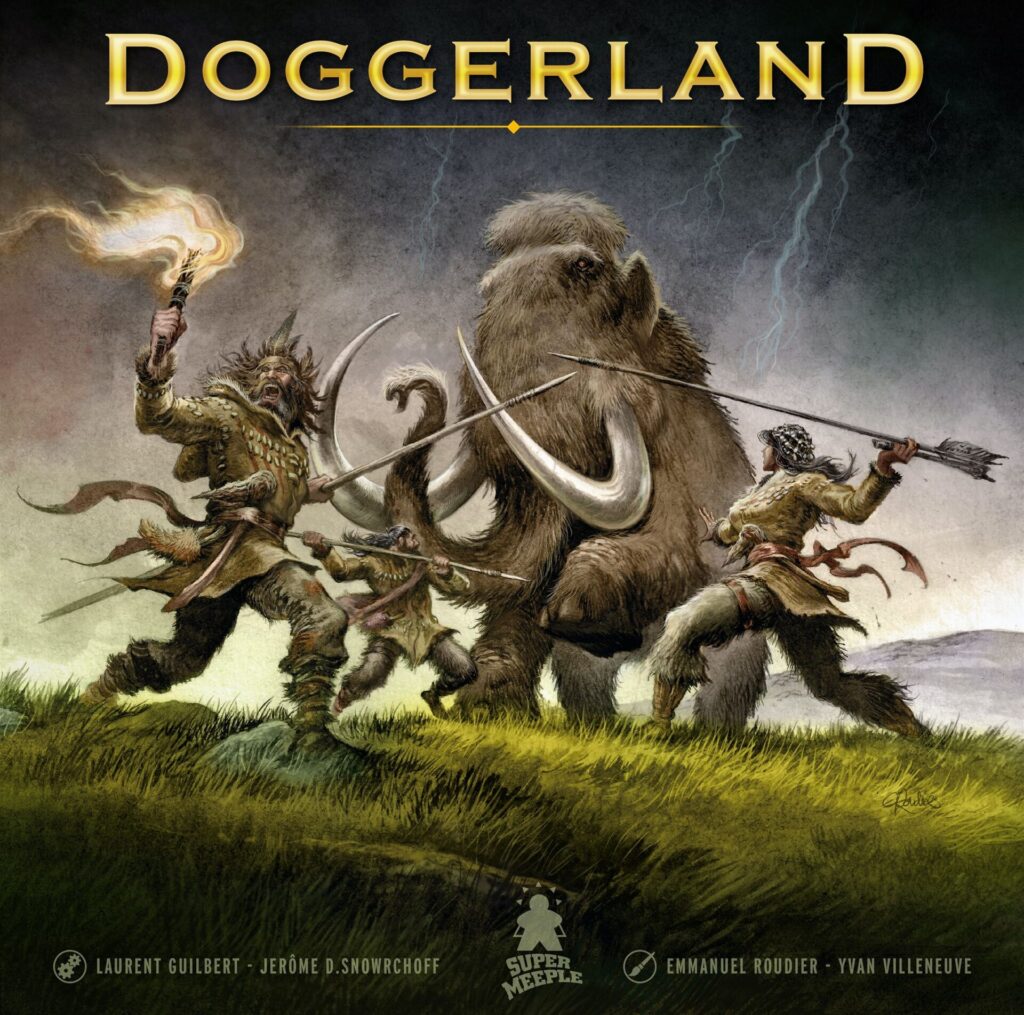
Doggerland (2023)
Design: Laurent Guilbert, Jérôme Daniel Snowrchoff
Publisher: Super Meeple
Art: Emmanuel Roudier, Yvan “Gawain” Villeneuve
Players: 1-4
Playing time: 60-180 mins

Adam is a board game critic with over 15 years of experience in the hobby. A semi-regular contributor to Tabletop Gaming Magazine and other publications, he specialises in heavyweight Euro games, indie card games and transparency in board game media.