
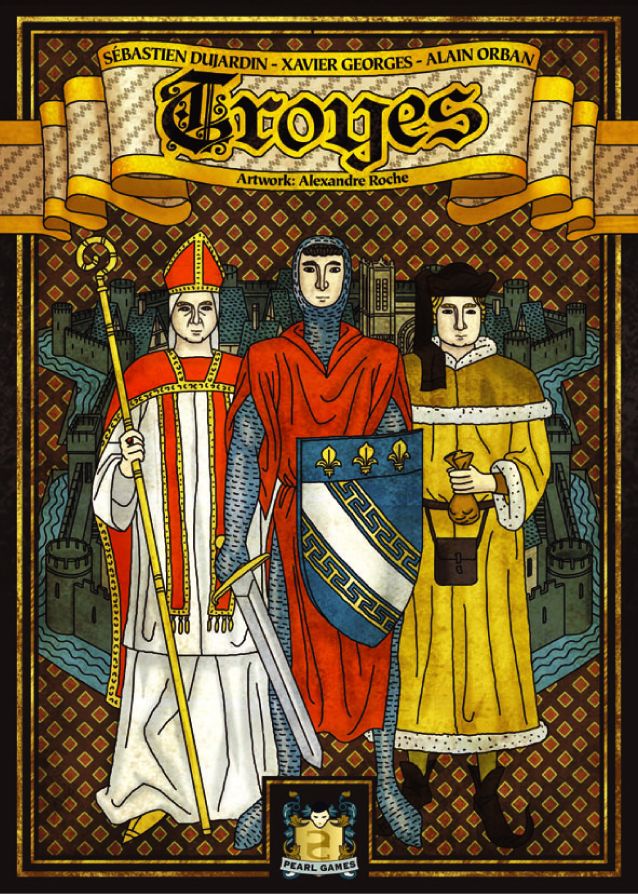

As part of something new I’m trying here, I want to make sure I’m showing some love for games that newcomers to the hobby might not have played yet, or have had the chance to play but dismissed it as “old, and probably not that good anymore”. The fact of the matter is that there are some astounding games out there that have stood the test of time. Games that ask – nay, demand – that you give them a chance.
Oh, and in case it needed saying, I don’t care what anyone else defines as old. This is old as far as I’m concerned, in board game terms.
First up, we have Troyes.
What do you do in Troyes?
Let’s get this bit out of the way now. It’s pronounced ‘Twah’, and not ‘Troyes’ (rhyming with boys). It’s because it’s all French and continental and what have you.
It’s a game where you roll dice and use them to take actions in the French town of Troyes in the 1200s. Phwoar! If that doesn’t get you hot under the collar, are you even human?!
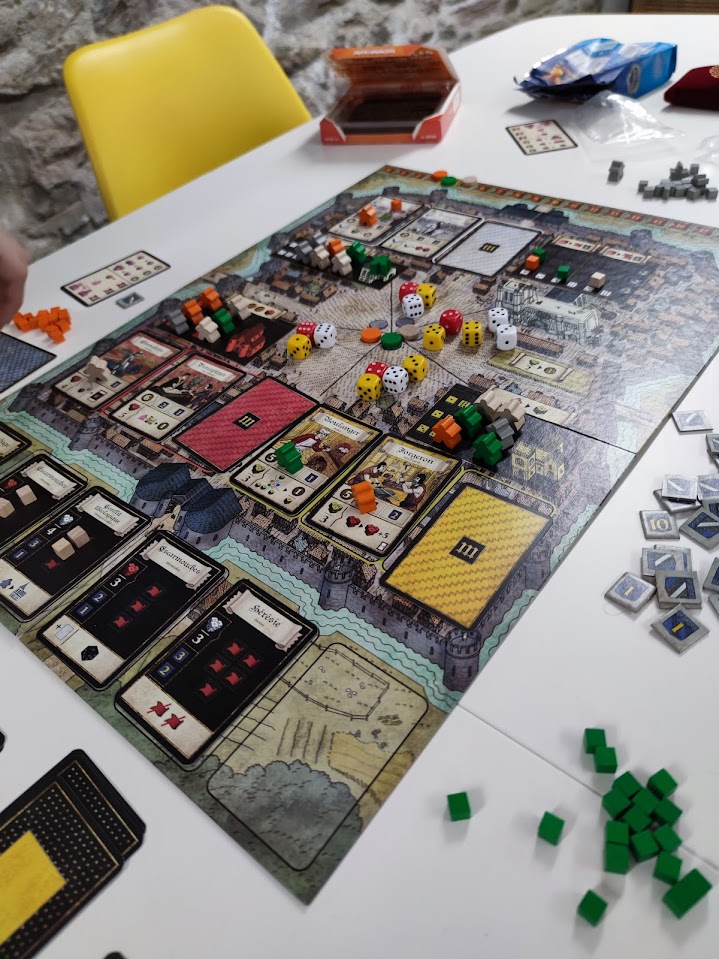
The board is split into districts where the players’ dice get placed, and around the outside of the board are the buildings of the town, where you’ll try to get your workers some honest employment. Military is red, religious is white, and civic is yellow. If you have people in those buildings, when you collect income you have to pay some money, but you also get dice in the colours corresponding to the colour of the building they’re in.
Each building has a variety of actions available to them, and one of the cool things about Troyes is that the action spaces are actually cards, which are randomised during game setup. You don’t know what actions will be available until the cards get flipped. By spending money, you can place your meeples (sorry, citizens, don’t sue me Hans Im Gluck) on the cards to not only get VPs, but also have the actions on the card available to you.
You spend the dice in your district to take actions, to put people in buildings, to combat events, and to help build a cathedral, just like you do in the greatest game ever, Hamburgum (you’ll get your turn soon, my pretty). So earn money, place dudes, get dice, use dice for actions, laugh at your opponents as they tremble in front of you. You know – the usual.
Why should I still play Troyes in 202x?
That’s a fine question, and the whole reason I started this series in the first place. I’m here to argue for Troyes, like I’m its lawyer in board game family court. A ton of great worker-placement and dice-as-workers games have come out in the 16 years since Troyes landed, so what about it warrants replay in 2026?
Firstly, it’s a love letter to the mean streak that ran through German-style Euro games from the 90s and early 00s. Let’s say you don’t have enough dice to do the actions you want to. What can you do? Well, firstly you could spend one of the dice you do have to place a worker in the corresponding row or space in that particular building, hip-checking the others out of the way and potentially off the board altogether. Having a person in a building means there’s another die for you in the next round straight away.
Or, with all the hand-wringing, moustache-twirling glee of a camp villain, you can simply buy the other players’ dice from their district. That’s right, if I have the money and you only have one die in your district, I can just buy it, use it, and toss it away like a wet wipe I used to clean my face after eating your pudding.
It seems incredibly mean, doesn’t it? It is, and the game is wonderful for it. Most modern games (not looking at you here, Splotter) are like Euro games with the training wheels on. There might be some indirect player interaction, but for the most part, you very rarely directly take something away from your opponent, while they have no way to prevent it and very little mitigation.
One of the other things I love about playing Troyes even today is how clean and simple it is. The board is functional, if not gorgeous, but it’s so easy to setup and to put away. Turns aren’t plagued by AP. Nothing feels clunky or cumbersome. You get in, do a thing, and get out again. It’s not static like games like Stone Age were at the time, either. You don’t know what actions are going to be available until they’re revealed, nor what events you’ll have to deal with.
Troyes is just a thoroughly enjoyable time, and you, yes YOU, should play it. People who’ve recently come to the hobby might be surprised by how confrontational it can be, but I think it’s good to explore something outside of your comfort zone. Troyes is proof that not every Euro game night has to be friendly and cuddly like Flamecraft.
The only problem is getting hold of it, as it’s not in print in English at the time of writing. A lot of copies are out there in the wild, though, so you shouldn’t have too much trouble snagging a second-hand copy from somewhere. If you want to try before you buy, you can head on over to Board Game Arena and play it for free there.
Have you played Troyes? What do you think? Do you still play it? What games should I include in this series? Leave a comment and let me know.
Enjoying this article? Consider supporting me.



Adam is a board game critic with over 15 years of experience in the hobby. A semi-regular contributor to Tabletop Gaming Magazine and other publications, he specialises in heavyweight Euro games, indie card games and transparency in board game media.
For “should I still play X in 20XX”, I always find Troyes comes up with Black Angel. Is it one or the other in 20XX / going forward?
Fair point, after all Black Angel is essentially ‘Troyes in space!’. There are differences though, Black Angel is a bit less harsh when it comes to buying dice, and the the value spread on dice is a bit lower. Ultimately I think it comes down to which setting you prefer – Sci Fi or Euro. I love a nice, beige game set in a city somewhere in the past ❤️