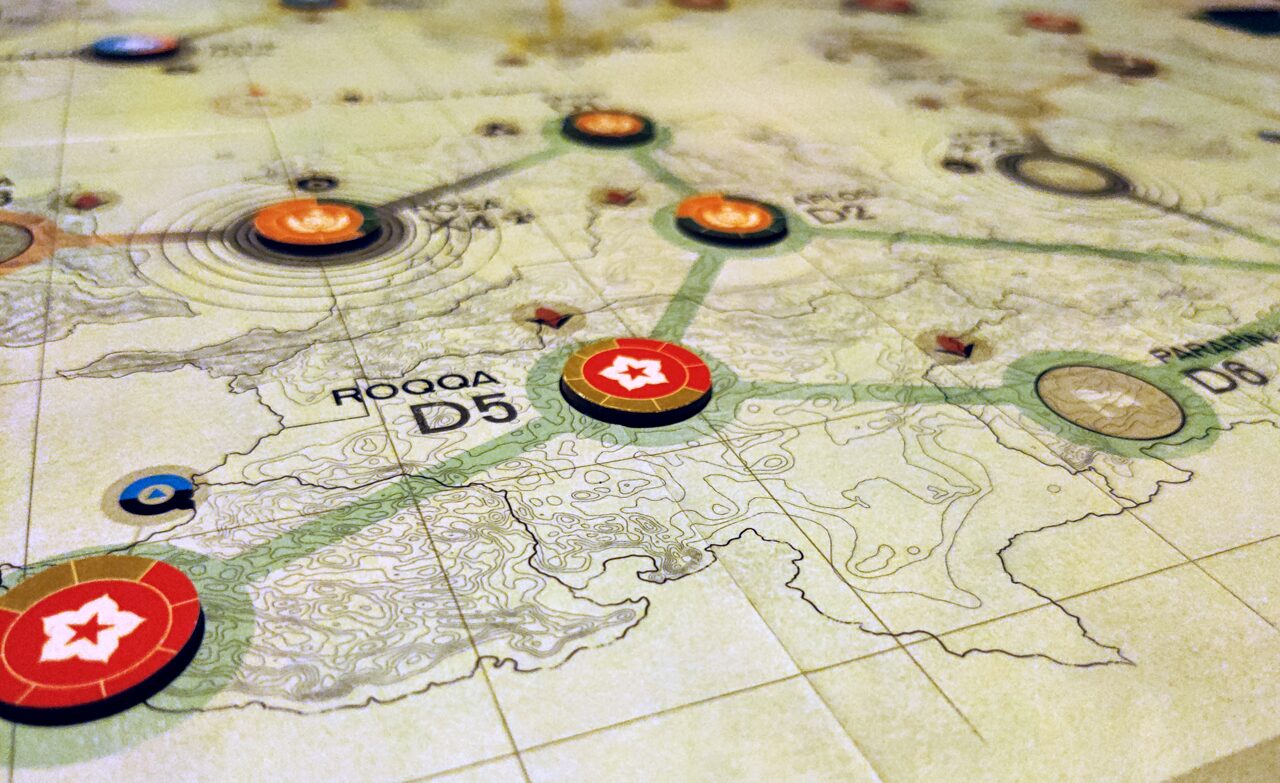

I’m doing things differently here for this one. For years now, I’ve had a rule that I don’t write reviews or previews based on digital playthroughs on platforms like Tabletop Simulator (TTS). For me, the physical experience of the game, the legibility of cards and iconography over the top of a table, and other things simply cannot be replicated over a screen. However, my good friend Marton, who shares the same taste in games as me (and is a bad influence), was insistent that I try Politik from newcomers Black Yeti Games. I succumbed, and I’m very glad I did.
VERDICT
players 2-6 | playing time 60-300 mins
Politik promises to be one of the best debut games from a new studio that I’ve had the pleasure to play. Keep this on your radar, you’re going to hear a lot more about it.
area majority
tableau building
political
changing market
heavy
Before I get into the meat of this preview, I ought to preface it with a couple of caveats. Firstly, as I mentioned above, this is based on my play of the TTS mod for the game. Secondly, I’m writing this off the back of a single play of the game. It’s important I’m up-front about this because I would normally never base a review of any kind on a single play of a game. The reason I’m stepping outside of my own guidelines for Politik is because of how much this game tickled me.
We will rebuild
Politik is set in a fictional world with real ideologies. The nations are made-up, the world map is fictional, as are the companies and everything else in the game. I say that the ideologies are real, but realistically, they don’t mean anything to the game. The game is set after The Great Collapse and follows the exploits of fledgling nations – the players – as they seek to claim dominance in a fractured world.
To win the game, you need to complete three Power Grabs (four in a two-player game, two for five or six players), in the game’s parlance. A power grab is managing to gain dominance in one of the three major areas of the game: Military, Political, and Corporate.
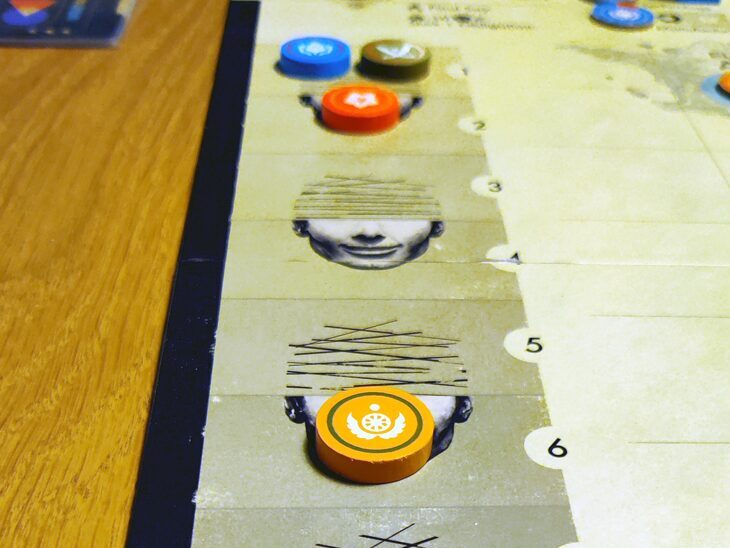
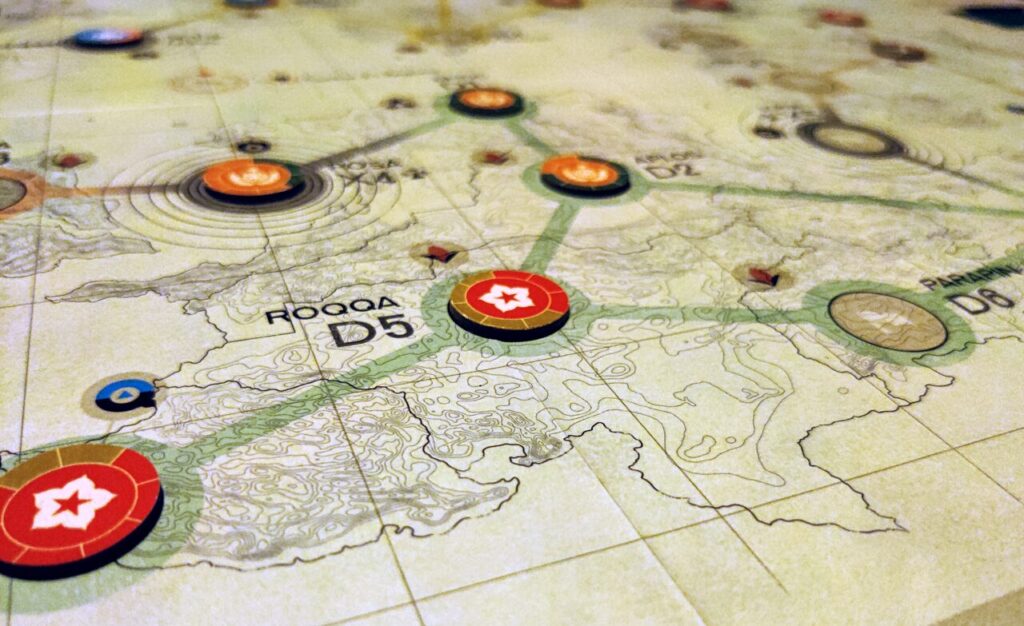
Politik’s cake is made of layers of area-majority and tableau-building, all slathered with a thick, creamy frosting of player-on-player interaction. The whole game is driven by a huge (400+) deck of multi-use cards. The main board is a map of the world, split up into a spiderweb of connected states across each of the regions. This is where players battle for Military dominance.
Each player has space for a tableau in front of them. Bang in the middle of the tableau is your Nation card, which dictates which cards, companies, and starting resources you begin with. There are spaces for your propaganda cards, and lots of space for the Companies your nation controls and improves, leading to a Corporate power grab. The final area on the bottom corner of the main board is the Council, where placing your control discs will lead to a Political win.
How heavy is Heavy?
If you’ve ever been taught a heavy, complex game by a fan of that style of game, there’s a good chance you’ve heard this line (or something similar).
It’s heavy, but once you start it’s actually pretty easy.
Sound familiar? I’m guilty of it myself. “On Mars? Yeah, there’s a lot going on, but it’s not that bad. Oh yeah, Hegemony, amazing game. It’s a lot to learn, but then it’s quite easy to play”. Politik is another game that sits comfortably in the assprints left by its heavy game forebears. Your entire turn is ‘take any two actions’. Nice and easy.
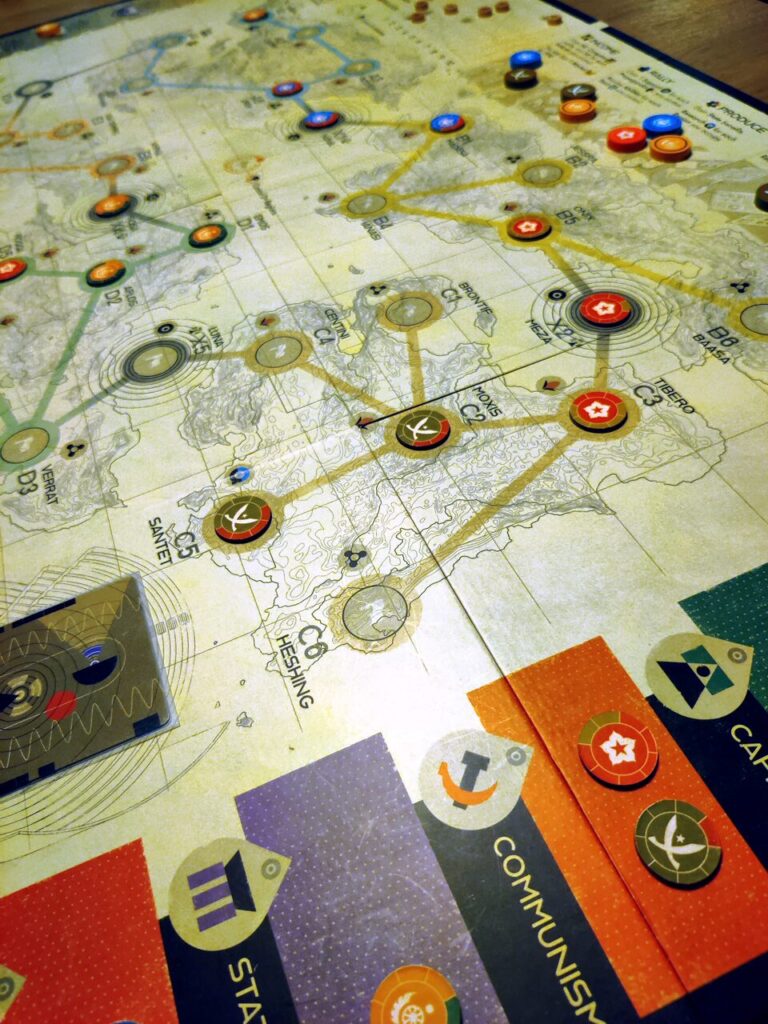
You might play a card, paying its cost. That company card in my hand costs 20 Capital (money) and one carbon. If I have the resources, I can pay for it and place it in my tableau. If it’s a new company, I take a token matching its industry and set its margin (how much money it can generate) on its little board. If it’s an asset, I can add it to an existing company to boost its strength and give me some new actions.
There are a bunch of standard actions you can take with their costs set by a central, player-influenced market of prices. Researching lets you take more cards in hand. Campaigning lets you move your markers from the ideological bases on the side of the board into the council seats at the bottom of the board. Education lets you spend your food resources to create new Leaders, who in turn you can send into clashes.
The point I’m trying (and failing) to make here is that none of these actions is difficult to understand or perform. I mentioned On Mars before (read my review here). That game had five different types of resources with huge amounts of interplay, gems, and all sorts of things going on. Politik, in contrast, has just Capital, food, and carbon. All costs are really easy to read, and it’s very easy to know exactly what you have and what’s possible at any given time.
Stuff like this matters.
Rock the Casbah
So sang The Clash, and that’s as good a segue into clashing as you’re going to get from me. Clashes are the bedrock that the foundations of Politik are driven into. In order to take a new state on the map, you have to Clash for it. Clashes are easy to resolve. If you’re fighting over a space that someone else has control over, you can add as many red leaders as you like, and then play cards from your hand face down into the clashing area. Both players do this, then you flip the cards and count up the totals of the red symbols on the cards, the number of the leaders on each side, and calculate the difference.
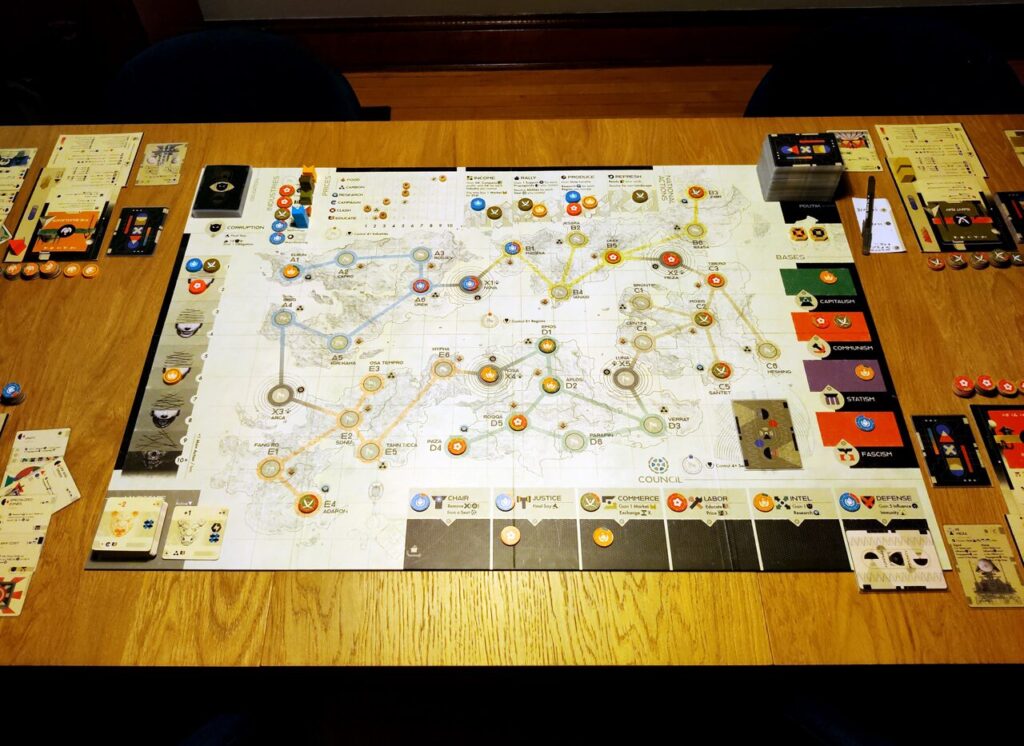
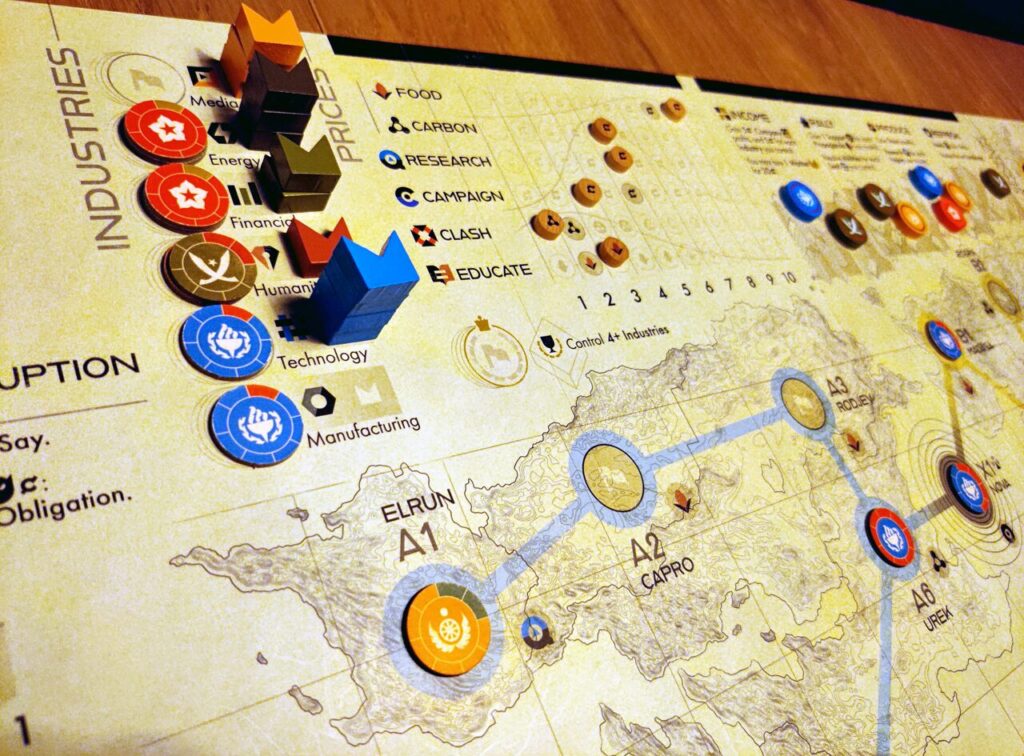
What Politik does really nicely is to not make control over things strictly binary. Whether it’s states, industries, or seats in the council, each control token has a strength value, represented by marks around the side of the counter.
I mention this because it’s not just the case that if you lose a clash, you instantly lose control. If the difference at the end of the clash is -3 against you, but you had a control token with a strength of six in there, you don’t lose control. You just replace the token with one with a strength of three.
I really like this approach. It means you aren’t forced to spread your influence wide and thin. You can try to pin down specific industries or seats in the council. It’s in places like this, the variable level of control, that Politik hides its complexity. It’s in the player-driven market prices, which can make reinforcing influence in certain aspects of the game prohibitively expensive.
All of this, and I still haven’t mentioned the National actions and the way you can trigger the powerful council actions. I haven’t mentioned trading. I haven’t mentioned Landscape cards and their huge effect on the game state. I haven’t mentioned Edge actions, which are instant actions you can take even during other players’ turns to boost things and negate things. I didn’t mention the hugely important corruption track. There is so much lurking inside the box.
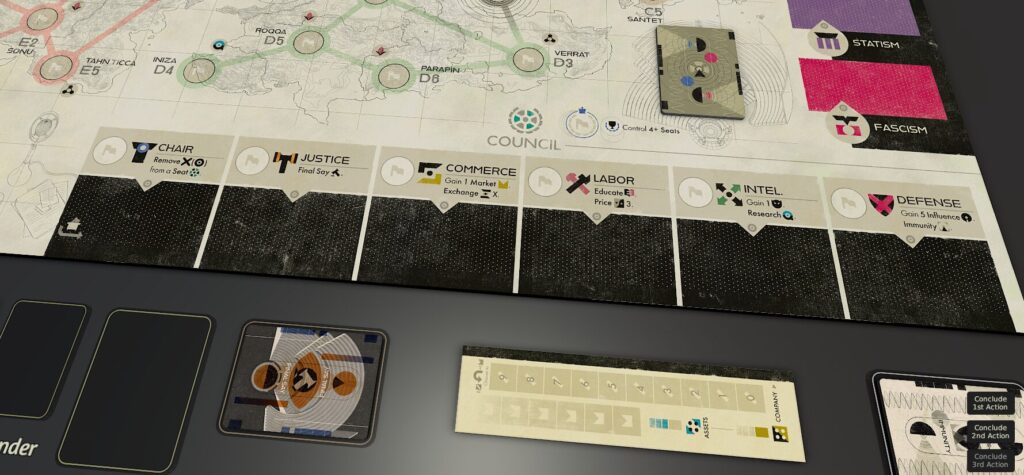
All of this means that Politik is a game which you can learn to play with a surprising amount of ease, compared to what you expect when you first see the game laid out in front of you. The complexity comes in how you best employ the different actions, and when. It’s obvious to me, even after a single play, that Politik is a game that removes the rivets from its boilerplate and reveals its intricate gearing to you after repeated play.
Final thoughts
If it isn’t obvious yet, I really enjoyed my play of Politik. Enough that I broke my own rules by covering it after a single play, and even playing it on TTS. So bear all of that in mind and take everything I say with a pinch of salt.
I was sucked in by the mixture of Brutalist architecture and Bauhaus design choices in the game’s artwork and presentation, and although the saying is true that you can’t polish a turd, fortunately, Politik’s gilding goes further than skin deep. The design choices complement and enhance the game’s feeling. It looks stark and unfriendly, and although it’s a strange thing to compliment a board game for, it does warn off those looking for lightweight, easy games.
My first impression was that Politik was going to be one of those Convention Games. Games that are too convoluted and require too much time to be the highlight of your weekly games night, in the same way I think of Hegemony. I love Hegemony, but it’s not the sort of thing you can rock up to the group with on a Wednesday evening and say, “Let’s learn this”. I think, however, that once you know the game, three of you could play through in three hours fairly comfortably.
Politik is an exciting, ambitious debut, and one that I truly hope the team at Black Yeti Games succeeds with. Hegemonic Project Games proved that it can be done with Hegemony (read that review here), so it’s certainly not unprecedented, and this is a game that shares a similar vibe to Hegemony, Die Macher, or Weimar. Not because the games share a theme or mechanisms particularly, but because they share an air of dry, political, Euroness. I also love that the Power Grabs you need to win for two to four players cannot all be the same. No super min-maxing here.
If they deliver on the promise of a plethora of screenprinted tokens, hundreds of cards, this beautiful graphic design, and everything else that Politik appears to have woven into its fabric, then there are going to be a lot of very happy gamers out there, me included. Superb stuff.
Politik launches on Gamefound on June 30th. Follow the page now to be the first to know when it goes live.
THANKS TO MY SUPPORTERS
Krissie  Craig Paul Brendan Brett Gary Becky
Gavin Chris Mark Johan Richard Simon Ben Sam (new!)
Help me keep Punchboard independent by joining the supporters

 Buy me a coffee
Pros & Cons
Pros
- Heavy, Bauhaus action
- Player-driven market
- Simple actions with very long tendrils
Cons
- Not a game for casual gamers
- It can run long
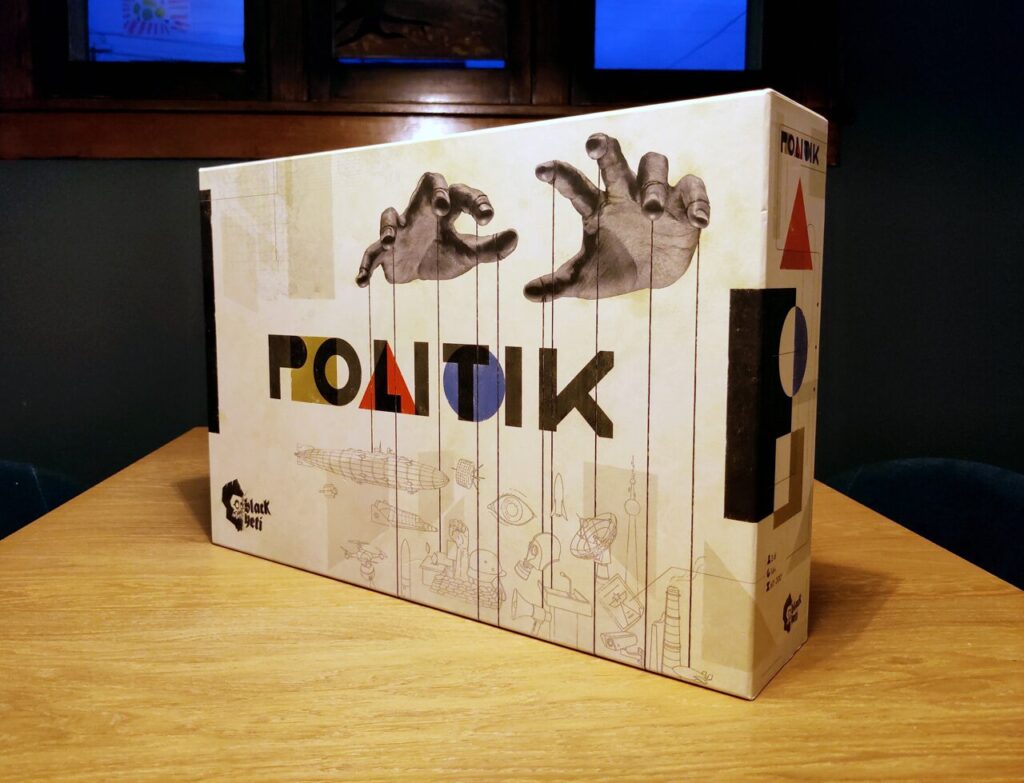
Politik (2026)
Design: Jonathan Klabunde, Lukas Peregrine
Publisher: Black Yeti Games
Art: Black Figure Studios
Players: 2-6
Playing time: 60-300 mins
More games like this one