
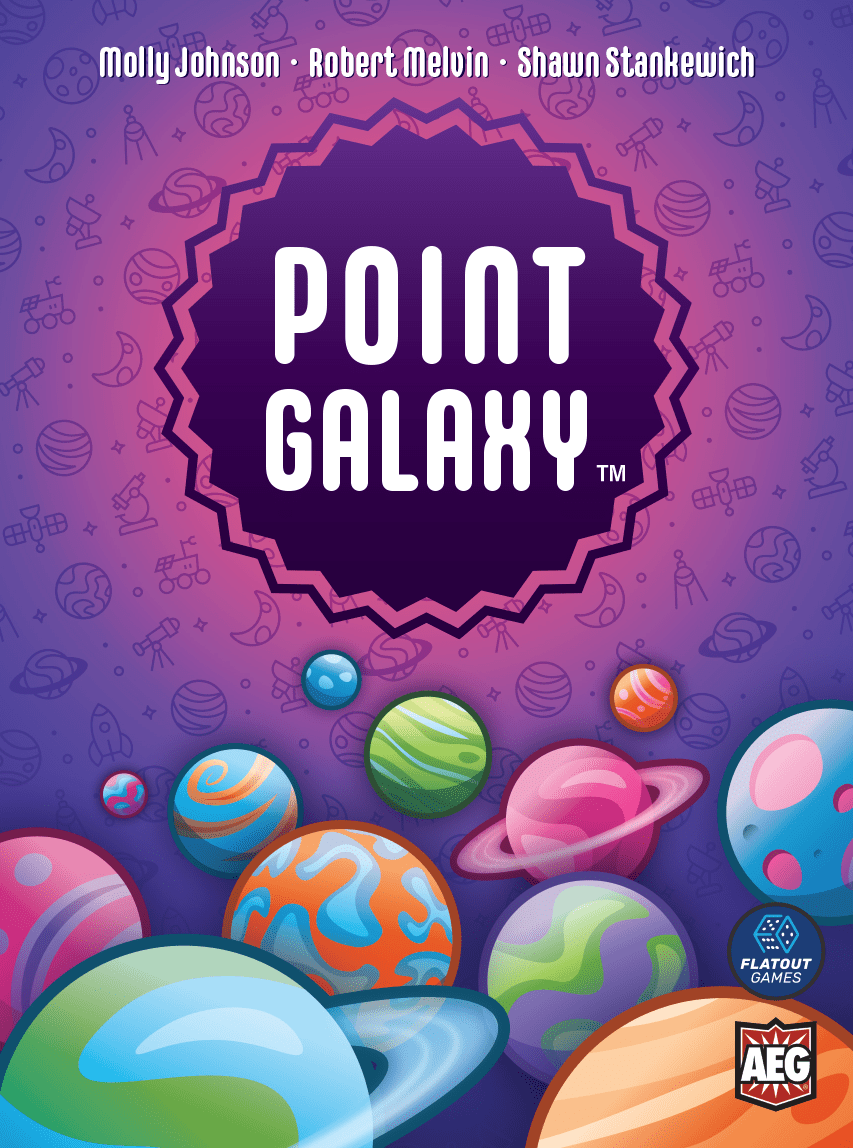

A review copy of Point Galaxy was kindly provided by AEG. Thoughts & opinions are my own.
There’s no shortage of games with names that start with Point, thanks in no small part to the team at Flatout Games. Designers Molly, Shawn and Robert hit the headlines a few years ago with Point Salad (2019), followed by Point City (2023), which I reviewed here. Both are superb examples of clean, easy-to-learn tableau builders. When you start out with vegetables, then go to buildings, how do you go bigger for your next game? You go into space, naturally. Point Galaxy is a game which will feel immediately familiar if you’ve played either of its predecessors, but with quite a lot more going on in the cockpit.
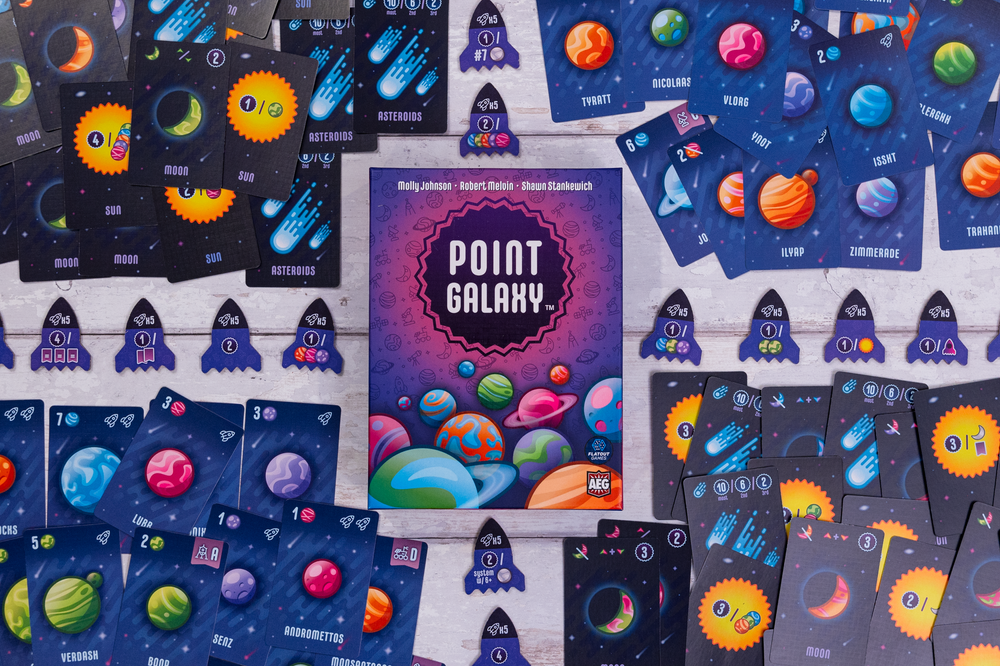
The first thing to know about Point Galaxy is that it’s a more complex game than the two that came before it. Instead of just trying to make sure the permanent resources on your cards help you buy and build future cards, there’s some other stuff going on.
The cards you collect get added to stacks called solar systems. Solar systems consist of planets, suns, moons, asteroids, and wormholes. Each of the different card types has its own requirements or scoring opportunities, and it takes a game or two to properly wrap your head around them. Sun cards, for instance, give each solar system scoring opportunities based on things like matching pairs of coloured planet cards, a bit like the point cards in Point Salad. Moon cards can score points, as long as they’re next to, or between, certain types of planets. Asteroids don’t do much on their own, but during final scoring, there are big points on offer for the players with the most of them.
Kessel run
Where Point Galaxy makes a deviation from Point City is the way the cards you add to your solar systems need to be in runs. Once you add two planets with two different values in a solar system, then the direction is set. So if you have a four on top of a two, then anything below the two goes below it, and anything above four goes on top. If you’re familiar with ladder-climbing games, this concept will come to you more naturally than if not, and it’s a fresh feeling in the Point games.
There’s no denying that Point Galaxy is the most complicated game in the series, but it’s important to note that when I say complicated, it’s relative. Is it complicated compared to Point Salad? Yes. Is it complicated compared to Civolution (read my review of that fantastic game right here)? No, not even close. But there’s still a lot to think about when you’re drafting cards from the market during your turn.
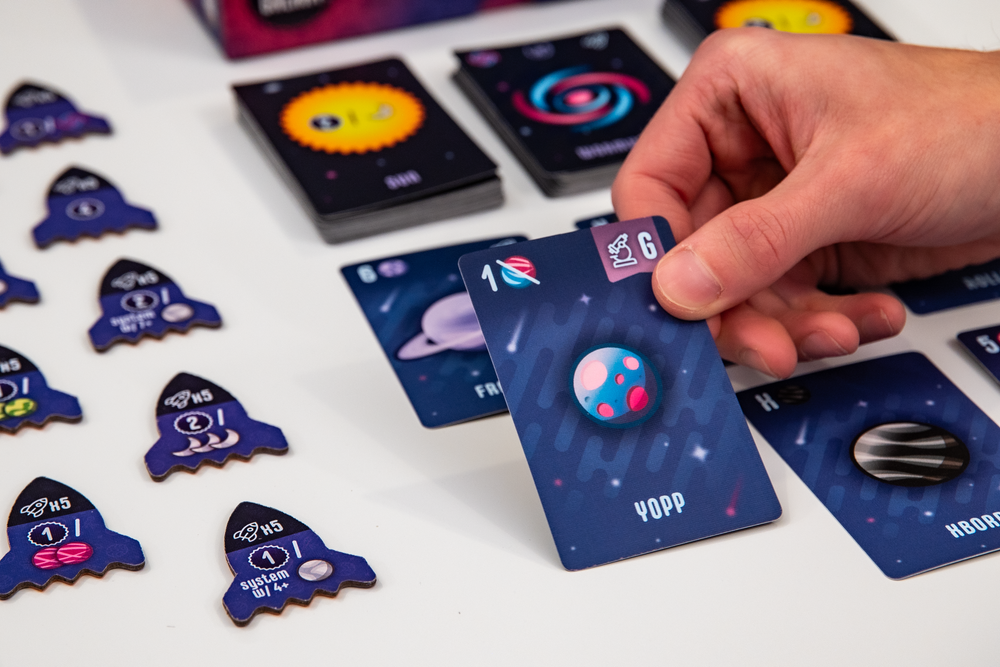
Does this planet fit in any of my solar systems? Is there any point in my taking asteroids when that player has loads? Should I start another solar system? Can I fit that moon in anywhere?
Those sorts of questions will be rattling around inside your head the whole time you’re playing, and I’m here for it. I like it when a game has a little bit more going on. What I particularly like about it in Point Galaxy is that it feels gamier, for want of a better word. It doesn’t feel like you’re being short-changed if you came to game night to have your grey matter lightly tortured.
Final thoughts
Point Galaxy is absolutely slathered with the Point game jam that Shawn, Molly, and Robert cook up in the Flatout Games kitchen. The flavour is at once familiar and satisfying, and it’s sticky enough that it’s hard to put down. Bet you weren’t expecting fruit preserve metaphors when you clicked on this link.
For my money, Point Galaxy is the trickiest to get to grips with, but for the same reason, it is probably the game with the most longevity baked in. I’m a sucker for sci-fi and space, so the theme was always going to be a hit with me. That said, I can’t help but feel that maybe it’s the fussiest of the three games. There’s a lot of tucking and stacking of cards, and once you’ve got three or four solar systems on the go, there’s a lot to keep track of, and a fair bit of space needed.
Enjoying this article? Consider supporting me.


If you like Point Salad or Point City, you’ll enjoy Point Galaxy, it’s as simple as that. It’s another feather in the Flatout Games cap, and another great example of an approachable, fun tableau-builder. I think my favourite is still Point City, but I also think if you ask me again in a month or two, that might have changed. Good stuff, keep it coming.
Pros & Cons
Pros
- That familiar ‘Point’ game feeling
- Quick and easy to learn and play
- The graphic design is gorgeous
Cons
- More complicated than Point City and Point Salad
Point Galaxy (2025)
Design: Molly Johnson, Robert Melvin, Shawn Stankewich
Publisher: Flatout Games, AEG
Art: Dylan Mangini
Players: 1-5
Playing time: 15-30 mins

Adam is a board game critic with over 15 years of experience in the hobby. A semi-regular contributor to Tabletop Gaming Magazine and other publications, he specialises in heavyweight Euro games, indie card games and transparency in board game media.