
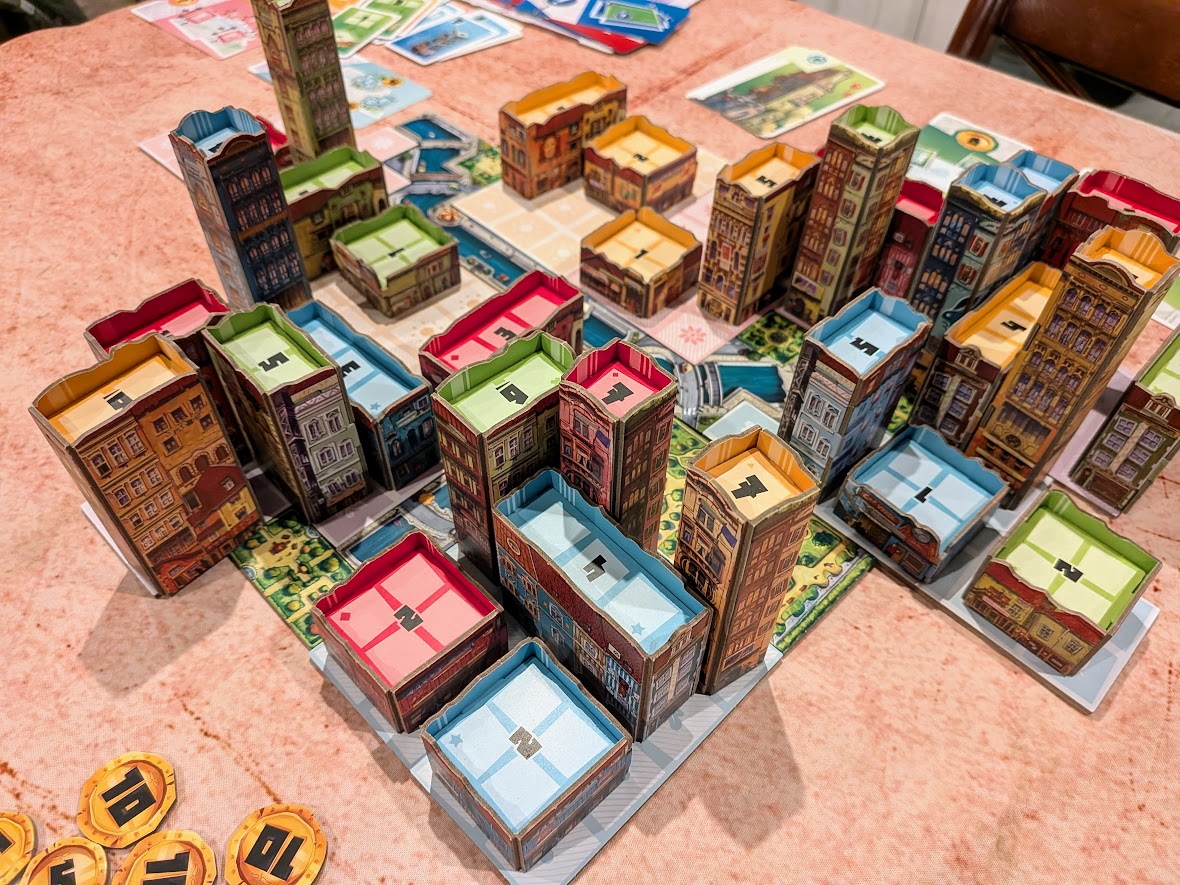

I was sent a copy of Bella Vista for free by Hachette Boardgames UK. Thoughts & opinions are my own.
Bruno Cathala has a stellar back catalogue, and along with Andrea Mainini this time, he has spawned a twinkling new star in the board game cosmos. Bella Vista is a spatial placement game in three dimensions, building on the foundations (pun very much intended) of his previous tile-placement games like Kingdomino, it surpasses them to create a game which has come out of nowhere and really surprised me. In a good way!
VERDICT
players 1-4 | playing time 30-45 mins
It’s not even June yet, and Bella Vista is already the frontrunner for my medium-weight game of the year.
competitive
modular boards
turn order auction
3D buildings
The idea of the game is fairly mundane and very board game. You’re architects striving to be the very best, while communally creating a new city on a shared board. Each player has the same eight building types to erect during the course of the game, and in most of the eight rounds they have a choice of three to build. The choice is driven by having a hand of three random cards, so while everyone will eventually build the same buildings, they won’t necessarily all go up at the same time.
Impressive erections
Forgive me, I’m a child.
When you’re competing as architects, you need to know what qualifies as building better. Or what it means to have a more impressive erection. In Bella Vista, it’s all about how your new building imposes itself on the skyline of the buildings already around it. If you build a building in an area with nothing else adjacent, you get three coins. Coins act as money in the game, and also as VPs when the game ends.
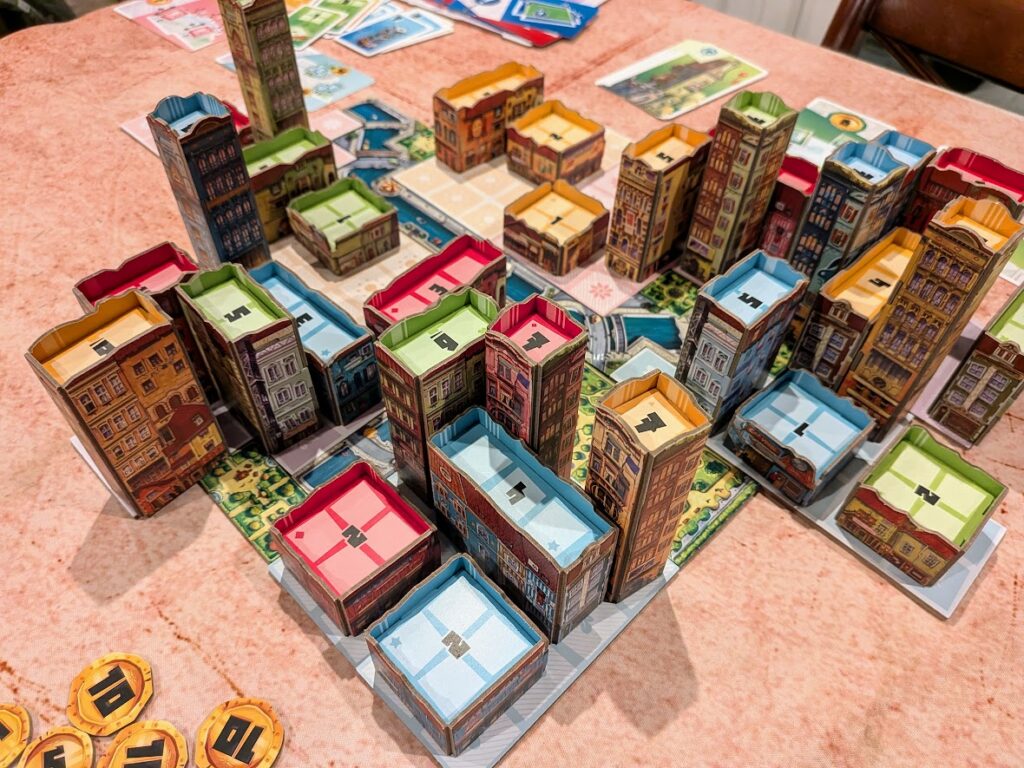
If, however, you build next door to other buildings – whether they’re yours or somebody else’s – there’s more money on offer. You get a coin for every building that yours is taller than, and another three coins if yours is the tallest.
So, as you can probably already tell, Bella Vista is a game that wants you to get all up in each other’s grills. Coins are points, so the more coins you can get every time you put a building out on the board, the better. So just wait for everyone to put their buildings down, then do yours. Easy.
Oh, if only it were that easy.
In each round, there’s a turn order selection phase. In turn order, determined by the action order from the previous round, you can pay to play before the other players. Or, if you’re so inclined, you choose the no-cost spot first and force the others to take the other slots just to cost them some cash for the pleasure, because you’re just that kind of awkward sod.
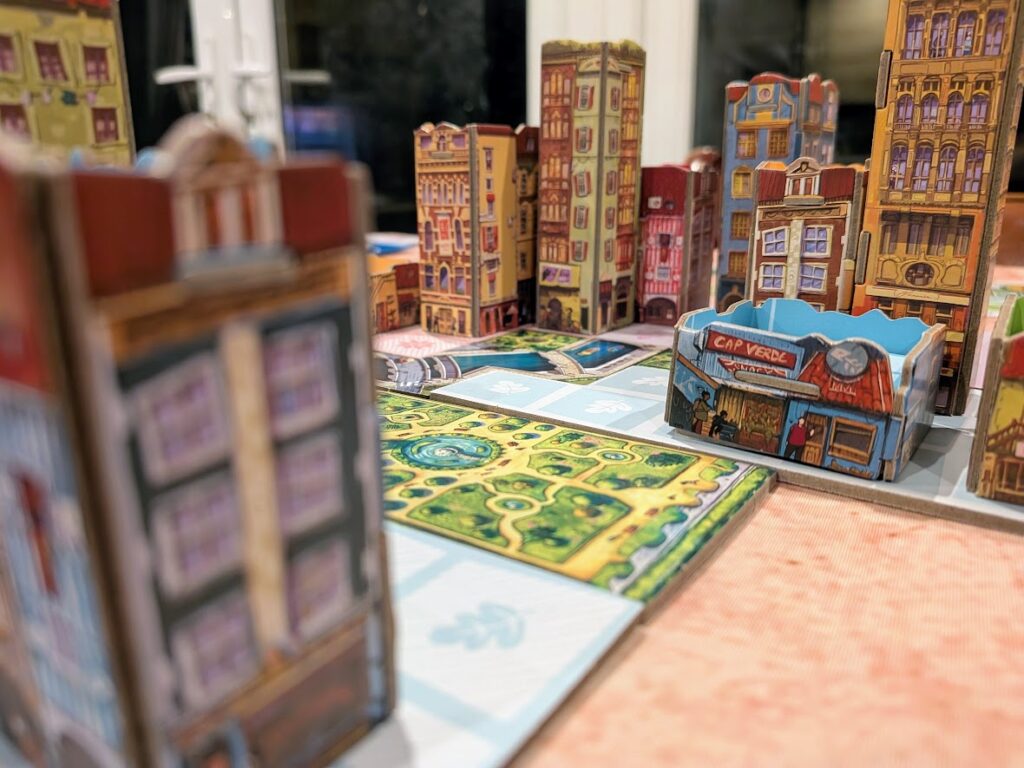
This whole thing (gesturing vaguely at the board and cards) is really great. Spicing up the building placement order is really interesting, as is the fact that until the turn order is finalised, you don’t even know which building cards the other players have chosen. It’s moreish.
Facade or structurally sound?
When I first tore the shrink wrap off of Bella Vista and looked at the back of the box, my heart sank a little. All of the little cardboard buildings are nice and everything, but who honestly enjoys punching out and putting together 24 individual buildings, complete with roofs?
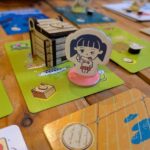
If the answer is you, then you’re out of luck, I’m afraid. The buildings come pre-assembled! And even better, they come in a fancy little slide-out drawer organiser thing in the box!!
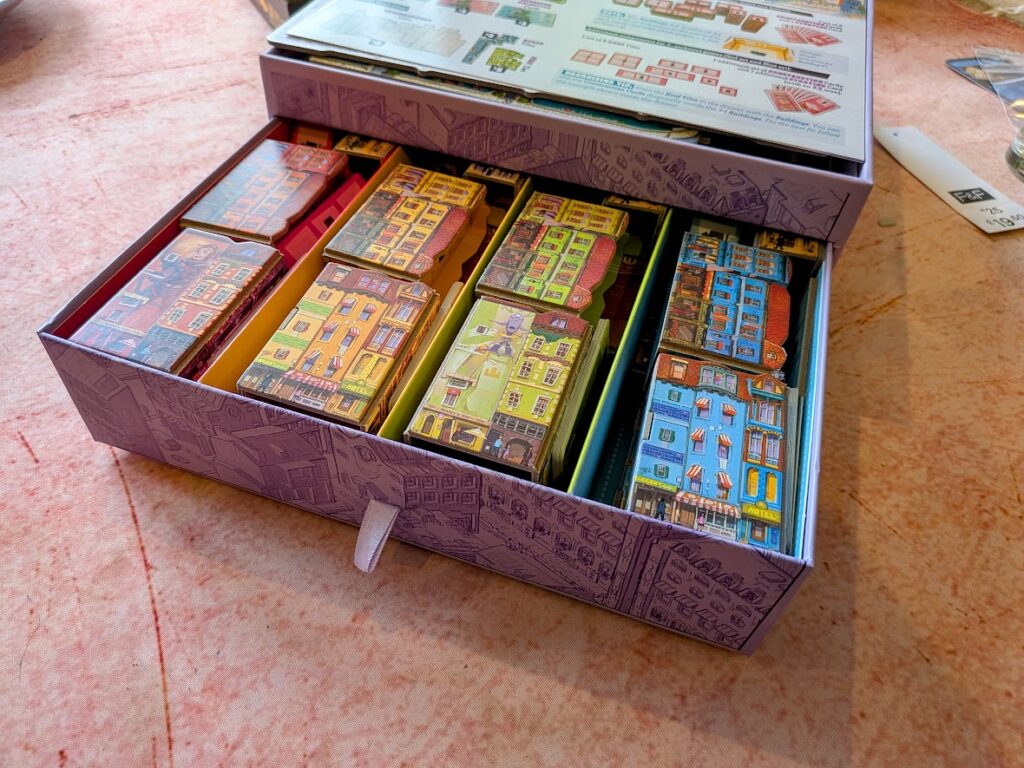
It might sound petty, but I can’t tell you how happy it made me when I realised I could just open the box and play straight away. Not just because I didn’t have to devote the next hour to looking like Father Dougal making a collage, but also because I knew there was no chance of me wrecking any of it!

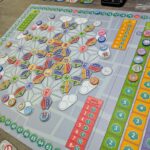
The main board is modular, which is awesome. There are a bunch of pre-defined setups you can use in the rulebook, which loosely mimic famous cities like London, New York, and Paris, but you can place them randomly, too. This is such a nice touch, because while you could effectively learn which Zoning cards (building rules for each round) are in the box and which objectives might come out, the layout of the city will be different every time. No chance of learning a game-breaking strategy here.
The biggest oddity in Bella Vista is how different player counts change the game. In three players, the fourth colour is still used, and each round, one player gets to place the neutral buildings to block and fill the board. With two players, each player gets a second set of buildings and cards to replace the player colours on the roofs. Neither of these is bad, per se, but neither feels quite as pure as the four-player game, which feels like it’s how the game was designed to be played.
Objectively speaking
On top of the number of coins you end the game with, there are a couple of other ways to score points at the end of the game. First and foremost, there are a couple of objective cards randomly chosen for each game. Height objectives reward you for putting buildings next to parks, the river, or the edge of town. Grouping objectives reward you for how well you group your buildings, but I really like the one card that just penalises you for having isolated buildings instead. Negative reinforcement is always fun.
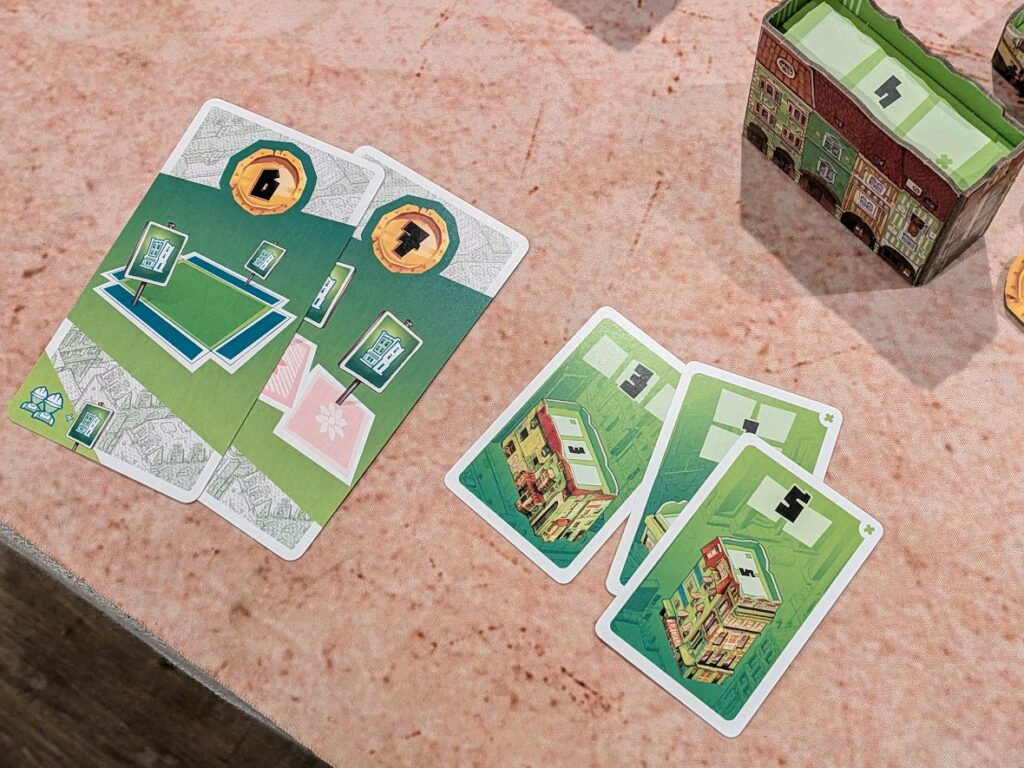
Along with the objectives is a market of contract cards. Contracts are on display in a first-come, first-served situation for all players. I really like this. It’s another example of where Bella Vista encourages player interaction. All of the players can see what the scoring conditions are on the contracts, and it’s pretty likely that multiple players can fulfil the same one in a turn.
So what happens if more than one person can claim the same contract? Who gets it?
You guessed it. The player who paid the most for turn order. Not only do you get to place your building before anybody else, but you also get first dibs at the contract market. This is made especially interesting by the fact that the contract market doesn’t refill until after all player turns, at the end of the round.
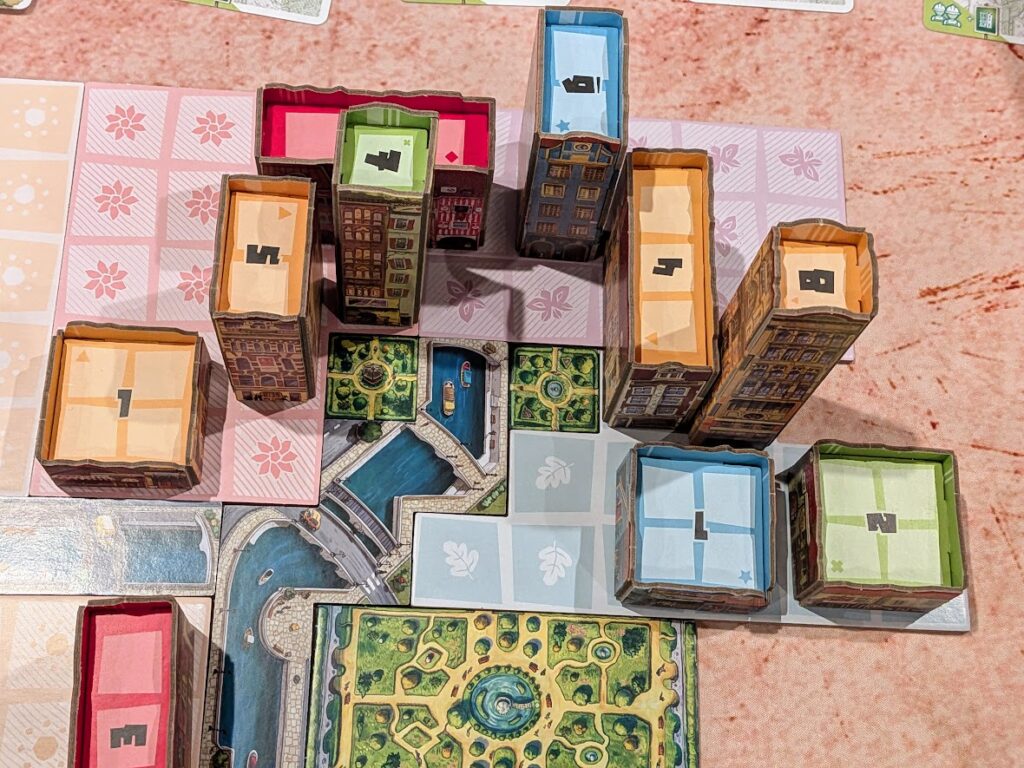
All of this and everything else I’ve mentioned in this review all combine to give this one overarching, paradoxical feeling throughout your plays of Bella Vista. You want to go first so you get first chance to claim good spots for the objectives and to fulfil contracts, but at the same time you want to go last to take advantage of building next to other players to earn money. What are you going to do?
That’s the question that’ll frustrate and delight you for the entire game, while you simultaneously curse and laugh at the other players. It’s very good.
Final thoughts
There’s no shortage of games with 3D buildings, but they don’t always need them. The recent special edition of The Castles of Burgundy (which I reviewed here) is a prime example. The game with just the cardboard tiles is fantastic. The little buildings in the special edition are also great. But the game doesn’t need them. Bella Vista needs the 3D buildings just to function, as the third dimension is incredibly important.
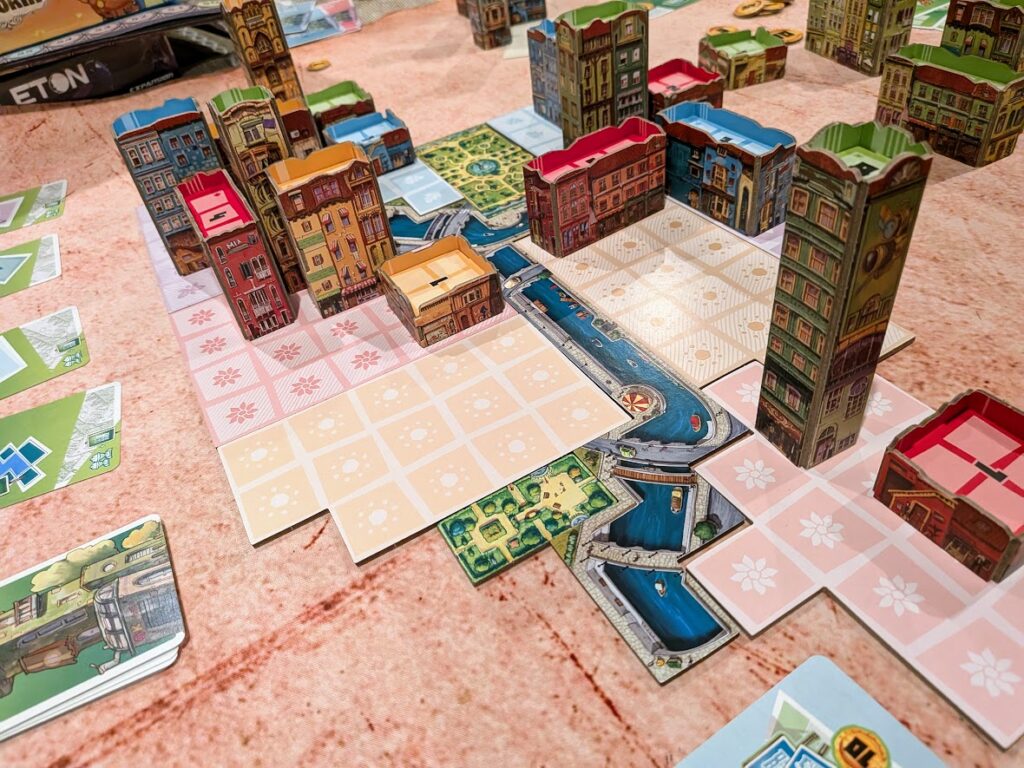
Bella Vista is a game which looks like a board game designed to have toy appeal at first, but it’s so much more. Yes, the toy factor is there, and it looks and feels great to build your own little city on the table, but all of this novelty belies a great game. Bella Vista manages to encapsulate the feeling of trying to rise to the top in a crowded space, almost like your buildings are stretching for fresh air in a crowded elevator.
There’s so much variability thanks to the modular boards, the different combinations of objectives, the zoning cards, and the contracts, that every game genuinely does feel different. The way you approach each game varies every time, and it’s really interesting to see how differently each city evolves. The players are coaxed and corralled into shaping it the way the gods of chance have decreed. It’s a tight, competitive, fun time that has genuinely blown my socks off. It’s not even June yet, and Bella Vista is already the frontrunner for my medium-weight game of the year.
THANKS TO MY SUPPORTERS
Krissie  Craig Paul Brendan Brett Gary Becky
Gavin Chris Mark Johan Richard Simon Ben Sam (new!)
Help me keep Punchboard independent by joining the supporters

 Buy me a coffee
Pros & Cons
Pros
- Truly a game played in all three dimensions
- Turn order matters so much
- A really beautiful production
Cons
- At its best with four players
- If you don’t like competitive games, it’s not for you
Where to buy Bella Vista
As an affiliate, I may earn a commission from qualifying purchases made through these links, at no extra cost to you. This helps support Punchboard.

UK

US

EU/International

Bella Vista (2026)
Design: Bruno Cathala, Andrea Mainini
Publisher: Studio H
Art: Cyrille Bertin, Léa Menard
Players: 2-4
Playing time: 30-45 mins
More games like this one

I’m not really seeing how it would play any different with flat tiles numbered 1-8?
From a purely practical point of view, there’s no difference. But you could say that about any game that uses any kind of pieces that aren’t flat tiles.
Bella Vista is a light game aimed at groups and families, and adding the physicality really helps. You can see which buildings are tallest, and in a game where the theme is building a city, the fact that you actually build a little city full of buildings is neat. It’s fun, and it adds a novelty factor which – and this is the important part – doesn’t have a negative impact on the game.
Contrast that with something like Castles of Burgundy Special Edition. The resin castles look cool, but they hide the tiles behind them, and you really need that information. Bella Vista’s 3rd dimension doesn’t do this.
I like the buildings aesthetically, though found it annoying that they make it hard to read the board by the time it gets full. We had a player completely miss a good scoring opportunity because it was invisible from their perspective. I have to disagree that it’s “truly a game played in all three dimensions though”. There are definitely games that is true of (e.g. Akropolis, Taluva), but this one is really just a 2-D game with fancy bits 🙂
Fair comment. And I love Akropolis.