
A review copy of Chicago & Northwestern was kindly provided by Rio Grande Games. Thoughts & opinions are my own.
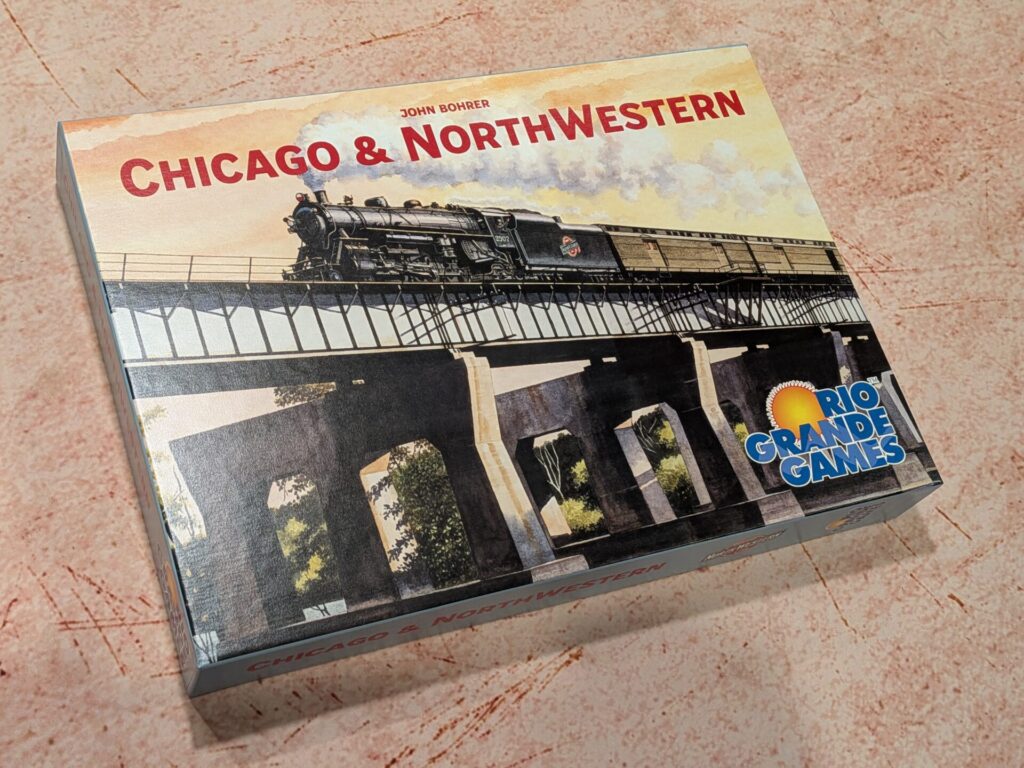
Ticket to Ride is too light, and 18xx games make my brain want to cry, so for me, Cube Rail games are where it’s at. Chicago & Northwestern from the person many consider to be the father of cube rails – John Bohrer – originally came out in 2016, then landed again in 2023 thanks to Rio Grande Games. Looking at the box, you’d be forgiven for wondering if it’s even worth opening the game, but if you’re a fan of games like Mini Express or Ride the Rails, you need to check it out.
VERDICT
players 3-5 | playing time 60 mins
Cube rail games fans will have a whale of a time building across 1800s America, milking shares for all their worth
cube rails
auctions
shares
ruthless
Let’s start with the designer. John Bohrer might not be a name you’re familiar with, but he hasn’t always used his own name. If you’ve played Ride the Rails (which is excellent; read my review here), you might remember the name Harry Wu on the box. Harry doesn’t exist; it was John. Heard of Age of Steam? You know, the Martin Wallace game? Go do some searching for ‘John Bohrer + Age of Steam’ and enjoy the rabbit hole. Either way, John and his label, Winsome Games, are well known in this space.
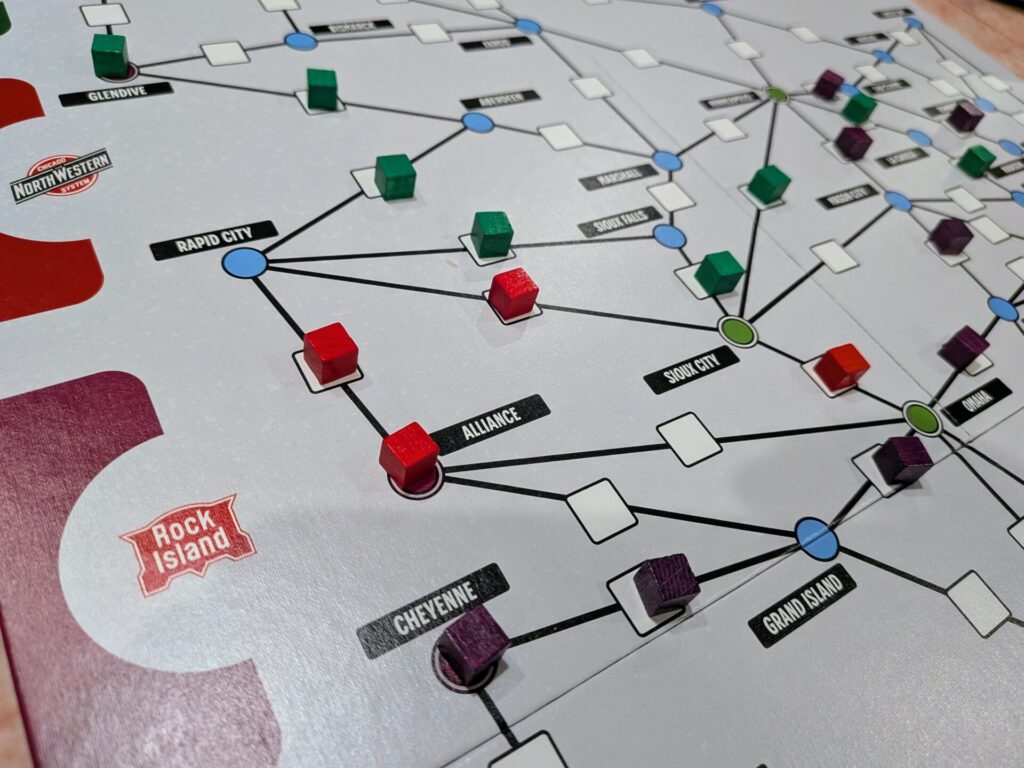
In Chicago & Northwestern, you’re trying to fill your own pockets by founding and expanding fledgling railways across late 1800s America. There are six companies available, with a limited number of shares up for grabs in each. The money you invest by bidding for shares is used by those companies to expand their rail network, edging ever westward. In a celebration of true capitalism, whoever has the most money at the end of the game wins.
I particularly like the tagline in the BGG description for the game:
This is not a friendly game.
Beauty in minimalism?
I mentioned the box not being very exciting, and that theme permeates the box lid through to the components. A plain-looking board, paper money, a few cards and some coloured wooden cubes. Coupled with rules printed on a couple of sides of A4, it’s not exactly screaming “look at what you get for your money!”
It should be expected, though. The Iron Rail system from Capstone had illustrator extraordinaire Ian O’Toole on board, and even they will never set your pulse racing. Or maybe it will; I’m not here to Yuck your Yum, but for most people these games are an exercise in less is more.
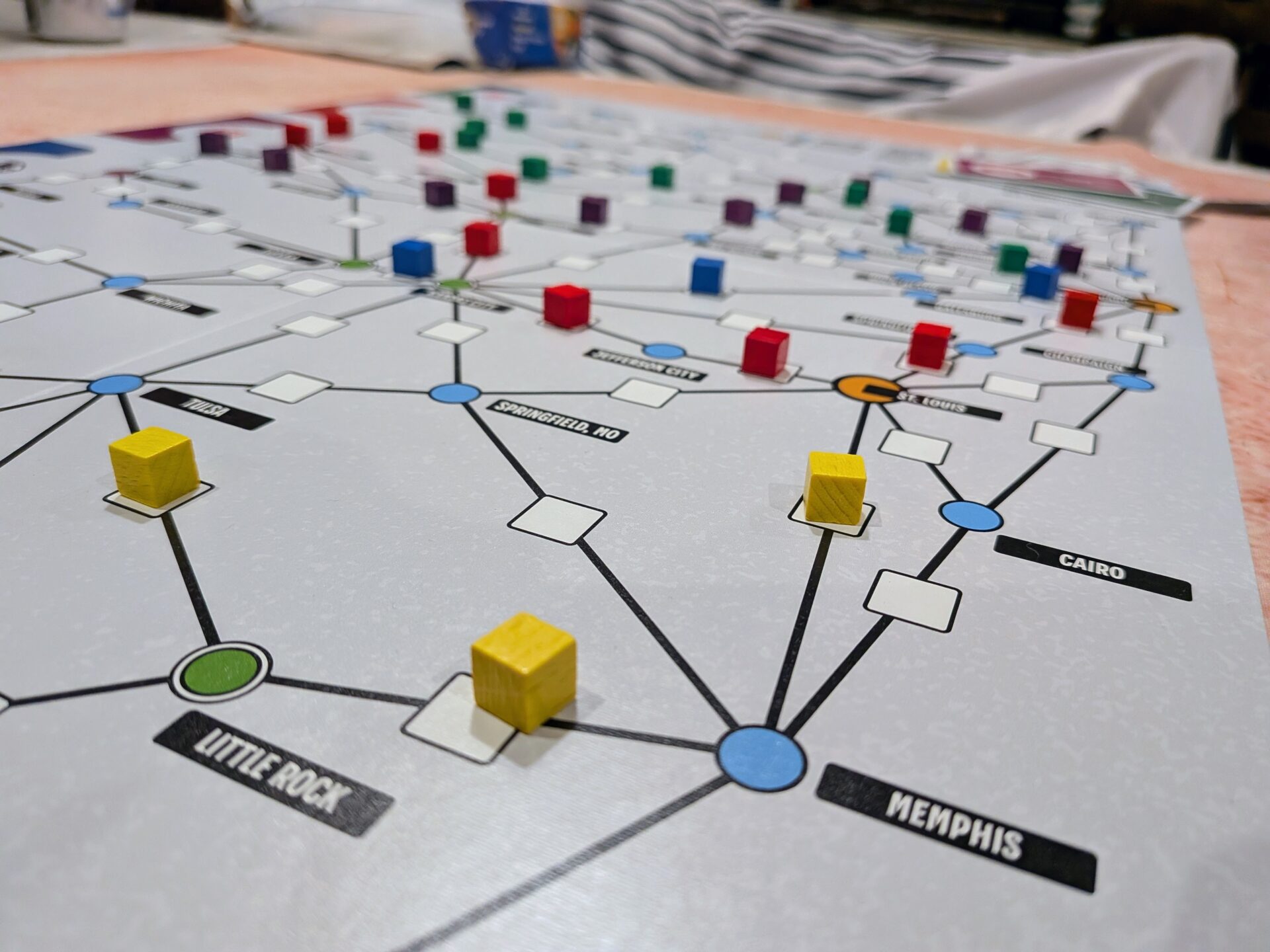
In Chicago and Northwestern, the lack of distraction is a blessing and helps John deliver a hugely competitive, cut-throat game in about an hour. Playing it is super easy. On your turn you usually have two choices. You either offer stock, starting a round of auctions for a share in a railway, or build some track.
If a share is still available and stock is offered, you bid for it with your own money. The highest bidder gets the share card, and the money they paid for it goes into that company’s coffers. That same money can be use to build track. Track is vitally important and really interesting. Adding a link to your railway (i.e. placing a cube of its colour on a line on the board) costs $5. Adding two links costs $15, and three links cost the princely sum of $45. Ouch.
Tickets please
Turning shares into cold, hard cash happens very rarely in the game. Only once during the entire game can you choose to cash in on your dividends. All players earn $3 per link, per share in each railway they own. $5 if the railway has made it all the way to the west coast. So the number of times you can earn from your shares depends on the number of players in the game. Once you use your Pay Dividends card, it’s gone.
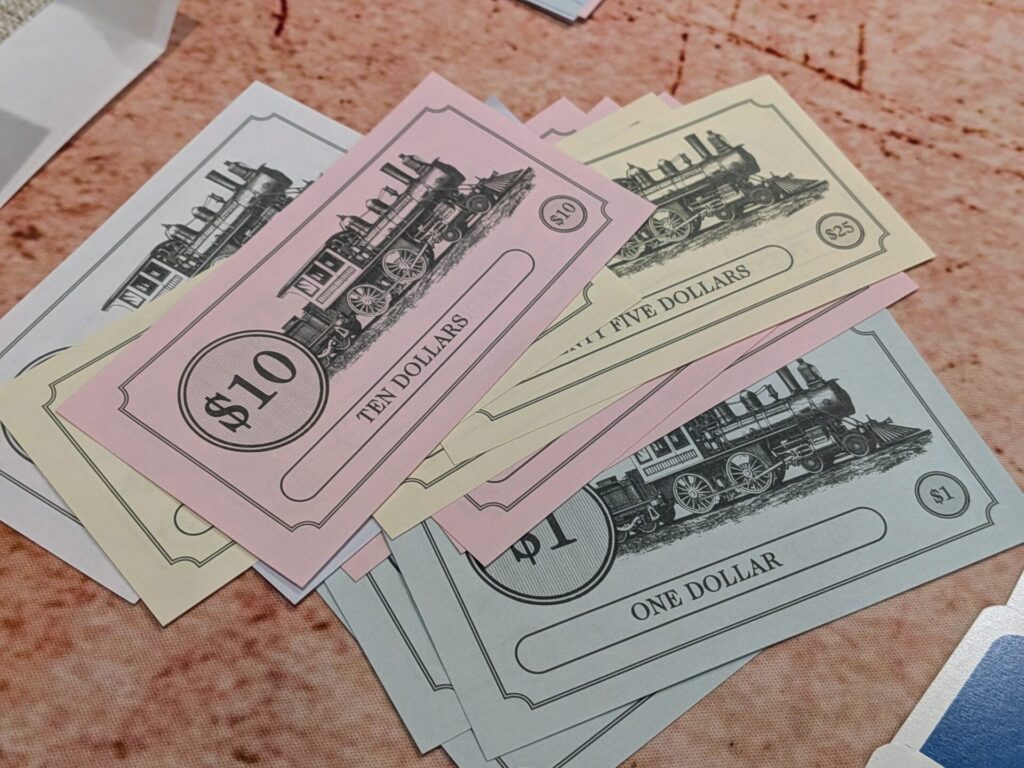
Timing, then, is everything. The longer you leave it, the more track gets built and the more chance you have to buy up lucrative shares. The same goes for the other players, though. And if you’re buying up shares, especially in hotly contested railways, how are you going to keep paying for them?
There is also a special action available to each railway. Anyone owning a share can use that railway’s special card – again, once in the entire game – to pay out dividends to everyone holding shares.
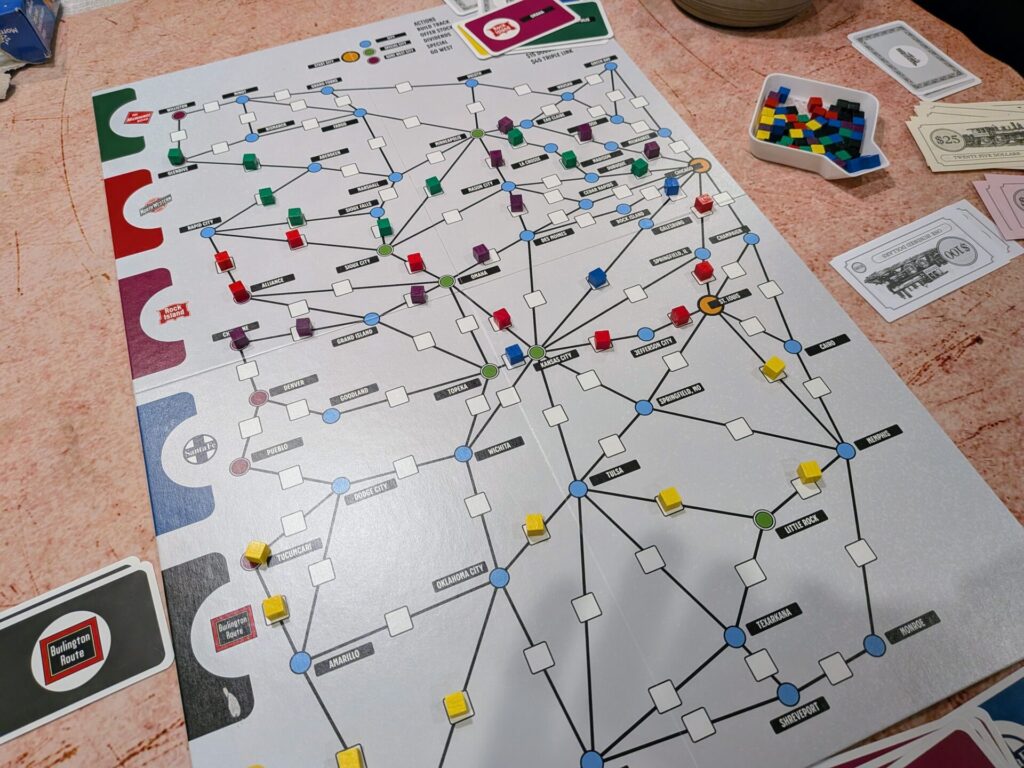
If it isn’t already coming across in my words, Chicago & Northwestern is, to coin a phrase, hella tight.
It’s also a whole lot of fun.
Final thoughts
There isn’t much more to say about Chicago & Northwestern. I really enjoy cube rail games, and if you’re curious, you should check out my reviews of Ride the Rails, Mini Express, and Luzon Rails. These games thrive on their simplicity, and CNW delivers it in spades. Teaching anyone the rules is much easier than any of those other games I mentioned, and, if anything, it delivers a much more ferociously fought game.
The biggest problem it has is the appearance. The box looks bland, the contents are functional, and that’s about as much as you can say about it. It’s never going to be an impulse purchase when you’re looking for inspiration on the shelves of your FLGS.
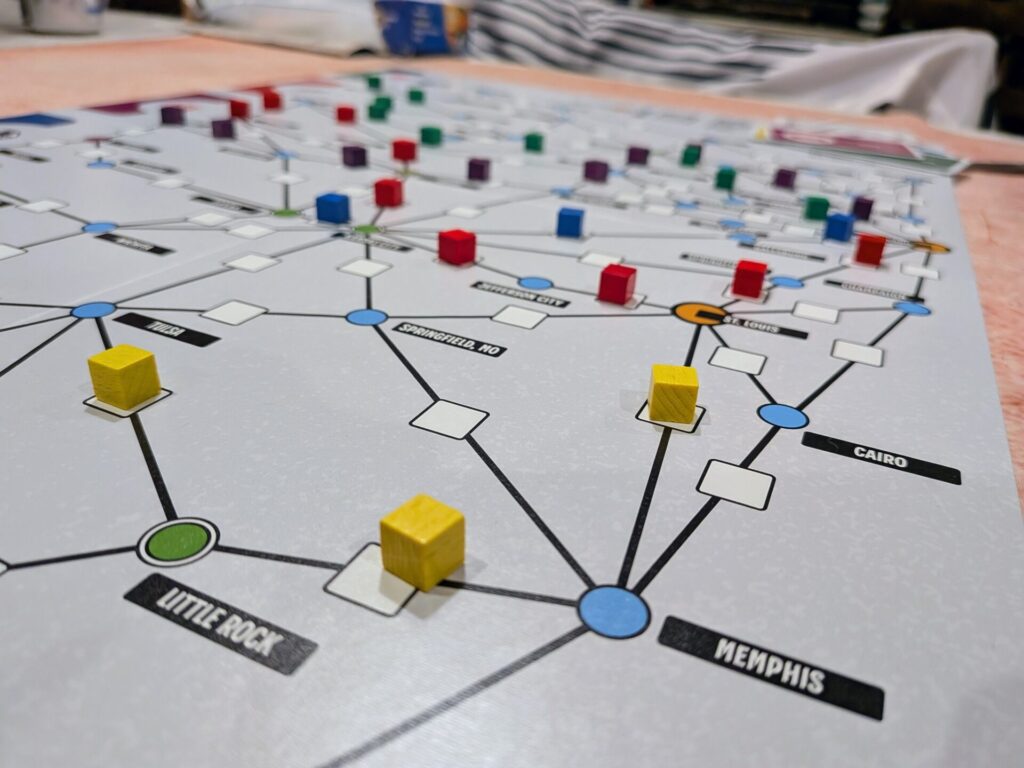
Get past the looks, though, and Chicago & Northwestern is the distilled spirit of cube rails. It’s mainline meanness moonshine, and it’s pretty awesome. It feels maybe a little too chaotic and hard to read with five players, but with three and four it’s a treat. The feel of a full-blown railway shareathon without the time and mental investment of even one of the lighter 18xx games. Wonderful stuff, but only if you and your group don’t mind a bit of conflict.
Want to get this to the table?
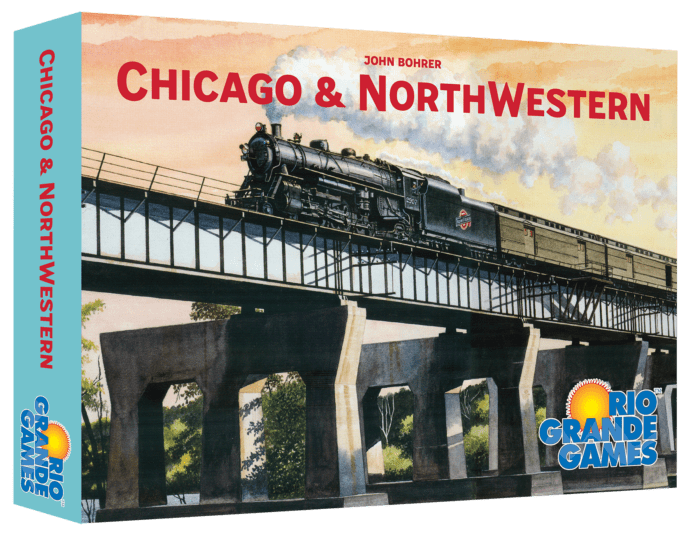
Chicago & Northwestern
3-5 Players | Ages 12+
Purchasing via this Zatu link supports Punchboard via an affiliate commission at no extra cost to you.
Pros & Cons
Pros
- It’s a cube rails game
- Plays out in an hour, with barely any setup
- Tons of banter and table talk
Cons
- It’s not a visually stunning game
- If you don’t like conflict, steer clear
THANKS TO MY SUPPORTERS
Krissie  Craig Paul Brendan Brett Gary Becky
Gavin Chris Mark Johan Richard Simon Ben Sam (new!)
Help me keep Punchboard independent by joining the supporters

 Buy me a coffee

Chicago & Northwestern (2016)
Design: John Bohrer
Publisher: Rio Grande Games / Winsome Games
Art: Todd Sanders
Players: 3-5
Playing time: 60 mins
More games like this one