
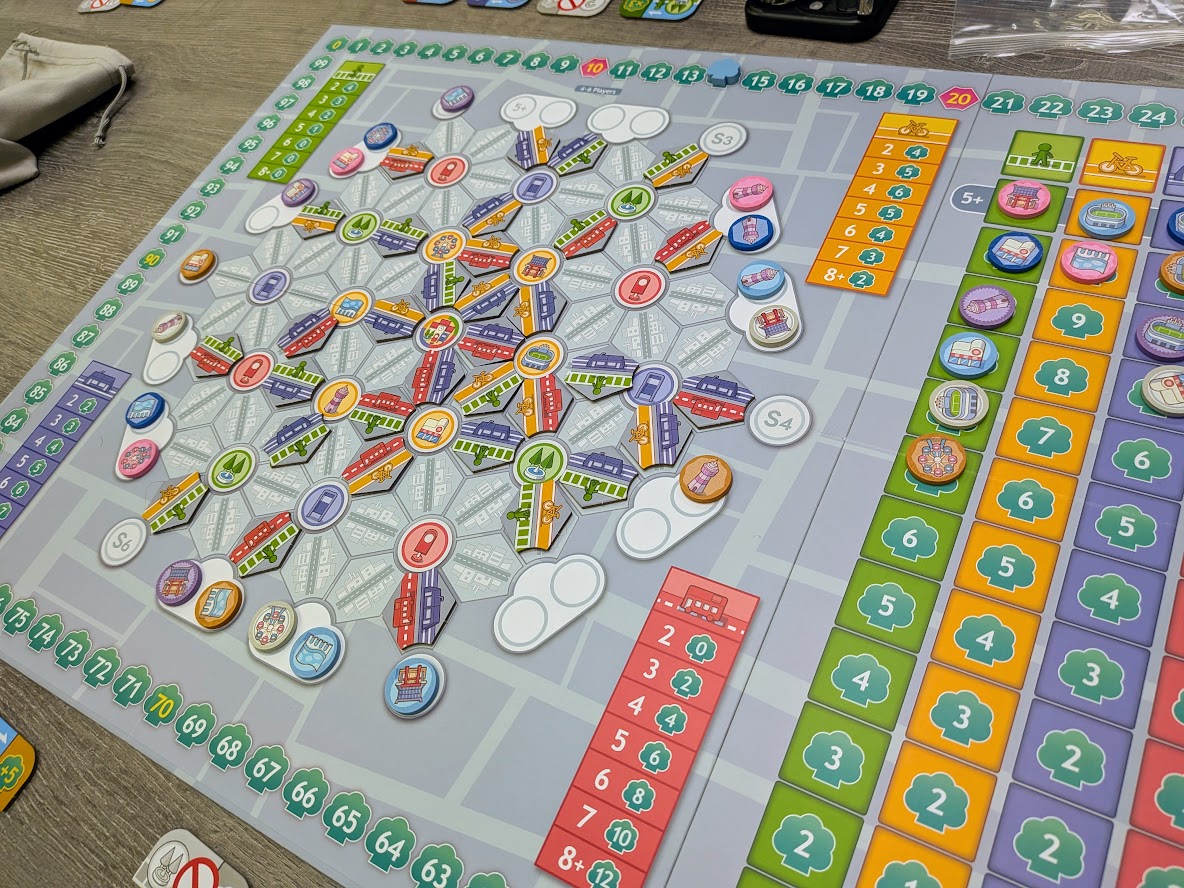

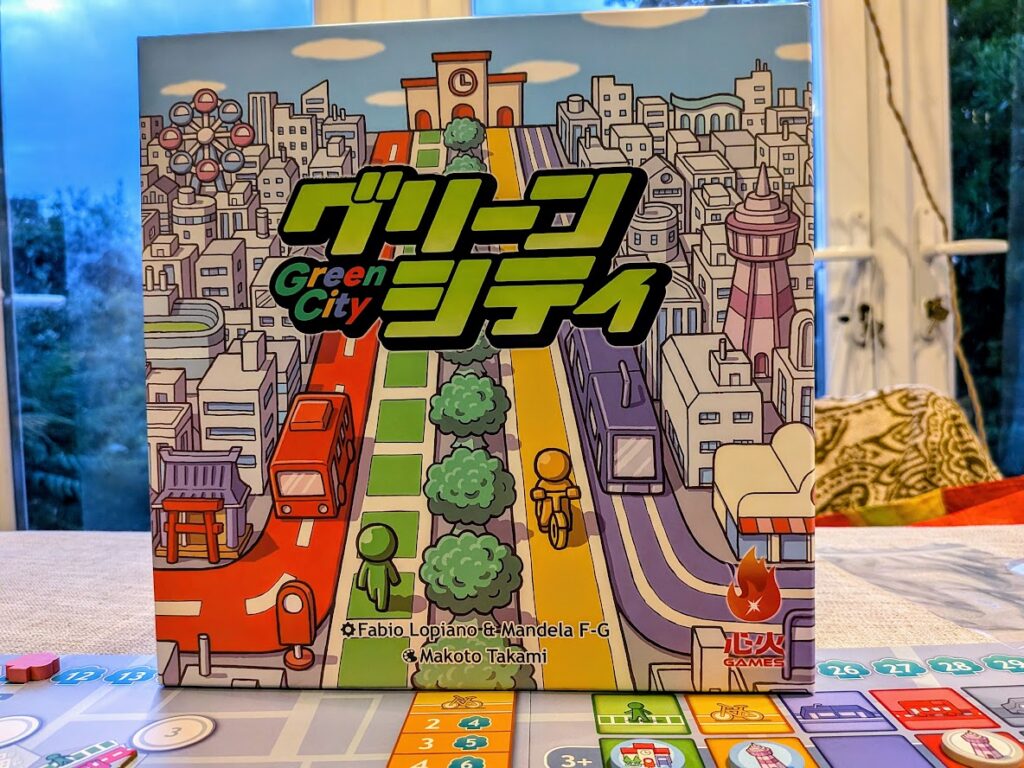
Fabio Lopiano and Mandela F-G’s names are well known around these parts. I’ve covered six of Fabio’s games here before. I’m a confessed big fan. I also love quirky games from Japanese designers and publishers. Last year, I reviewed Lunar Trick from Synka Games, which I still really enjoy. Imagine my excitement when a few months ago I saw a new game being shown off: Green City. A design from Fabio and Mandela, published by Synka Games. Oh my. I managed to snag a copy at this year’s UK Games Expo (read about my time at UKGE 2026 here), and while it’s not what I expected, it’s still a great game.
VERDICT
players 2-6 | playing time 30-45 mins
Green City condenses clever, thoughtful turns into a simple, elegant tile-laying game which fans of lighter games will really enjoy.
tile-laying
networks
route-planning
If you’re expecting a complex, multi-faceted brain burner like Shackleton Base or Sankore, you might be disappointed. Green City is the kind of game I imagine this pair might have started off with when they took their first steps aboard the good ship SS Game Design. The entire game rotates around one central gameplay gear.
Take a tile from the bag and place it on the board.
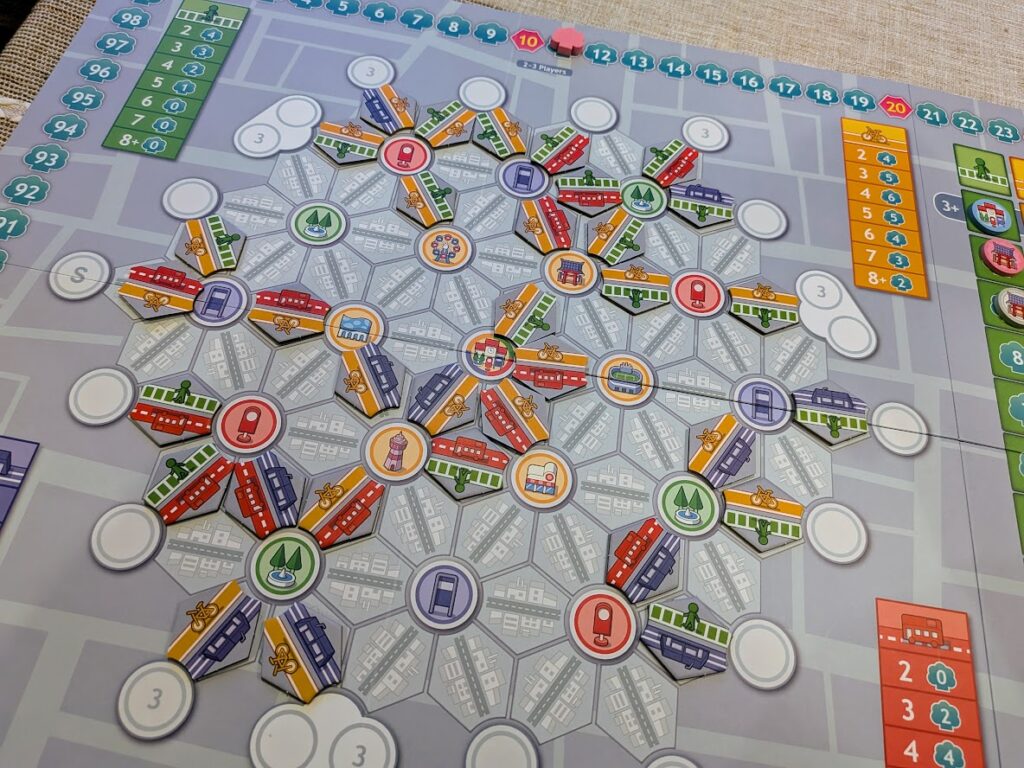
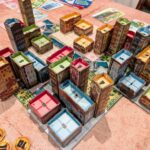
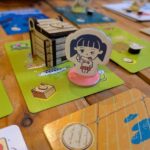
Each player has a number of Runners. Runners are discs that start around the outskirts of the board, and your job is to create routes from where they start to the destination which matches the printing on top of them. So the lighthouse runner wants a path to the lighthouse. The token we’ve dubbed ‘the toilet paper factory’ needs a route to the toilet paper factory.
There are four different colours of routes: red, green, yellow and purple. You might be expecting there to be a paucity of a particular colour to spice things up, but nope. Every tile is double-sided, and every tile has all four colours on, just in different combinations. For instance, your first tile might have green-red on one side and yellow-purple on the other, while the next is green-yellow and red-purple.
It does mean that you can block certain paths on the board. For example, there might be a place where you really want a red connection, but someone has put a green & yellow tile in the space you needed. It’s not the end of the world, but in a game where it feels like there’s not quite enough tiles and turns, it can be a royal pain in the ass.
Instead, where Green City gets its hooks into you is in the lengths of the completed routes.
“Okay Google, take me to the stadium”
Each colour in Green City represents a different mode of transport. Green is walking, yellow is bicycle, and red and purple are bus and tram, respectively. Points in the game are determined by how long your routes of a particular colour are. Say for example you want to move your stadium runner disc to the stadium. If you make a green connection to it – by foot – then you score the most points by making as few links in the path as possible. After all, who wants to walk five miles before they sit down to watch their favourite sportsball team play?
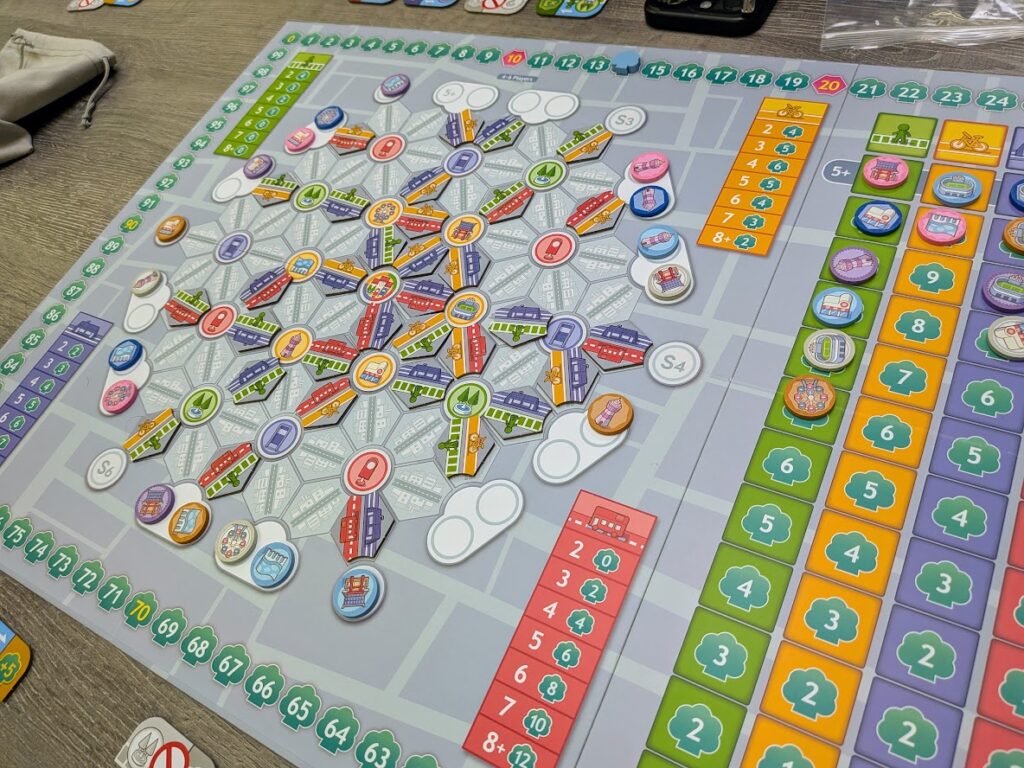
In contrast, we ought to use things like buses if we want to cover more distance, so the red routes score better for longer routes. Trams do the same thing. Yellow bicycle routes are somewhere between the two. It all makes sense, right? And that’s pretty impressive, to find a way to add a little theme to what would otherwise be an entirely abstract game of building links.
What elevates Green City above other very rote, by-the-book, lightweight tile-laying games is the scoring. You have the scoring based on route type and length, as I mentioned, but there are some other things to consider.
Firstly, you each have an identical set of bonus tokens. If your chosen route for a runner disc meets the conditions on a bonus token (e.g. a green walking route passes through a green park circle), you can flip the token to get bonus points.
Secondly and most interestingly, are the bonus tokens on the score track. There’s one per route colour, and they’re placed in random order at points al;ong the score track. Once a player’s score marker reaches one, it goes in the draw bag with the other tiles. When a player draws a tile at the end of their turn (you get a whole lap of the table to decide what to do with your next tile), if a scoring tile is drawn then that colour is scored.
Each runner that completes a journey gets put on the matching colour scoring track on the board. When the scoring token is drawn out of the bag, every player with at least one token on that track scores the highest visible points on the track (the more players with tokens there, the lower the bonus) multiplied by the number of tokens they have.
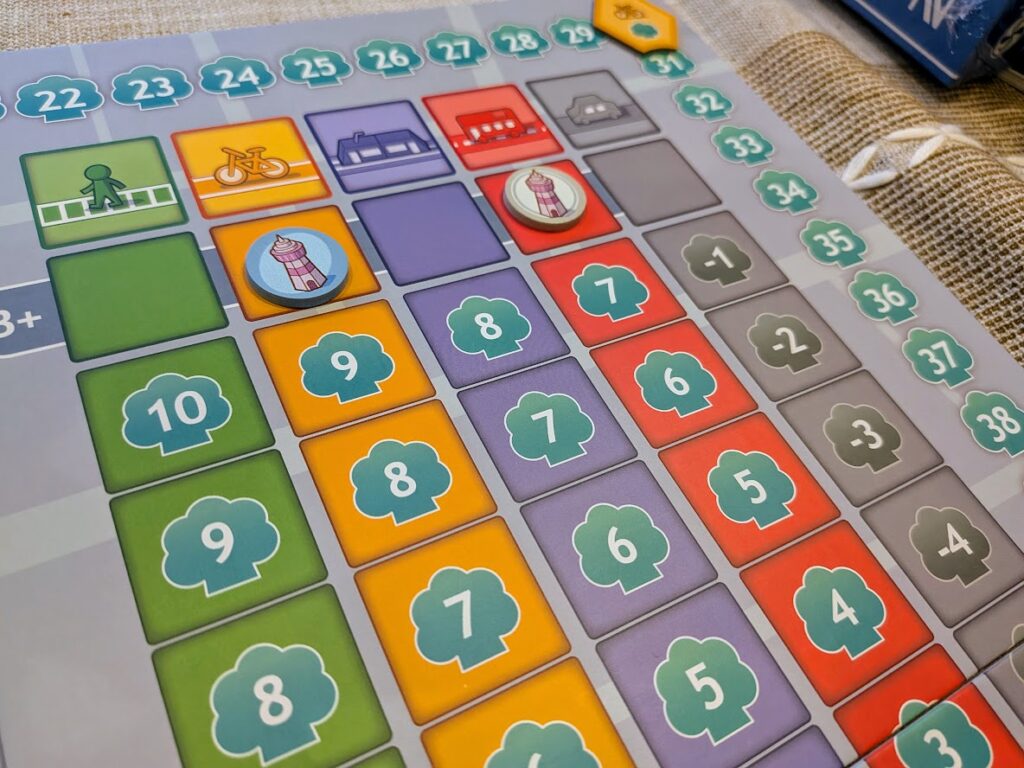
It adds a really fun dynamic to play with. Diversify your routes to use all of your bonus tiles, or hit multiple routes of the same kind to trigger good scoring rounds. You can’t do both really, so figuring out which way you want to play can be surprisingly challenging.
Final thoughts
Green City is an odd beast. Fans of Fabio and Mandela’s heavier games might well be disappointed. It feels very light compared to something like Sankore. Half an hour after you start, the game’s over, which makes it great to start or end a game night on, but not so much for your group’s main course. If you take the approach of ‘This is a smaller game from a Japanese publisher’, it’ll help set your expectations accordingly.
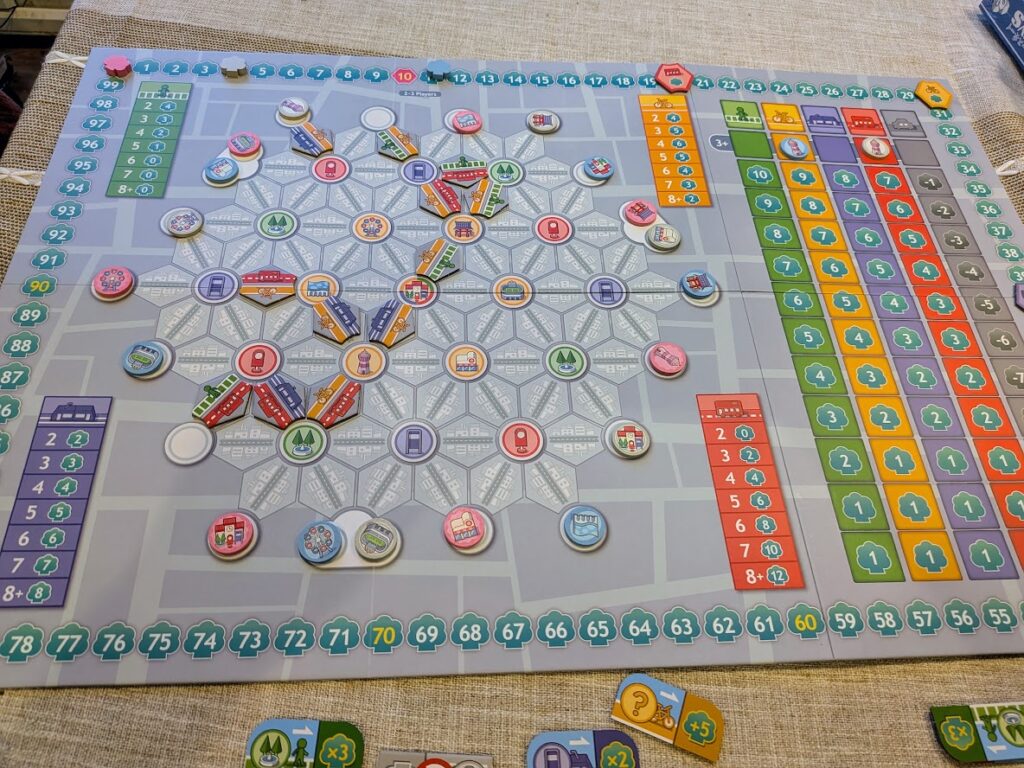
I really like the fact it plays from two to six players. So few games cover that breadth of player count without being a card game. I’ve played it at two, three, four and six players now, and I can honestly say that it works at all of them. I preferred the table talk and the drama of late-game tile draws more with six, but it’s still solid with two or three, thanks in no small part to a double-sided main board.
If you’re looking for the next Lopiano Euro crunchfest, Green City isn’t it. If, however, you want something lighter, something really different, and to see what happens when European designers meet Japanese publishers, Green City is great. I picked my copy up from the very limited stock at UKGE, so we’ll have to wait and see what happens about more widespread distribution. I really hope it gets a wider audience, because Green City is a charming, clever game that I think a wide variety of gamers will enjoy.
THANKS TO MY SUPPORTERS
Krissie  Craig Paul Brendan Brett Gary Becky
Gavin Chris Mark Johan Richard Simon Ben Sam (new!)
Help me keep Punchboard independent by joining the supporters

 Buy me a coffee
Pros & Cons
Pros
- Quick, easy gameplay
- Plays great with two to six players
- More to it than the first play suggests
Cons
- Much lighter than you might expect from a Fabio & Mandela game
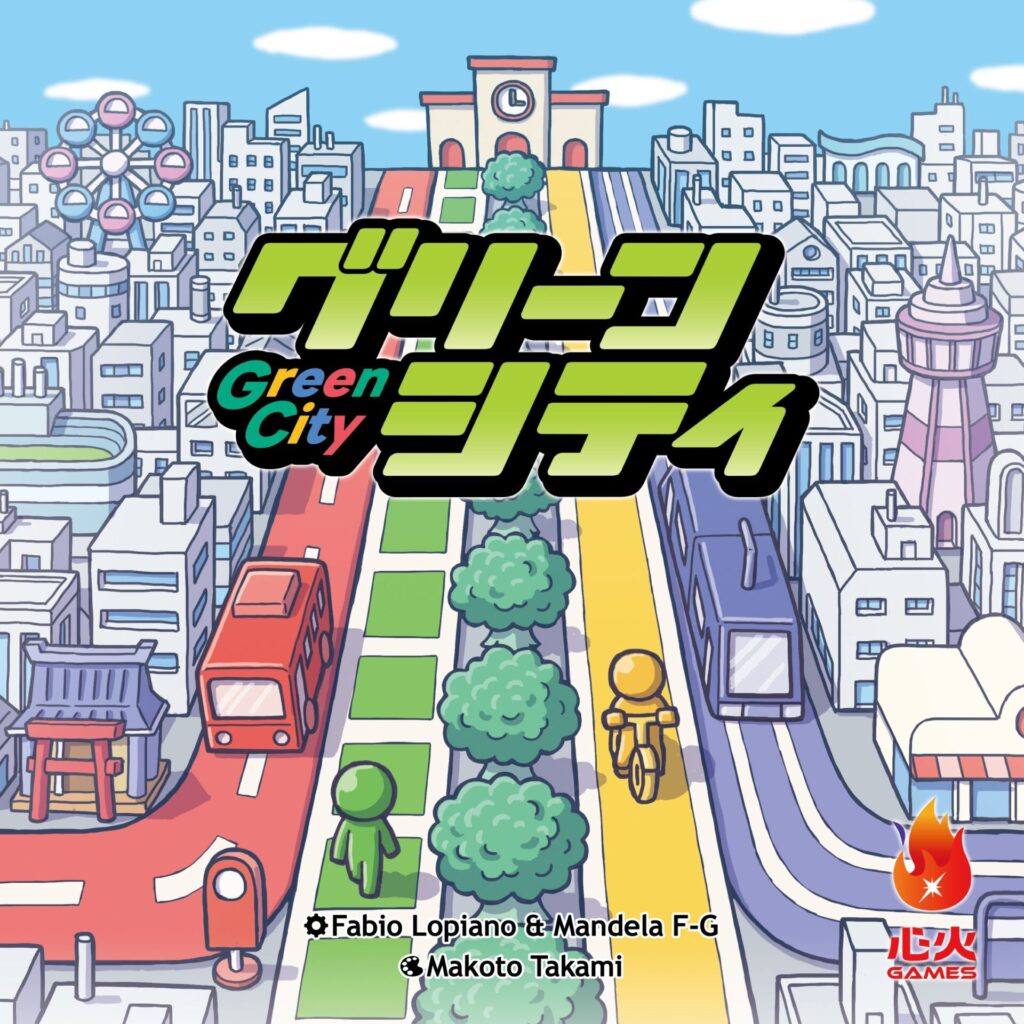
Green City (2026)
Design: Fabio Lopiano, Mandela F-G
Publisher: Synka Games
Art: Makoto Takami
Players: 2-6
Playing time: 30-45 mins
More games like this one

This sounds super interesting. Is the game getting a wide release?
I hope so. I spoke with Synka at the UKGE and I know he was looking for distribution.