
Ringyo (Ringyō / 林業) is a game about forestry in Edo-period Japan. Well, kinda. It’s more accurate to say that it’s a game where you’re a Daimyo in Japan overseeing a province covered in trees and floodwaters. I can honestly say that I can’t point at another game and say “Ah, that’s just like Ringyo”, because there are a lot of things Ringyo does that feel fresh and different. It’s a heavier game than I anticipated, and I think it works in its favour. Ringyo is a game you ought to have on your radar.
VERDICT
players 1-4 | playing time 45-90 mins
Ringyo takes worker placement and throws in an ever-changing board and an uncertain weather forecast to make something pretty unique.
worker-placement
research tracks
turn order
changeable
The vast majority of Ringyo revolves around a mixture of worker placement and a pretty unique spatial puzzle. In each round, you play a character card to determine turn order, get the bonuses you choose or are left with for the round, then work out how best to use them alongside the workers in your province.
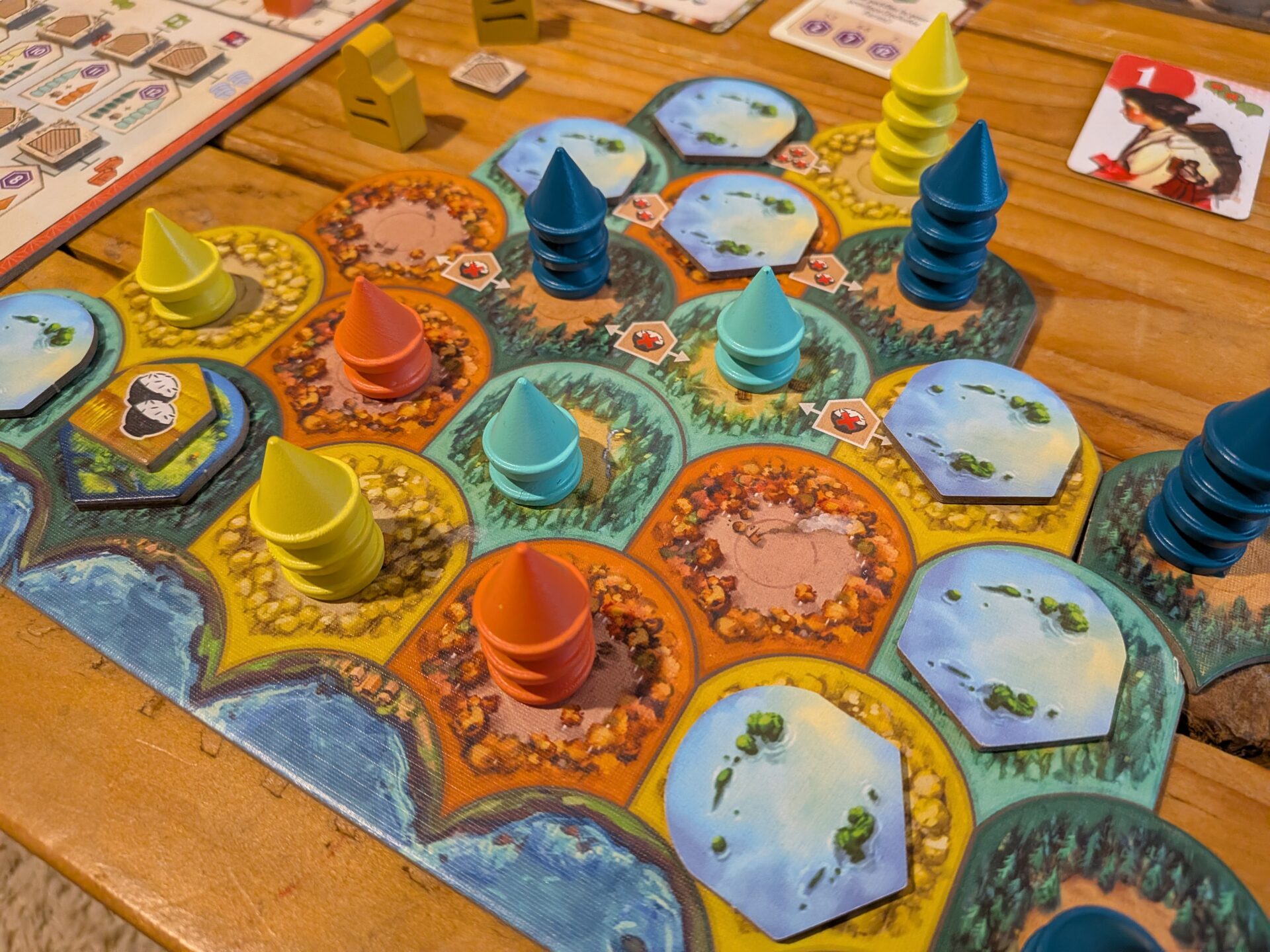
Your province is a triangular board of hexes, with each hex coloured to denote what type of tree could grow there. The really interesting thing to know about the province board, which isn’t obvious when you look at it, is that the hexes as you move from bottom to top of the board are treated as if they’re increasingly higher, like walking uphill. This becomes really important when we look at what happens when it rains, but more on that later.
You place your workers on the corners where three hexes meet, then, depending on the type of worker, carry out actions on one, two, or all three of the neighbouring spaces. You’re with me so far? Good.
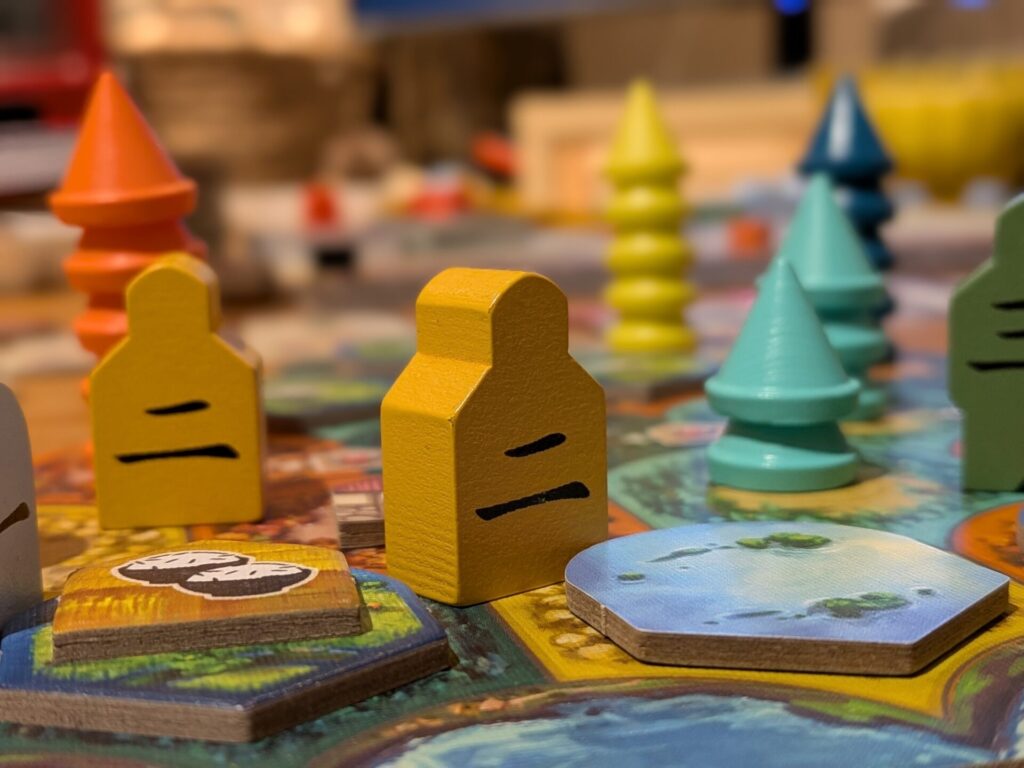
As you’ll have gathered, the pretty, pointy pieces in Ringyo represent trees, and they stack. Some might say like the pieces in Earth (read my review of Earth right here), but the pieces put me more in mind of Cosmic Encounter, just without all the aliens. Actions include things like growing trees, chopping trees down, cutting trees into smaller logs, and even sticking bits of trees back together to make bigger logs again. Albeit using rice, apparently?
Here comes the rain
At the end of each round of play comes the fun bit. If, that is, your idea of fun is storms and typhoons. You see, once a round ends there are three communal weather cards that get revealed. They’re randomised from a deck of cards, but the odds of certain types are stacked. The forecast card for the round assigns each of the four types of tree in the game – Cypress, Beech, Pine and Oak – to either A, B, C, or nothing at all. There’s a higher chance of drawing A cards than B or C.
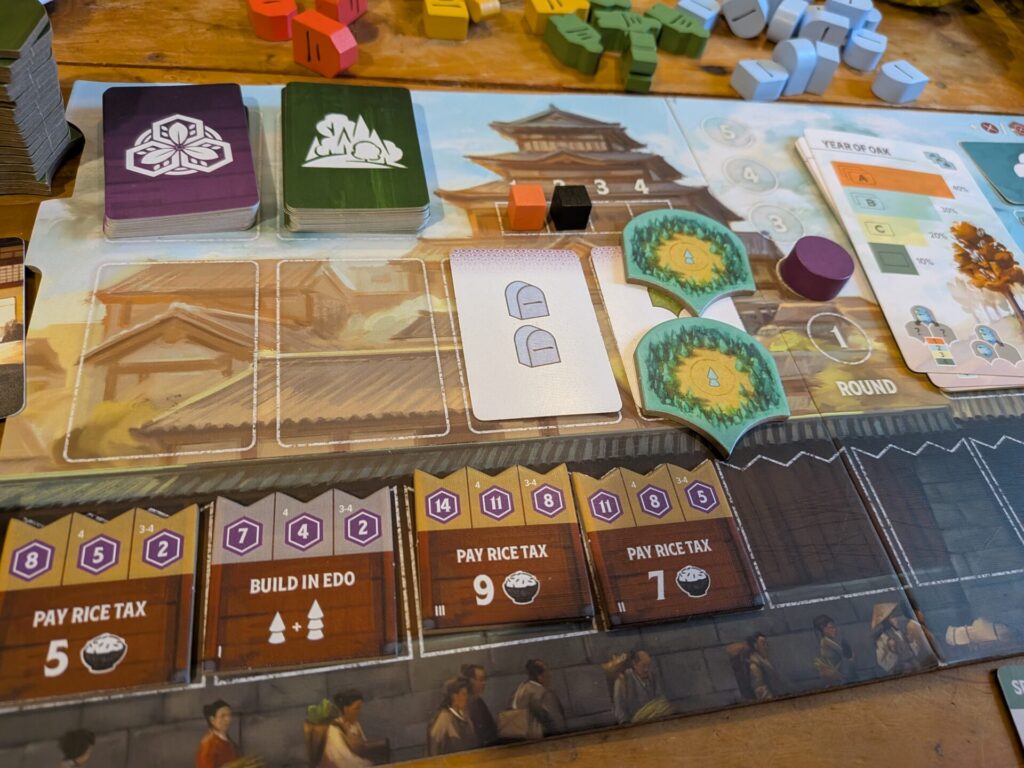
For each card that’s flipped, if you’ve got a tree in the matching type of hex, it grows. Yay! If it has a rice paddy or a farm, you get rice. Yay! If it’s empty, just an expanse of open land, then it floods. Yay?
Flooding once is okay. One of your workers’ actions is to transform flooded land into a rice paddy, so that’s good. The problem comes when an already flooded hex gets flooded again. Now, thanks to bloody Newton and topography, gravity dictates that the extra water has to go somewhere, so it floods downwards, wiping out farms, paddies, and fortresses (another thing you can build) as it goes.
Shockingly enough, this is bad news.
Losing paddies and farms means losing rice income, and rice is what you use to hire villagers to act as workers for you. No rice means no extra workers. No extra workers means no extra actions. No extra actions mean you end up severely restricted in terms of what you can do.
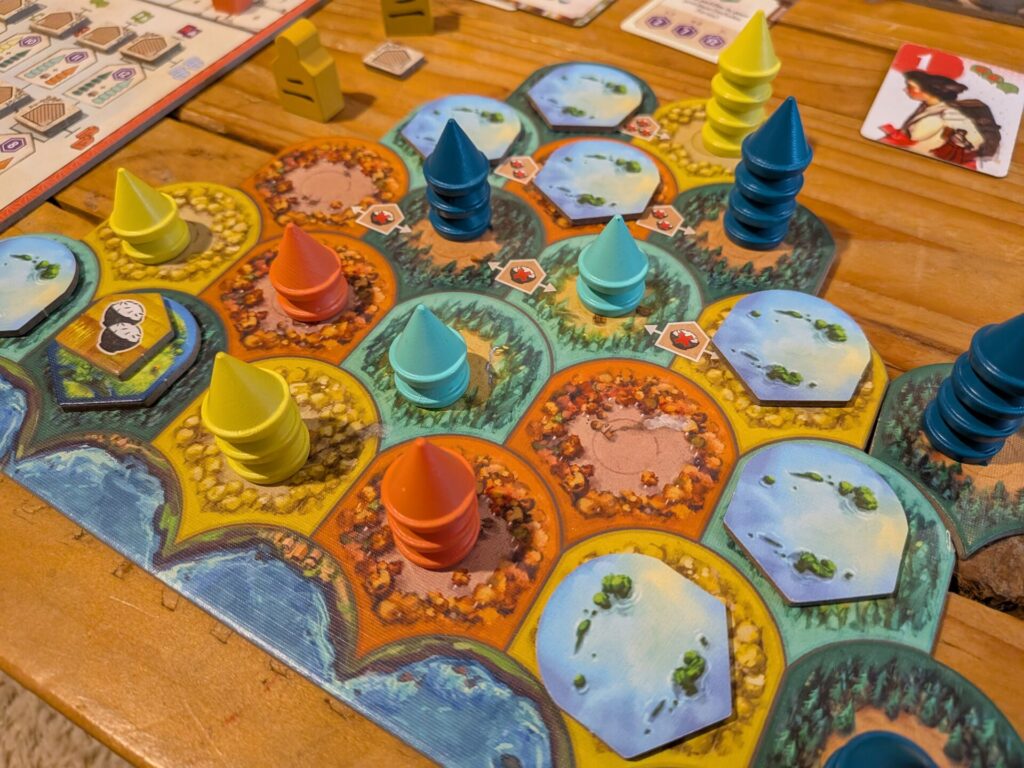
This weather system is really clever, I like it a lot. You can see which type of space is most likely to get rained on at the end of the round, so if you want to you can just let the wheel spin and see if Lady Luck rewards you with lush vegetation, or punches you in the balls and floods everything you own. But you can also mitigate through other actions which let you take a sneaky peek at the round’s weather cards so you know what’s coming.
Or if you’re really sneaky, you can wait for someone else to look at the cards and see where they choose to bolster on their board. Be warned though, Ringyo is a game where action selection and execution is meant to be simultaneous, so watching and waiting the other players is dishonourable. It’s specifically called out in the rulebook, so don’t do it, right!?
Or at least don’t get caught doing it…
Spoiled for choice
So many new games that come to market, especially those aimed at fans of medium-weight games, are a little prescriptive in terms of what they ask you to do. Sure, you can lean one way or another, but your turns – especially during the early game – can feel a bit rote. You’ve got to do X so that you can afford Y, which means you can aim for Z. Ringyo pulls the training wheels off right from the outset, gives you a firm shove in the back and says “Go for it champ, you got this”.
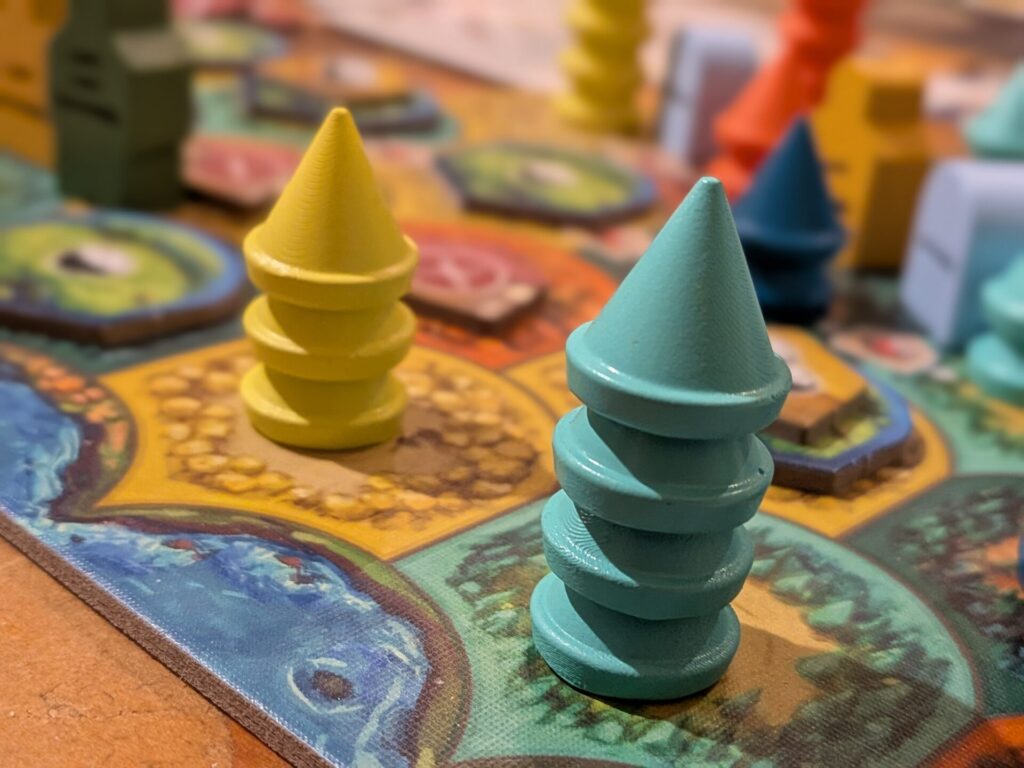
Each player has a board with buildings on it. If you harvest trees of the right size, you can combine them as per each building’s requirements, remove a token from that board, and then either build a fortress or develop a rice paddy into a farm. The buildings have a neat dependence structure too, which means you can only build buildings from your grid of tokens if they’re orthogonally adjacent to a previously-built structure. This all means you need to plan in advance to make sure you have the type of wood that each building demands.
This might make you think “Grow, grow, grow. Put trees everywhere, chop ’em down, and make stuff”, and that’s a perfectly legitimate strategy.
HOWEVER
You also have a Forestry research board. This board has a marker that you can move up forking branches(!) of its tracks by placing certain types of workers next to hexes containing trees of certain sizes. So instead of chopping everything down, you can have a damn good look at them. These tracks reward you with extra workers, resources, and even tokens which let you look at the round’s weather cards.
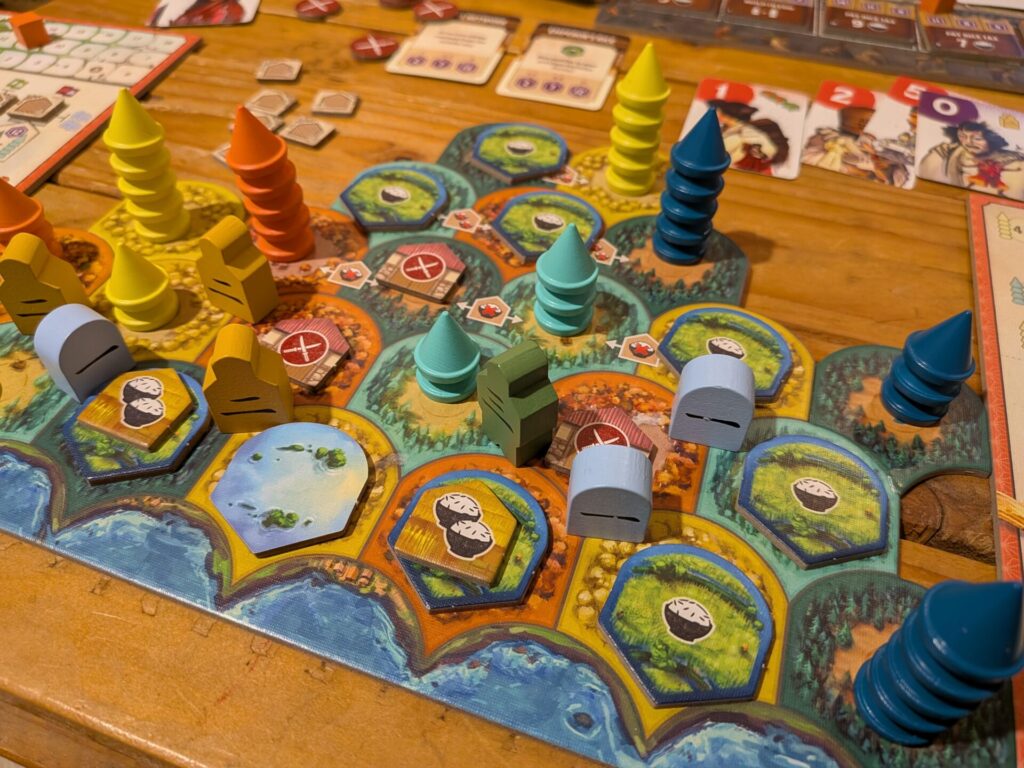
So maybe you should do that instead? Maybe. Or maybe a bit of both? Again, maybe. There’s a distinctly sandboxy feeling to Ringyo. I think that’s due in part to the fact that your own personal province board changes so much during the game. One minute you can’t move for trees, the next you’ve cut everything down and it’s flooded so much it looks like you’ve upped sticks and relocated to Atlantis instead.
Ringyo is a game about timing. Choosing when you do things is as important as choosing which things you do. Its cutesy colours and appealing table presence belie a game which is actually pretty tricky to formulate and execute a plan in.
Final thoughts
When I first saw Ringyo, I had no idea what to make of it. Because of games like Cascadia and Harmonies in the past few years, it’s easy to look at the pretty province boards covered in little trees and assume it’s a game in the same vein. It is not. True, it’s very much a multiplayer solitaire affair in which you have no real player interaction, save for the turn order choice each round. But the game’s roots run much deeper than the others I mentioned. There is a lot more going on, and a lot more asked of the players.
The biggest problem, for want of a better word, I had with Ringyo was trying to formalise my turns. Early in the game, things are relatively simple. Later though, you start getting situations where combos are popping off all over the place. Doing this thing gets you this other thing, and you can use that to do something else. But it’s quite hard to plan ahead for all of these, and even just getting a single extra rice can mean hiring another villager, which in turn leads to another action, and… you can see where this is going.
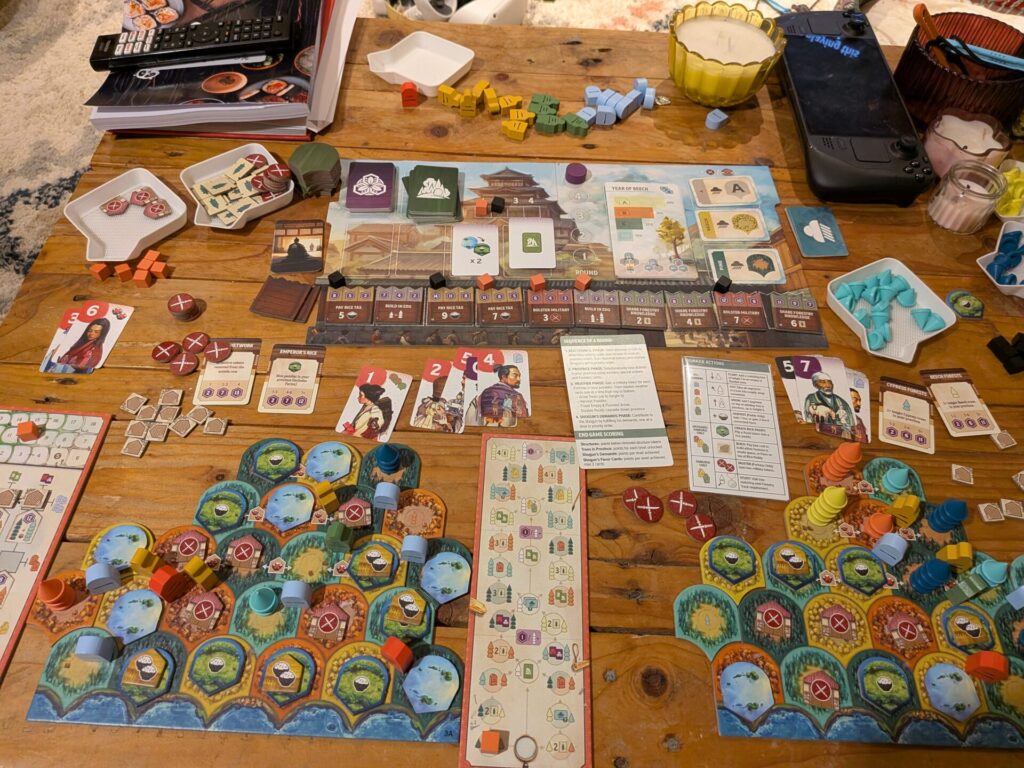
Be prepared to let players retcon and rewind their actions while they find their feet. It’s reassuring to know that Charlie and the folk at Paverson Games recognise this enough to call it out in the rulebook again. It’s just something to bear in mind. If you drop Ringyo on the table with friends who only like light games, they might not have a good time with it.
That grumble aside, I think Ringyo is great. The ever-changing board state, the unknown of what’s going to happen with the rain at the end of the round, the sheer variety of options open to you with every worker you place, all add up to a game which surprised me. It isn’t the lighter, end-of-game-night game it imitates. It’s not board game petit fours. It’s a main course. The simultaneous action phase just makes it feel quicker than something heavier.
After Distilled (read my review here) and Luthier (and read that review right here), it’s clear that Dave and the rest of Paverson games have no qualms about trying new themes, mechanisms, and now even designers too. Another fine ludological arrow to add to their quiver of games; make sure you check it out.
At the time of writing, Ringyo is LIVE on Kickstarter. Check it out right now. Go on.
Pros & Cons
Pros
- A really nice twist on worker-placement
- I love how much the board changes
- Kwanchai Moriya artwork ❤️
Cons
- More complicated than it looks
- Can be prone to rewinding entire turns
THANKS TO MY SUPPORTERS
Krissie  Craig Paul Brendan Brett Gary Becky
Gavin Chris Mark Johan Richard Simon Ben Sam (new!)
Help me keep Punchboard independent by joining the supporters

 Buy me a coffee
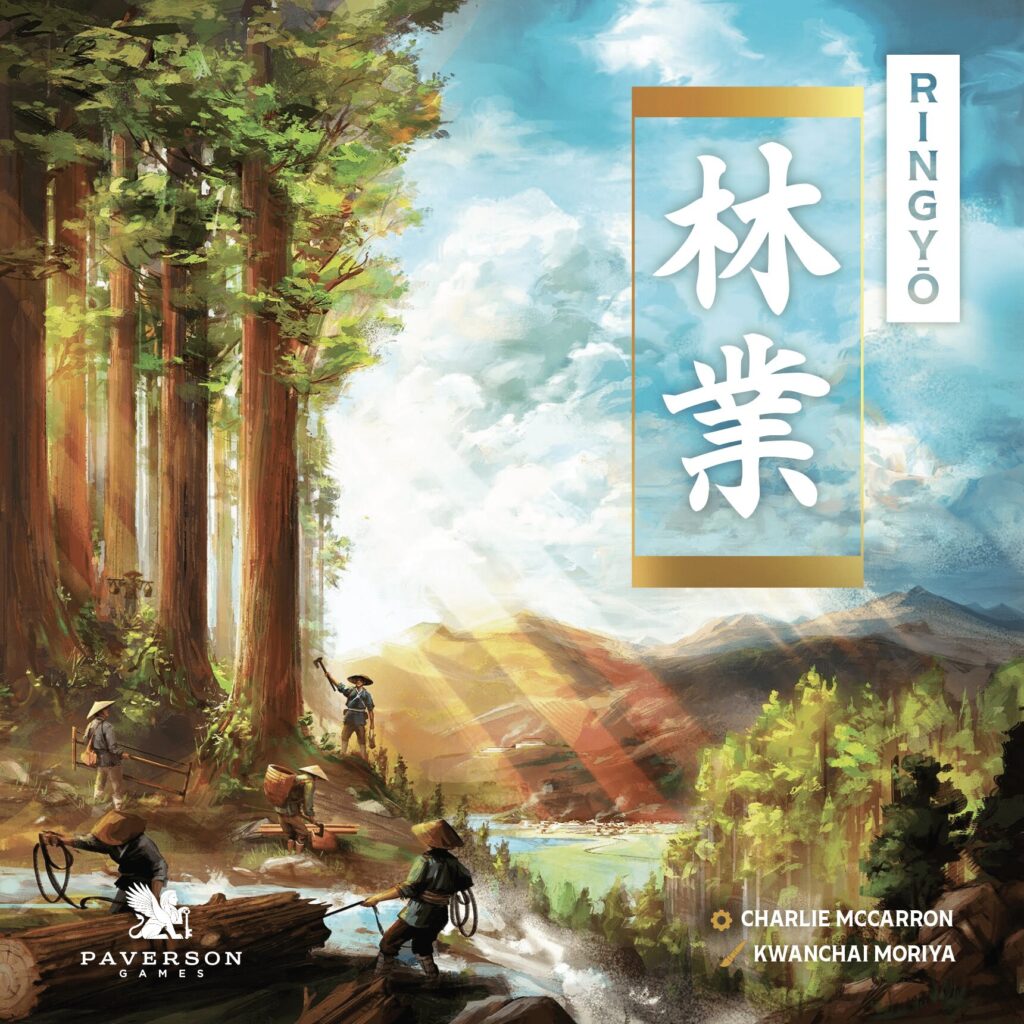
Ringyō (2026)
Designer: Charlie McCarron
Publisher: Paverson Games
Art: Kwanchai Moriya
Players: 1-4
Playing time: 45-90 mins
More games like this one