
A review copy of Vantage was kindly provided by Stonemaier Games. Thoughts & opinions are my own.
Vantage landed last year with a lot of hype behind it. Jamey Stegmaier’s baby, years in incubation, landed on tables with a heavy thump as grateful storks departed. The premise is huge. Vast even. Remarkably, Vantage manages to deliver on many of its lofty goals, but I think there’s a lot of scene to set here, which is particularly apt given that scene-setting is a substantial part of the game.
VERDICT
players 1-6 | playing time 120-180 mins
Vantage is to board games what Firewatch is to video games. Not a thrill-a-minute, but a good time walking, exploring, and crafting your own stories.
cooperative
story-telling
exploration
sandbox
Do you remember a few years back when the video game No Man’s Sky was announced? It was touted as this impossibly vast, open-ended, galactic sandbox where the only limits were the players’ imaginations. Predictably enough, it was a huge disappointment. The idea of a vast, open sandbox sounds enticing, until you realise that there is just SO MUCH SAND and only so many ways to build a sandcastle.
This was in the back of my mind when Vantage arrived at my house. The prospect is amazing. You play as spacefarers making your way towards an uncharted planet. Stuff happens, and you all crash-land on said planet, but all over the place with very limited amounts of information at your disposal.
Vantage gives you entry into this world through the viewport of cards. Lots of cards. Over 400 location cards, each of which gives you a first-person vantage (geddit?) of what’s in front of you. At each location, there are a bunch of options available to you. You can interact with the different creatures and features, and by using your powers of observation, might get some hints about the world around you, which help inform which direction you want to keep exploring in.
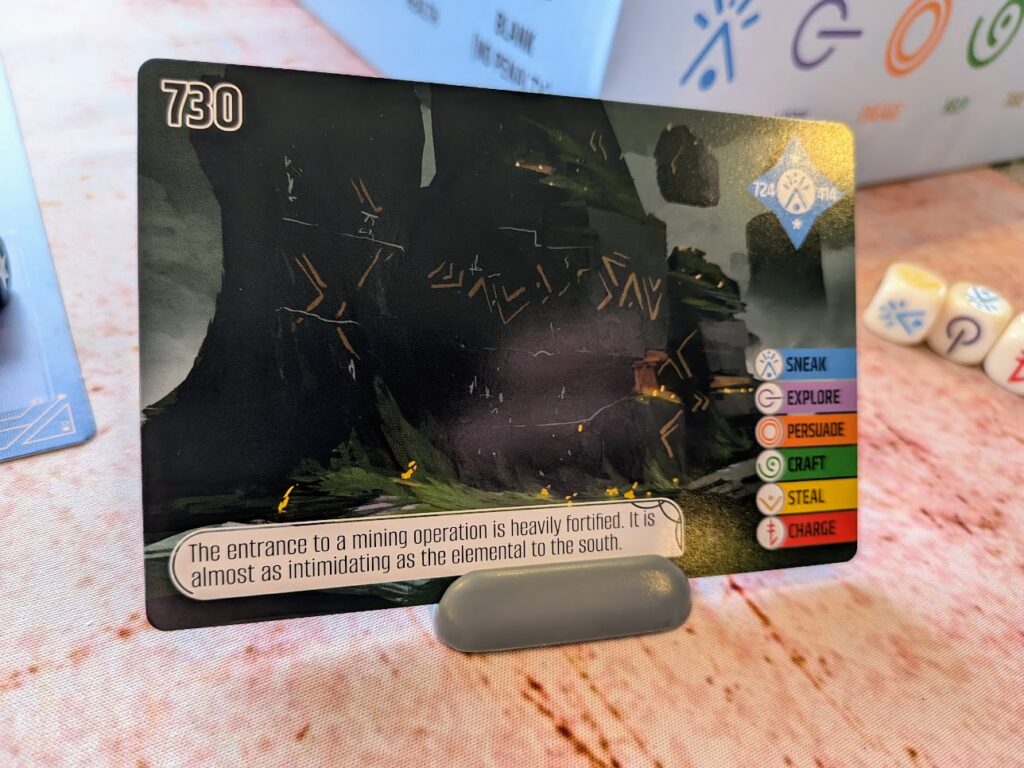
Let me give some context by way of not-too-spoilery examples. In one early location, I saw some creatures being led by another creature. It looked like they’d been captured. I was given the option of jumping in to free them. I’m not going to tell you the outcome of my choice, but remember that this is an alien planet, and not everything is as it seems. Bravado only gets you so far if you’re unaware of context.
In another location, when I looked at the artwork on the card, I could see what looked like enormous creatures off in the distance. I’m given choices at this point. I could move towards them, through successive movements across cards, and see what they are and what they’ve got going on. Maybe they’re friendly giants, lumbering beasts who want their tummies scratched in return for good vibes and giggles. Or maybe they’re reminiscent of some bastardised giant dinosaur from another unnecessary Jurassic Park sequel.
These kinds of decisions are strewn through Vantage like delicious fruity goodness in a slab of raspberry ripple ice cream.
Are you game?
This all sounds well and good, but at this point it sounds more like a tabletop role-playing game (TTRPG) than a board game as such. I’ll come back to this in a bit. What do you actually do in Vantage to make it a game?
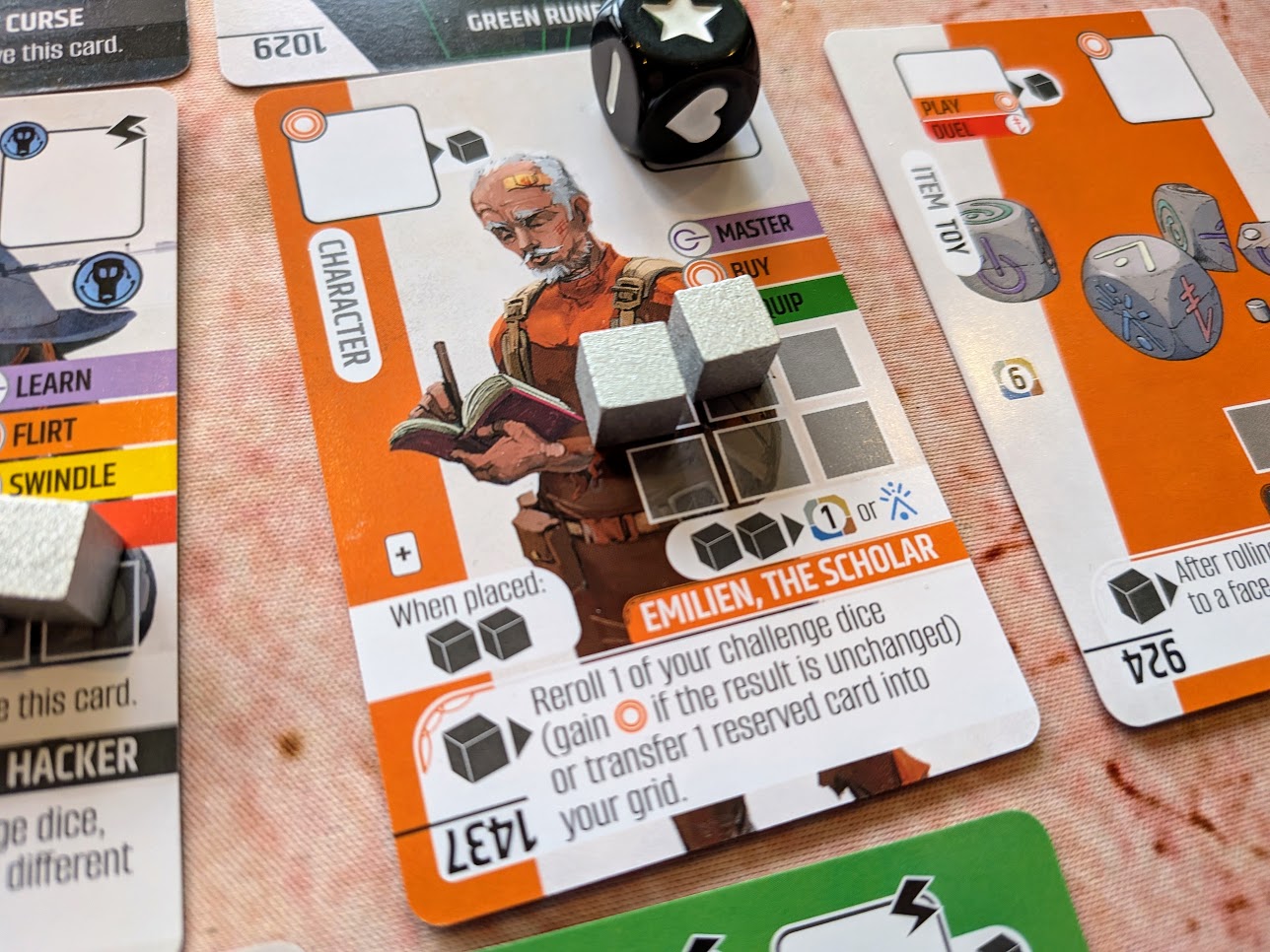
Each player has a character card representing them in the world. Your character card sits in the middle of a 3×3 grid, where the other spaces can be taken by items, companions and other things that you’ll collect during your adventure. Along with these, you’ll collect and spend skill tokens. Every action in the game relates to one of the six different skill types in the game.
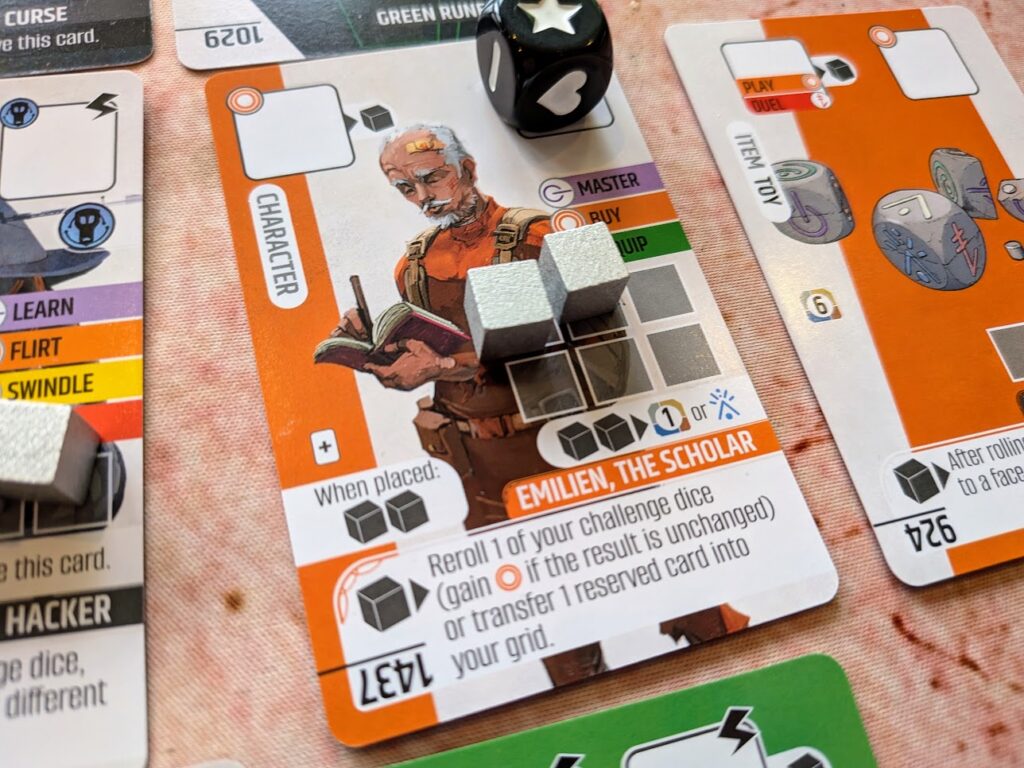
At each location, you’ll have a choice of things to do, in addition to moving to another location. The actions at each location are often context-specific. So, for example, you’ll only get the ‘Offer’ action at a location where there’s a sentient (the game refers to NPCs as sentients) present to offer something to. To take an action you take the game book matching the colour and type of the action, and flip to the numbered paragraph that matches the number on the location card.
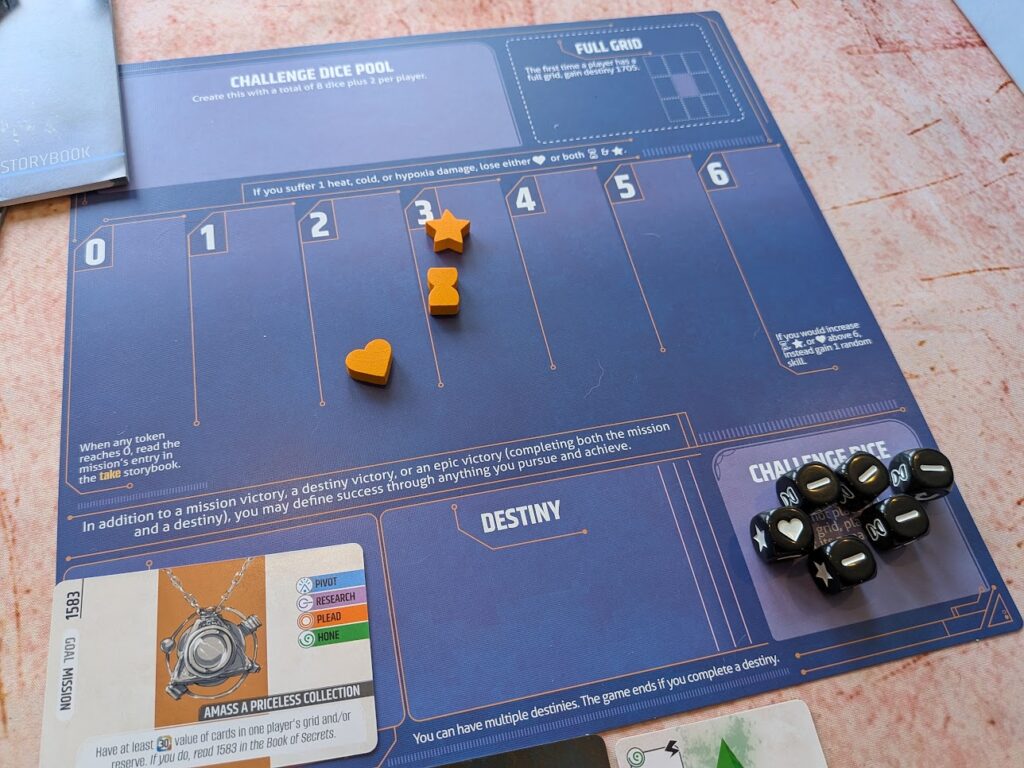
Actions have costs. Each cost is rolling a number of challenge dice, and generally speaking, you want to roll as few of these as possible, as each die has more negative outcomes than positive or neutral ones. You can reduce the number of dice you have to roll by spending matching skill tokens, or by using bonuses from the various cards you acquire on your travels. Many cards have boost costs or rewards, and boosts are a generic cube in the game. You assign your rolled dice to the available slots in your cards. Sometimes that’ll give you boosts, which you can store on that card to use its abilities.
You might get a Tool item card, for example. The tool can hold three boosts, and you can spend two of them on a turn to give you the equivalent of a yellow skill token, thereby making a yellow action cost less expensive. If you run out of valid slots on your cards (some slots have specific requirements), you have to take a penalty hit to one or more of your stats; health, morale and time. i.e. performing this action costs you some time, and maybe you got hurt doing it.
Playing Vantage is very easy once you get into the swing of things. Actions are really easy to resolve, the iconography throughout is superb, and because of this I wouldn’t necessarily worry about introducing a newbie gamer to it. There are very few games that play in an even remotely similar way. And there’s the rub.
When is a game not a game?
The way Vantage has been designed from the ground up sounds intriguing. The idea that the vast sandbox can be explored almost endlessly, never playing the same game twice, is amazing. Especially when you consider that each time you play, it’s not a legacy or campaign affair. Each and every time you crash-land, like some kind of intergalactic Phil Connors, you’ll end up somewhere new doing something new. While there’s no true legacy in the game, you can sometimes learn things about the world and its inhabitants that help you make decisions in future playthroughs.
There’s a weird kind of hollowness that permeates the game too, though, and it’s something I find really hard to put my finger on. It’s not that Vantage is bad. Far from it. I think the execution throughout is superb. The world is vast, but not devoid of soul or substance, like No Man’s Sky was. Every time you play there’s a new goal, new destinies, new things happening. It all sounds really enticing. Each time is a pastiche, a vignette, a day-trip to something alien and mysterious.
At the same time, however, when I finish a game I’m left with a feeling of “Well, that was nice”, and I’m not sure that’s what I want from a game. Especially a game that masquerades as a game of exploration and discovery. I’m not dying to get the game back on the table, or to immediately reset and go again.
I’ve thought about this a lot, and the best analogy I can come up with is a walking simulator PC game. If you’ve played and enjoyed games like Firewatch, What Remains of Edith Finch, Everybody’s Gone to the Rapture, or Gone Home, then you know what I mean. Games which tell stories as you journey through them. Your pulse isn’t set racing; you love discovering what’s there, but it’s not particularly exciting.
The question is – does it matter?
Final thoughts
Vantage is an odd beast. It gives itself a nearly impossible brief: to make an adventure and exploration game that’s engaging and almost infinitely replayable. To Jamey’s credit, it actually does what it sets out to do; I’m just not sure it’s that much fun.
There are some buzzwords that make me cringe inwardly so hard that I feel like one of those pocket anoraks. ‘Cosy’ is one of those words. Just through its overuse. I love a cosy mystery, but for the love of <insert preferred deity here>, it needs to stop, or at least slow down a lot. That said, I think Vantage might actually be the most chill, cosy game I’ve played in a very long time.
There’s no clock, no turn counter pushing you towards an end-state. There’s no immediacy. It’s not like a TTRPG with a GM pushing the narrative. Vantage is entirely self-driven. It’s an impressive box of world-building, but it’s at its best as a vehicle to create your own stories with.
If you’re after a thrill-a-minute sci-fi spectacular, Vantage isn’t it. It’s a ponderous beast that stops to sniff the flowers whenever it feels like it. If, however, you’re after a game you can bust out for a chill time one evening with a glass of something good, or to nurse a hangover with in your kitchen in the glow of a Sunday morning, I think Vantage is superb. One best enjoyed solo, too. The multiplayer doesn’t really add that much for me. Your mileage may vary, but as far as recommendations go, it’s a firm Maybe from me.
Pros & Cons
Pros
- A ridiculously ambitious game which does what it tries to
- Absolutely beautiful artwork and presentation throughout
- Genuinely near-infinite replayability
Cons
- I’m still not sure how much fun I actually had
- This game would seriously drag with six players
THANKS TO MY SUPPORTERS
Krissie  Craig Paul Brendan Brett Gary Becky
Gavin Chris Mark Johan Richard Simon Ben Sam (new!)
Help me keep Punchboard independent by joining the supporters

 Buy me a coffee
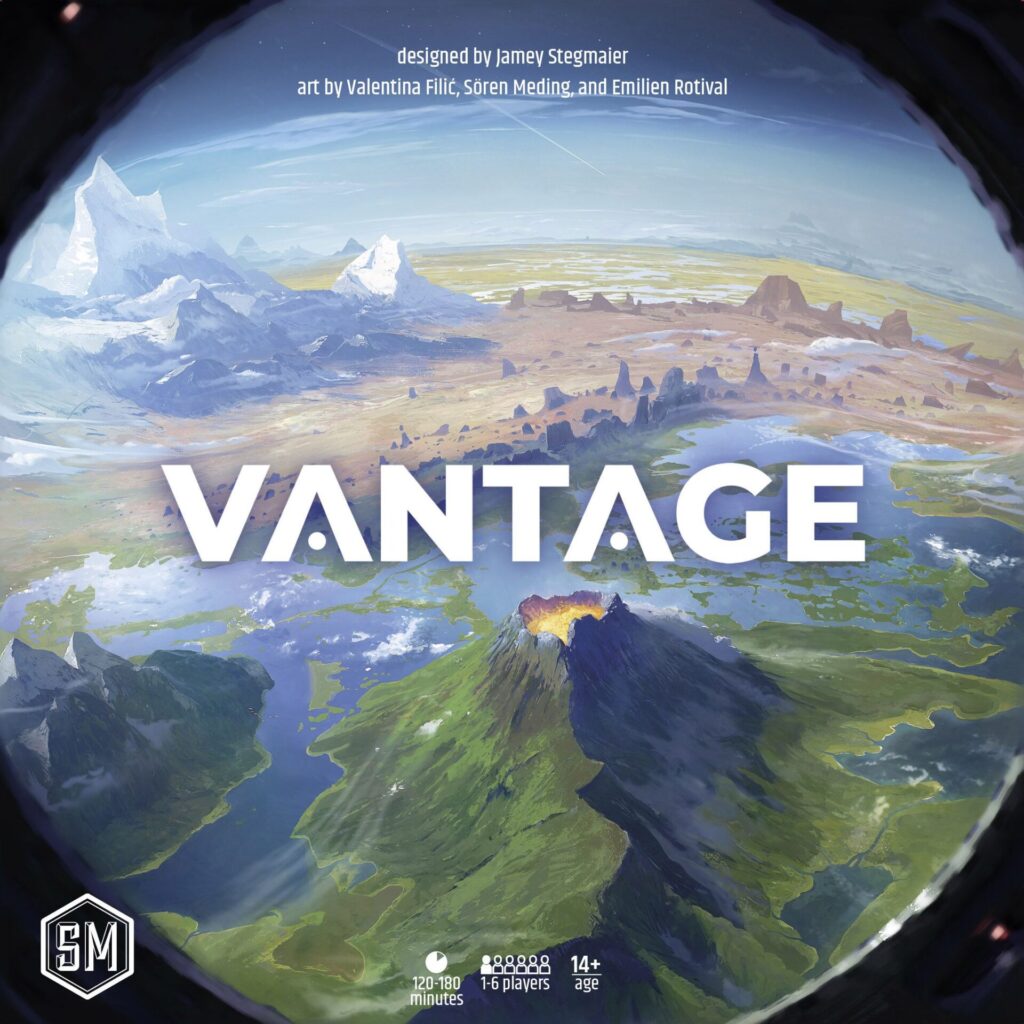
Vantage (2025)
Design: Jamey Stegmaier
Publisher: Stonemaier Games
Art: Valentina Filic, Sören Meding, Emilien Rotival
Players: 1-6
Playing time: 120-180 mins
More games like this one