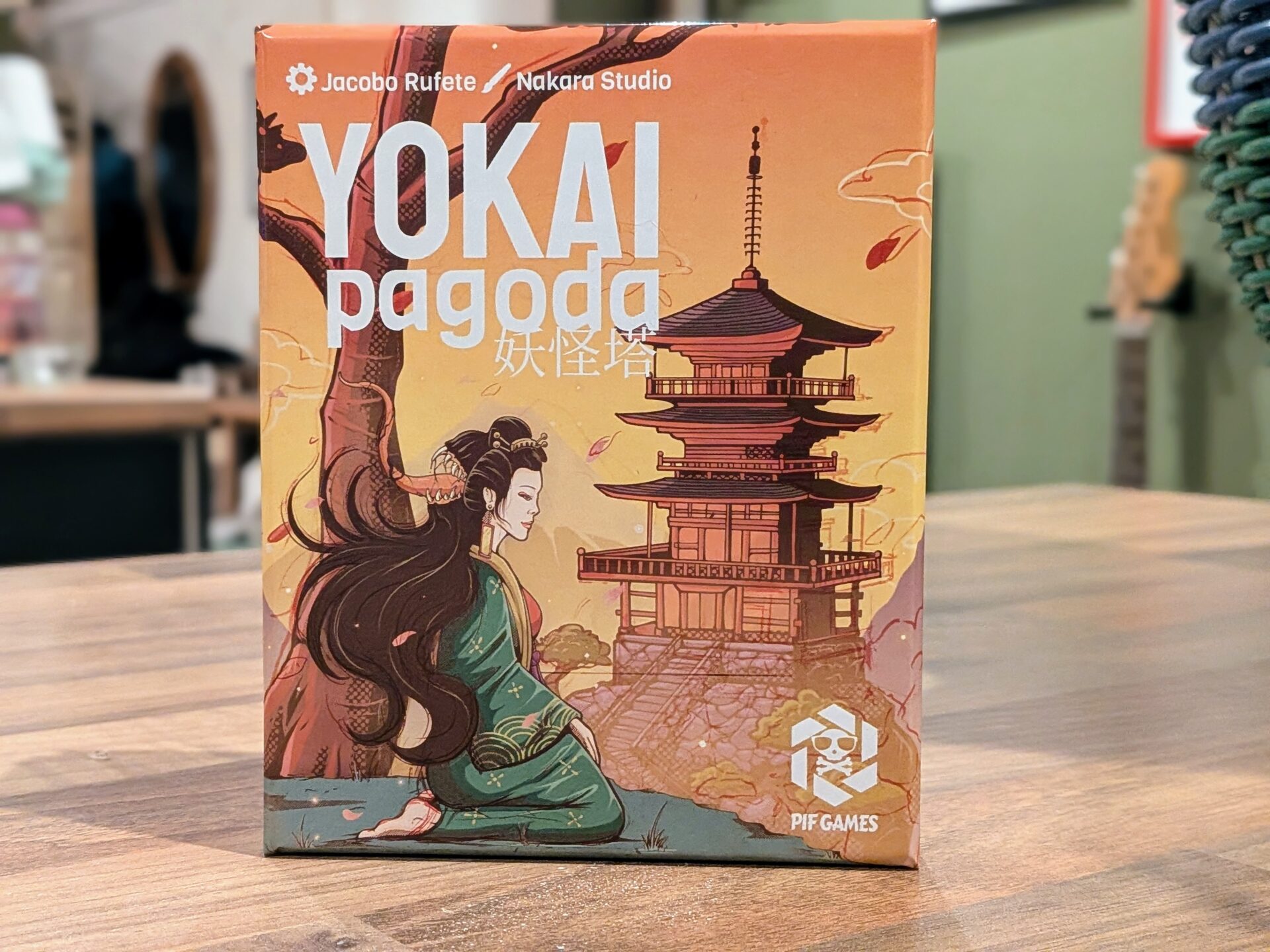

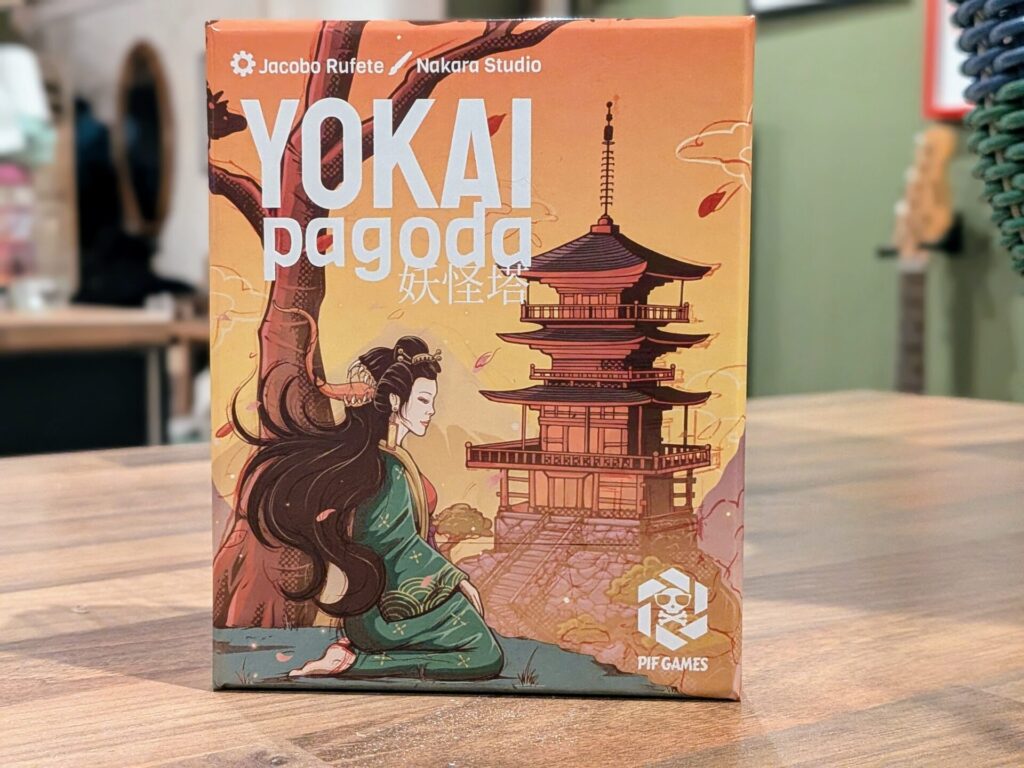
A review copy of Yokai Pagoda was kindly provided by Zatu Trade. Thoughts & opinions are my own.
With so many card games to choose from, a new one has to do something pretty special to stand out from the crowd. While Yokai Pagoda might not blow your socks off with its originality or mechanisms, it’s a really good, highly competitive game which gets tighter and more enjoyable with every play.
VERDICT
players 1-4 | playing time 30-45 mins
Yokai Pagoda hides layers of strategy without getting convoluted. Fast, fierce fun.
shedding
hand management
yokai
Let’s get the story out of the way, because it’s pretty irrelevant. A mysterious pagoda has appeared. You investigate the new pagoda, but – oh no! – you’ve disturbed the yokai (spirits and creatures from Japanese folklore). Now it’s your job to appease the yokai by… playing cards?
Anyway, it’s the game that matters, right? Each player has a hand of cards, and each card is one of the suits of the yokai with a number from one to ten. There’s a discard pile on either side of the draw pile in the middle of the table. On your turn, you play a card from your hand on top of either discard pile.
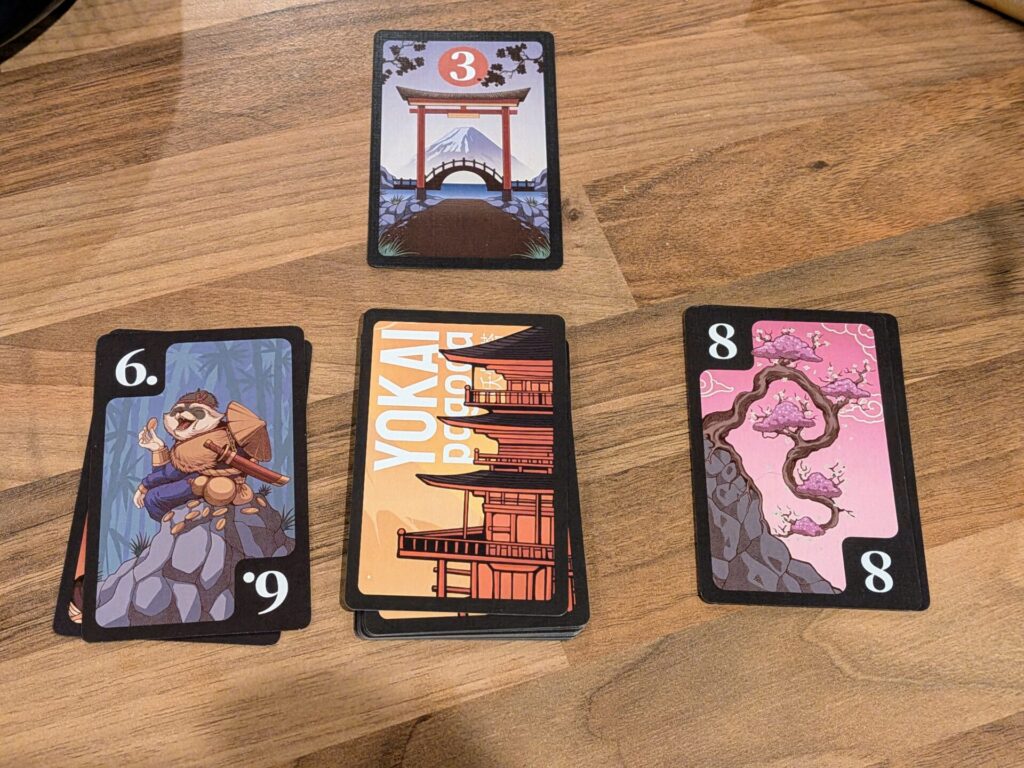
If the value or suit of the card you play matches the card you discarded on top of, you can give one of your cards, unseen, to another player. If the played card’s value is higher, you take a card from the top of the draw pile or from the other discard pile. If the card’s value is lower and your hand’s value is three or lower, you can end the round. More on that in a bit.
After three rounds, the player with the lowest score wins. Scoring, however, is where Yokai Pagoda gets really interesting.
No No Thanks, thanks
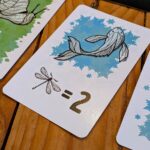
I’m going to assume you’ve already played No Thanks. If you haven’t, what are you doing with your life? Go get a copy, now. It’s great. The scoring in No Thanks is really interesting. If you have an unbroken run of cards, only the lowest value in the run counts. Yokai Pagoda does something similar. If you have multiple cards of the same Yokai type (suit), only the lowest counts towards your score. So when I talked before about your hand’s value being three or lower, that’s what I’m talking about. You might be swimming in Kappa cards – 10, 7, 5, 4, 2 – but only the two counts as your score.
This zany scoring condition is what makes Yokai Pagoda great.
If you play a lower-value card and can show your hand to have a total lower than four, you and all the other players have to put they hand of cards face down on their scoring pile. Everyone knows what you banked there, but you don’t know what the other players put in their pile. The assumption is that it’s a lot of points, but some coy bugger will often be sitting there smugly with a hand full of one suit, and the best part? Nobody except that player knows.
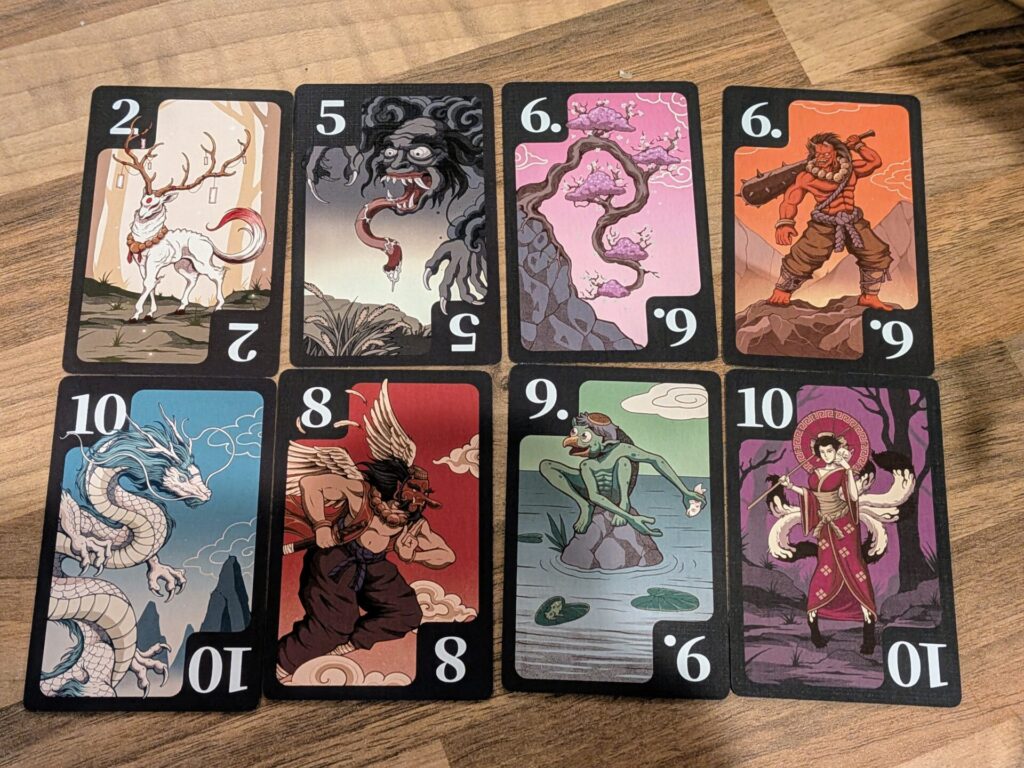
Your score pile grows over the three rounds of the game (four if there’s just two of you playing), after which everyone totals up their combined cards to see who has the lowest score and gets crowned Prince(ss) of the Pagoda.
I cannot stress enough how interesting I find the scoring in this game. Your natural instinct is to go out as soon as you can, but you quickly learn that long-term strategy is a real consideration. You can drive your smugness aura through the roof by appearing to lose every round, only to have squirreled away ten cards of a single suit and end up winning.
Final thoughts
I’ll admit that I went into Yokai Pagoda with tempered expectations. I mean, a Japanese theme added to a game by a Spanish designer? And it’s not even a trick-taker?! Excuse the sound of my scoffing as I polish my authentic Akiba weeb trophy. Take a leaf out of my book and don’t be a snob. Yokai Pagoda is superb.
The game gives you a couple of basic decisions to make at all times, but the spell it conjures in its little ludo cauldron are powerful. You don’t want those high-value cards in your hand, but getting rid of them means picking more cards up. Not too big an issue if the card you pick up doesn’t result in more points, but at the same time you’re making it easier for your opponents to play lower cards now.
Argh!
It works with two players, where it uses an amended set of rules, but Yokai Pagoda is at its best with three or four. Five is possible, but feels chaotic. It’s a terrific, tense, competitive shedding game with just the right amount of take-that interaction. My only complaint is that with such lovely Yokai artwork, it would have been nice to have a bit more information about the various Yokai and their origins.
Want to get this to the table?
Yokai Pagoda
2-5 Players | Ages 8+
Purchasing via this Zatu link supports Punchboard via an affiliate commission at no extra cost to you.
Pros & Cons
Pros
- Very easy to teach and to learn
- Fiercely competitive without being mean
- Really colourful artwork
Cons
- It would have been nice to have information about the yokai
THANKS TO MY SUPPORTERS
Krissie  Craig Paul Brendan Brett Gary Becky
Gavin Chris Mark Johan Richard Simon Ben Sam (new!)
Help me keep Punchboard independent by joining the supporters

 Buy me a coffee

Yokai Pagoda (2023)
Design: Jacobo Rufete
Publisher: PIF Games
Art: Nakara Studio
Players: 2-5
Playing time: 10-15 mins
More games like this one