
A review copy of Symbiosis was kindly provided by Hachette Boardgames UK. Thoughts & opinions are my own.
It’s not every day that the name of a game also describes what the aim of the game is. Symbiosis is, in stark contrast, telling you exactly what you want to achieve in the game. Make as many of your cards as possible work together. It’s a charming, really well-designed card game that packs a lot of fun into a short playtime.
VERDICT
players 2-4 | playing time 10-20 mins
Symbiosis boils tableau-building to its essence and does so with style.
tableau-building
neighbour interaction
beautiful artwork
big cards
Tableau-building is a well-established game mechanism now. It’s all about making the things in front of you all work together, and ideally score off of each other. Symbiosis takes this approach and sets the game in a pond, of all places. There’s no waffly preamble or convoluted story behind it, which I’m grateful for. You just want to make the highest-scoring pond.
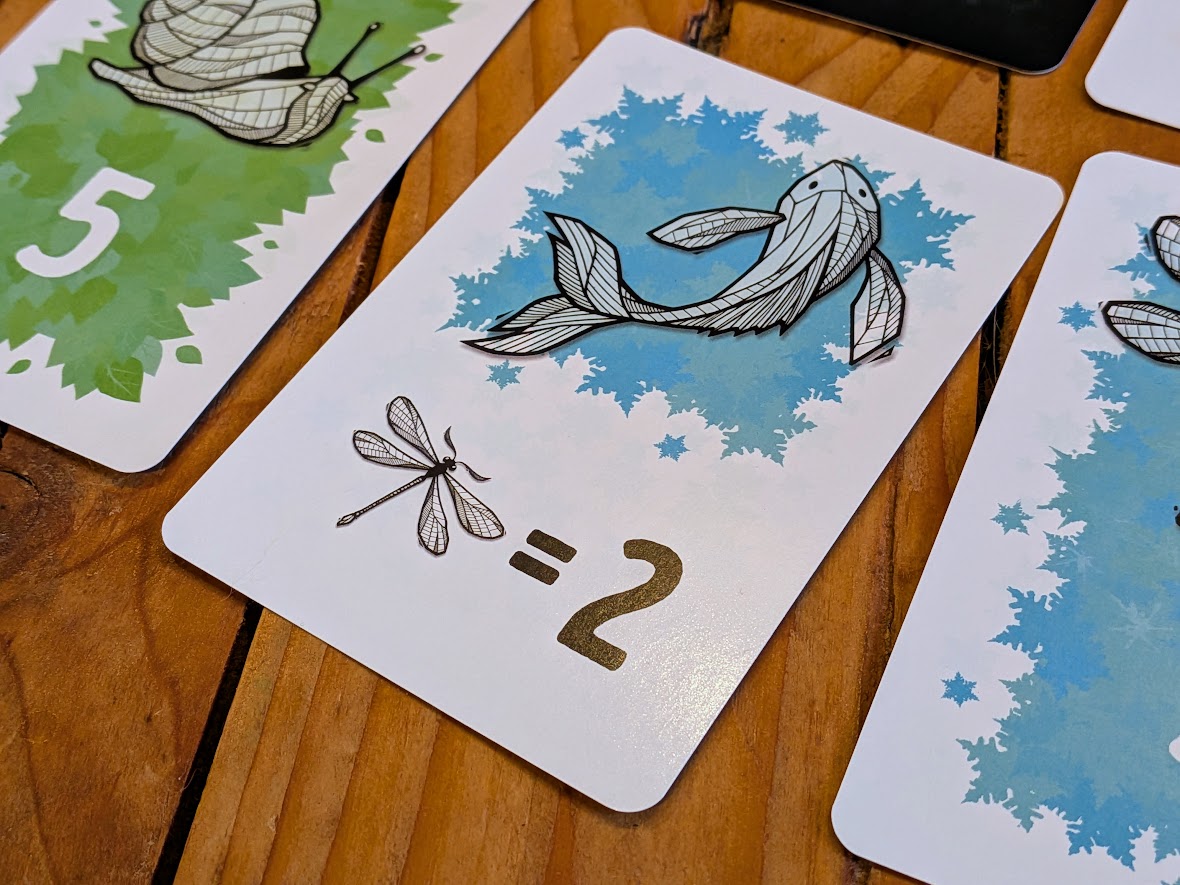
Your pond comprises of eight oversized playing cards with some beautiful artwork on them. I mean, just look at it…
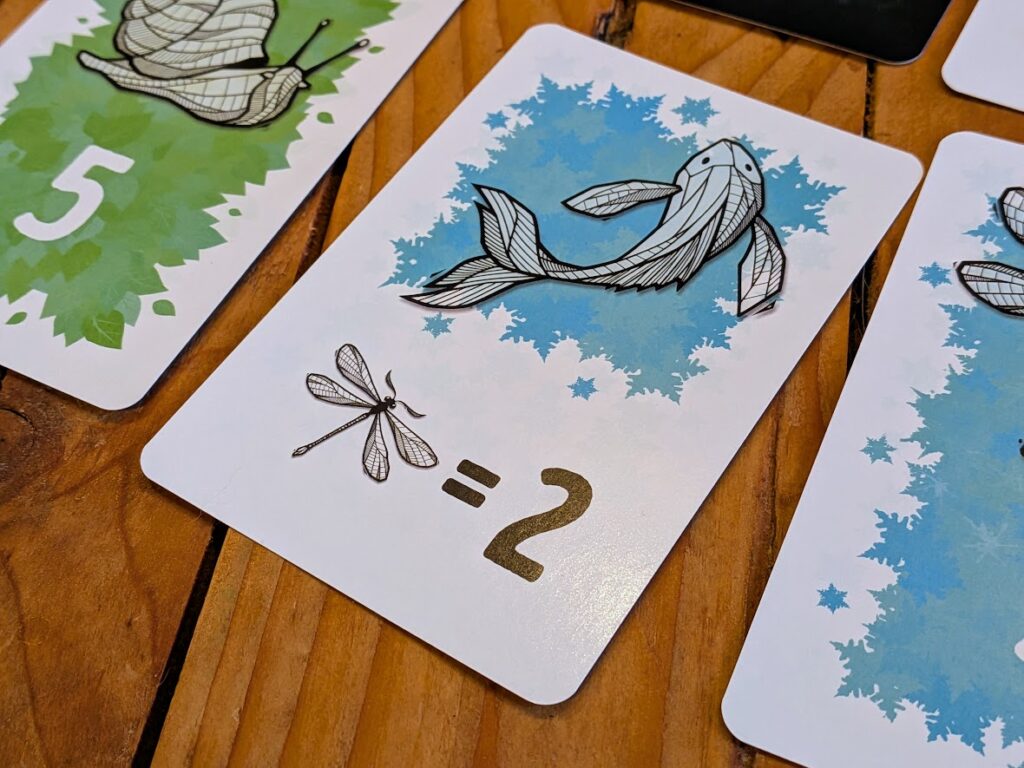
Your cards are laid out in two rows of four cards, and this shape is really important. Each card has a way of scoring on it. Some just have a straightforward number on them. These are easy. However, some score dependent on other cards. For instance, you might have a card which gives you three points for every frog, or two points for every pink card.
Symbiosis’s tricky little extra (because all card games need a special little hook now) is in where those cards are.
Neighbourhood watch
For the four cards in the middle of your tableau, only the cards in your pond count. So if one of the cards in the middle says ‘Score three points for every snail’, and you have three snail cards in your pond, that card scores you nine points. Nice and easy.
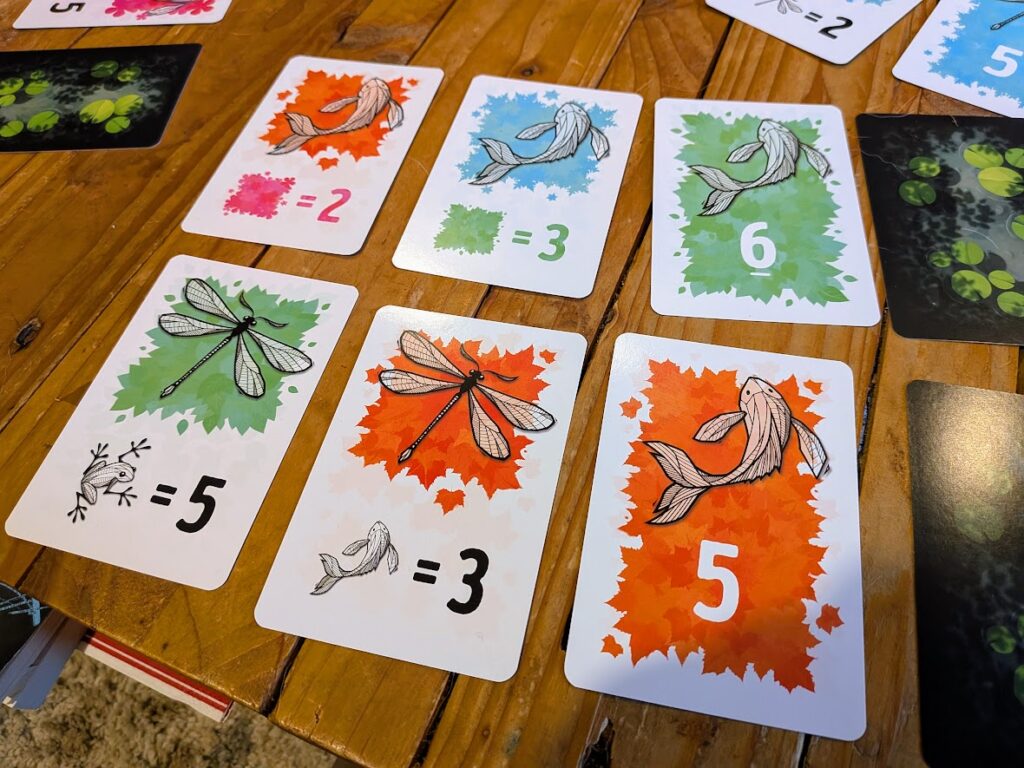
It’s the pairs of cards on either side of your pond where things get interesting.
The cards on the left-hand side of your pond score based on the pond of the player to your left. So if my top-left card has a scoring condition of two points for every orange card, I have to look for orange cards in my neighbour’s pond. If I have a load of orange cards in my own pond, it means nothing. The same is true for the cards and the person to your right.
You might be able to see where this is going.
If you can see that your neighbour is side-eyeing your cards, hoping to score well off your dragonflies, you might want to ditch those cards when you take a card from the market (called The River) on your turn. The problem is, your neighbours are trying to do the same to you.
What you end up with is a game which tends to go one of two ways. There’s the “Damn the torpedoes!” approach of just making sure your cards are scoring as well as you can, not caring what your neighbours are up to. There’s also an argument for just trying to screw the other players over and hoping for the best. Most of the time, you’ll be trying to do a bit of both, and it’s a lot of fun.
Final thoughts
Symbiosis knows what it is and doesn’t try to overreach. It takes the tableau feeling of games like Carnuta (review here) and Faraway (review here) and pares it back down to the wood.
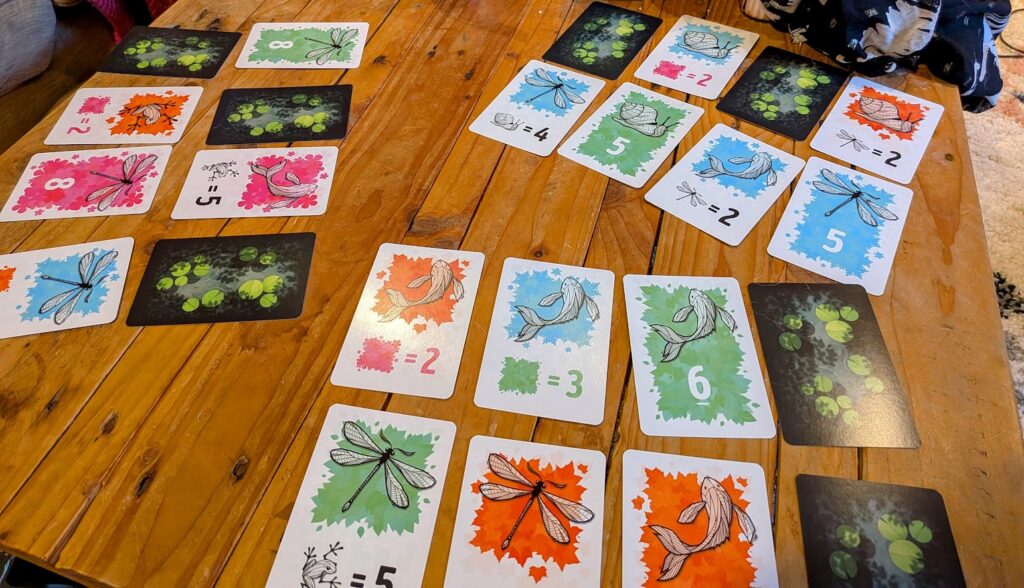
The iconography and graphic design are clean and vibrant, and when combined with the fact that the cards are bigger than normal playing cards, it means that even people with less than eagle-like eyesight can play in comfort.
There’s a two-player mode which fudges the standard setup to make it work, and it’s good, but it’s definitely best with three or four players.
Symbiosis is never going to be the main event of your games night, but it doesn’t try to be. It’s a ten-minute game with a miniature flurry of excitement every time you reveal another card in your pond. It’s short and sweet, and one that’s going in my bag for future cons. It’s a great ice-breaker or filler. For £15 or less, it’s an easy recommendation as an impulse purchase. Try it, you’ll be pleasantly surprised.
THANKS TO MY SUPPORTERS
Krissie  Craig Paul Brendan Brett Gary Becky
Gavin Chris Mark Johan Richard Simon Ben Sam (new!)
Help me keep Punchboard independent by joining the supporters

 Buy me a coffee
Pros & Cons
Pros
- Symbiosis is gorgeous to look at
- Quick and easy tableau-building fun
- Very easy to teach
Cons
- At its best with three or four players
Where to buy Symbiosis
As an affiliate, I may earn a commission from qualifying purchases made through these links, at no extra cost to you. This helps support Punchboard.

UK

US

EU/International
Symbiosis (2025)
Design: Jérémy Partinico, Christelle Partinico
Publisher: Subverti
Art: Baptiste Perez
Players: 2-4
Playing time: 10-20 mins
More games like this one