
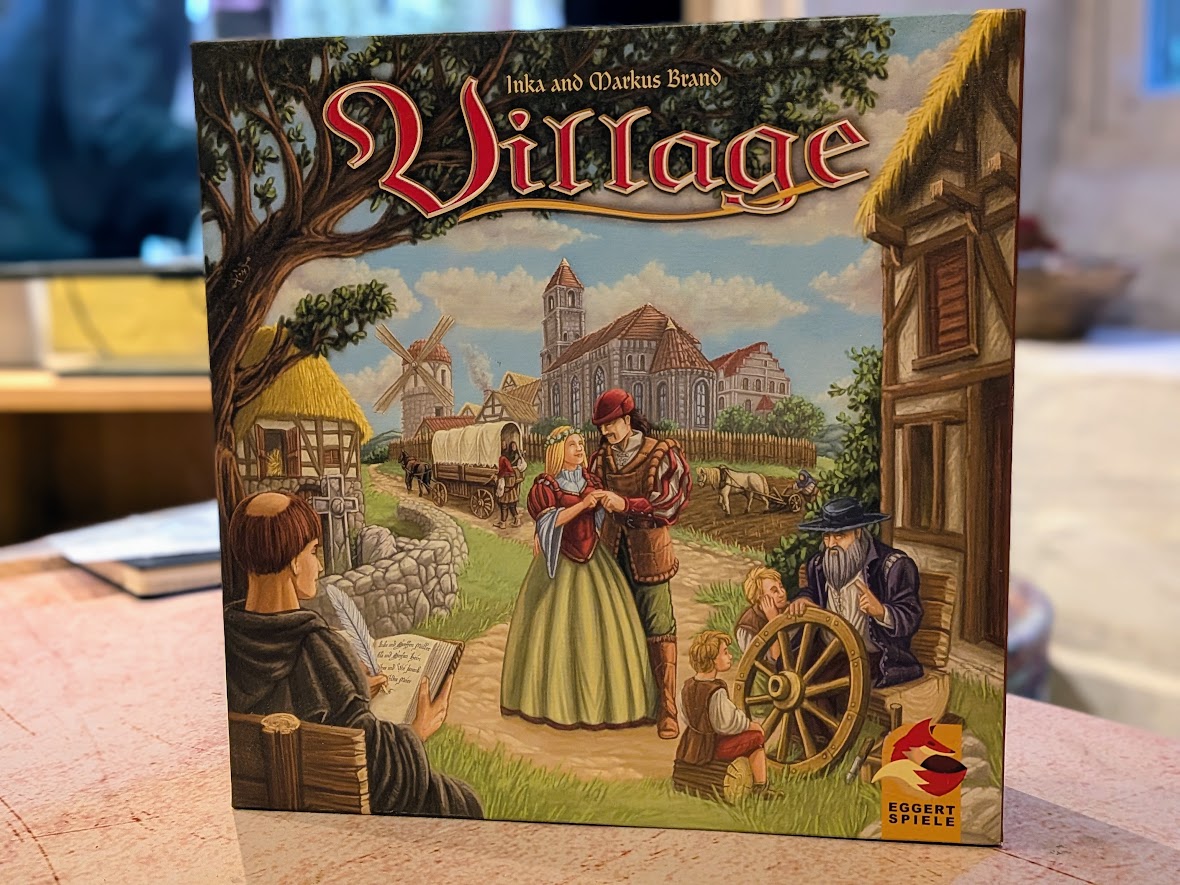

Continuing my push to get everyone playing older games (see all of the Play Something Old games here), today I’m rewinding back to 2011 and Inka & Markus Brand’s brilliant Eurogame, Village. If their names seem familiar and this game doesn’t, it’s probably because you’ve played one of the games they’re more famous for – the Exit series.
As much as I like the Exit games (they’re brilliant escape-room-in-a-box affairs if you’re not familiar), Village holds a special place in my heart, and despite my rose-tinted nostalgia for it, it still warrants playing today.
At the time I bought my copy of Village, I was still quite new to hobby games, and I remember thinking how complex it seemed. Today it’s a different story, but the difficulty grabbed me and Village is undeniably a big influence on me and my current love of heavy Euros.
What do you do in Village?
Village is a game that tries to simulate life in a village, shockingly enough. Actually, more accurately, it simulates lives, plural, in a village. It was the first game I played that had multiple generations of meeples in a game, and actually uses their passing as an in-game mechanism.
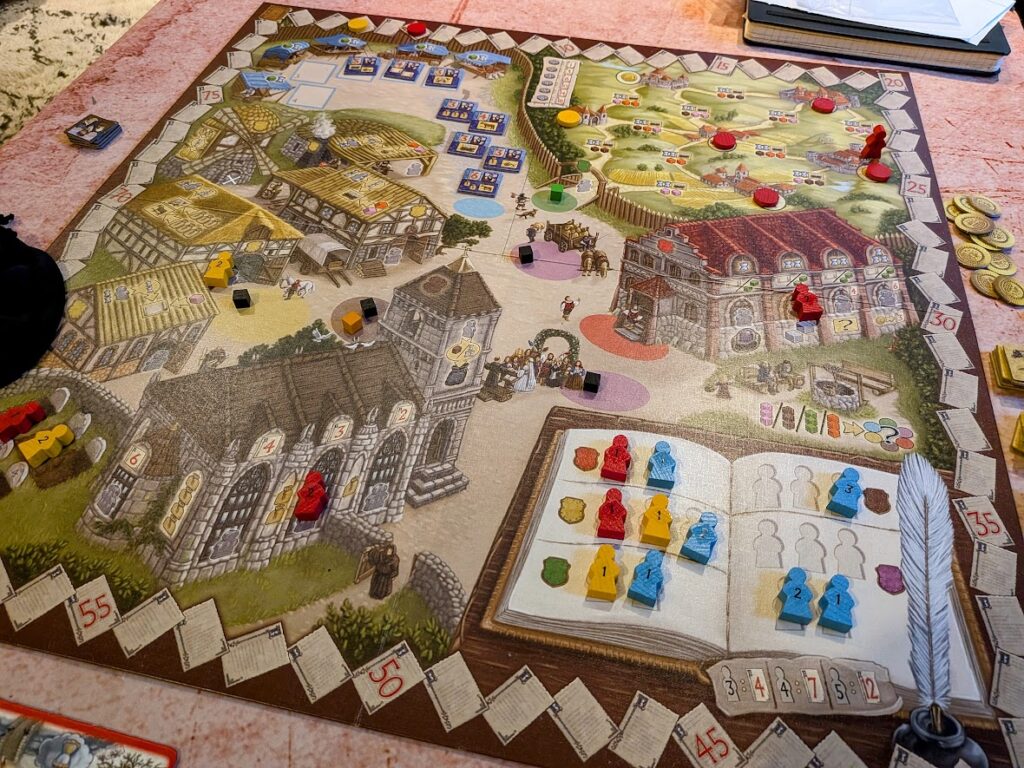
Each turn involves taking an influence cube from an action space on the board (these spaces get seeded with random cubes drawn from a bag), then carrying out the action. You gain resources, craft farm machinery, go out into the world, supply customers at the market, become clergy at the church, and even gain influence in the Council.
What makes the game special is the way it uses time as a resource. Doing things, whether it’s mastering an ox and plough, or seeking your fortune beyond the village games, takes time to do. A time track on your player board moves along, and when it makes a complete revolution, one of your oldest meeples shuffles off this mortal coil and into the village graveyard.
You spend the game carving your legacy on the village, balancing time and success as your intergenerational family toils and trades.
Why should you play Village in 20xx?
Most new Euro games have to try really hard to stand out nowadays. There’s a ton of competition from games with elaborate (if painted-on) historical or sci-fi themes, often with fancy-shmancy gimmicks or components. Village doesn’t do any of this. You have a nondescript village, and the gimmicks stretch as far as having a draw bag for the cubes you populate the board with.
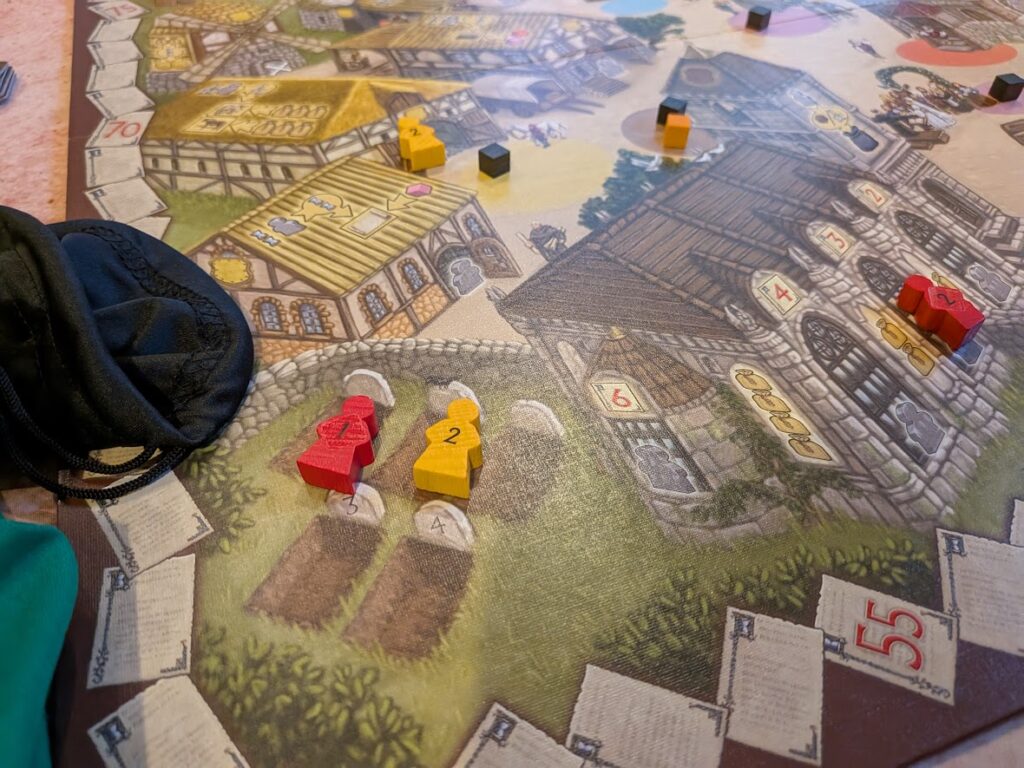
Actually, that’s not all. You also get a TON of small, transparent stickers that have to be stuck to all of the meeples. Front and back. That’s 88 stickers before you get to play. Story time – I’ve actually had to do this twice now. My original copy of Village was destroyed in a flood, so I bought it again and had to do it all over again.
Despite the sticker nonsense, Village is great. The competition for actions and the associated cubes is tight. Despite the two games being in no way alike, Village reminds me of Cooper Island in the way every decision feels like the least worst, rather than the best. It’s funny how time is a weird, almost stressful mechanism to have in a board game. Functionally, it’s no different to any other in-game resource, but it feels more important. This game, Gentes, and Pendulum, among others, make time feel precious.
It’s the life and death cycle which really makes Village stand out, though. There’s no portrait of Dorian Gray, so the reaper is coming for everyone at some point. The family action keeps successive generations in the game, and timing which one pops its clogs and when it all happens is a part of the game, and it’s so rarely done.
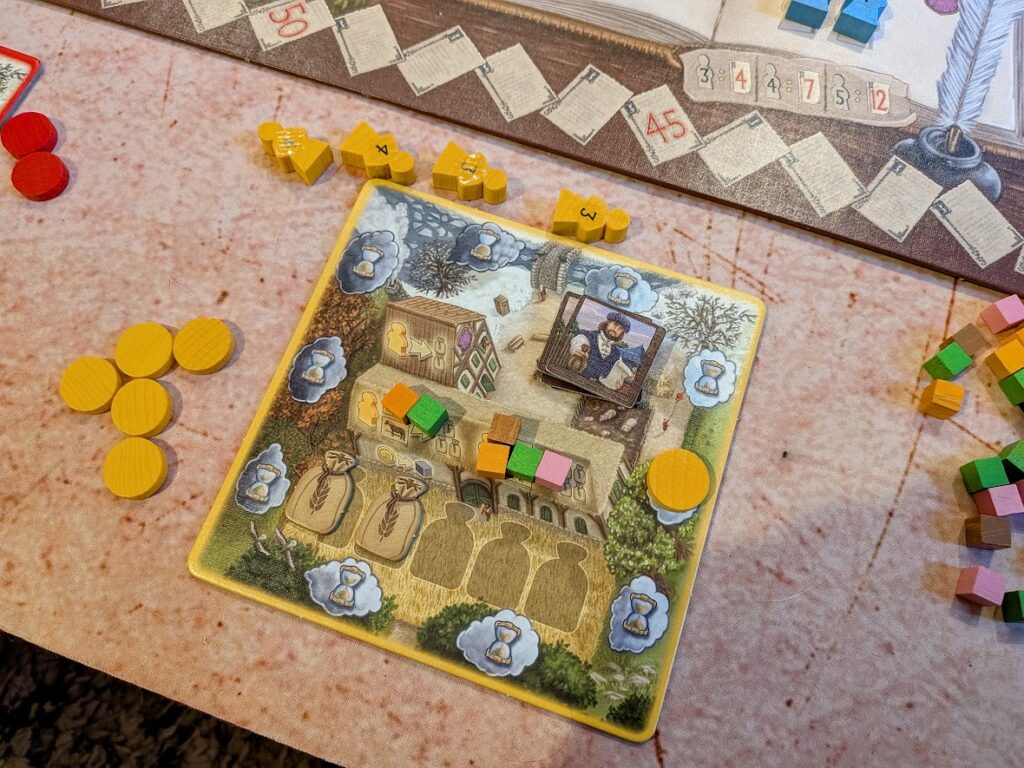
Village is clever, clean, and quick. The design is great and still stands up today, even if it feels a little minimal in terms of what’s available to you. The Brands are so much more than the Exit games. Find a copy of Village and give it a go.
THANKS TO MY SUPPORTERS
Krissie • Craig • Paul • Brendan • Brett • Gary
Becky • Gavin • Chris • Mark • Johan • Richard
Support Punchboard on:
Over to you
❓ Have you played Village?
❓ What do you think about it?
❓ What other games do you know with a life and death cycle?
⬇️ Let me know in the comments below ⬇️

Adam is a board game critic with over 15 years of experience in the hobby. A semi-regular contributor to Tabletop Gaming Magazine and other publications, he specialises in heavyweight Euro games, indie card games and transparency in board game media.