
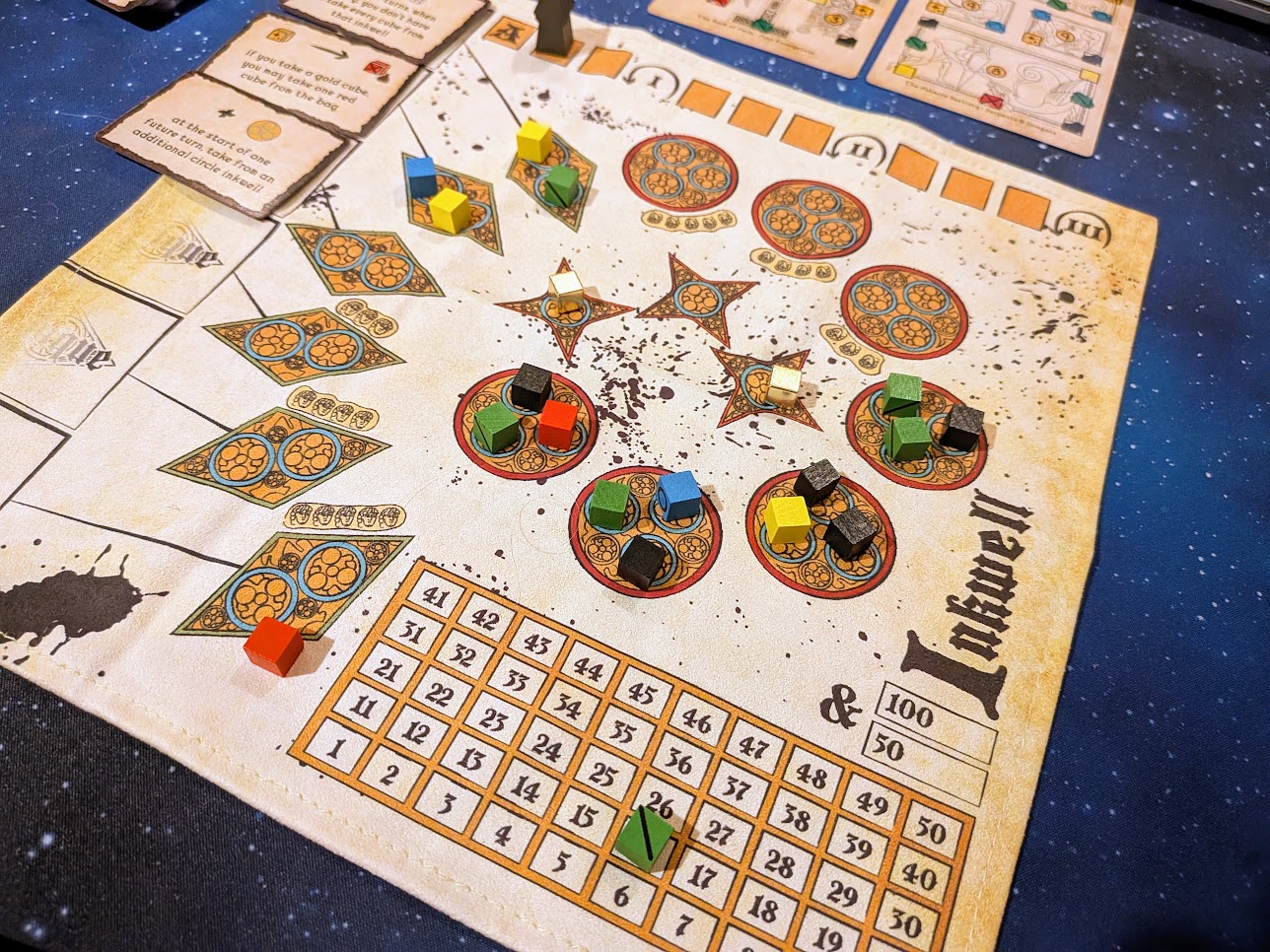

A review copy of Inkwell was kindly provided by Zatu Trade. Thoughts & opinions are my own.
Inkwell is one of those games that makes you want to touch it. The soft closing of the magnetic clasp on the box. The cloth playmat. The satisfying heft of the little golden cubes. It’s a lovely thing. As far as draft and set-collection games go, it’s pretty decent. There’s a lot here to like, but I’m not sure there’s too much to make hardened players keep coming back in the future. Let’s get into the weeds a little.
VERDICT
players 1-5 | playing time 30-45 mins
Inkwell is a beautiful, quick, but relatively lightweight drafting and set-collecting game in a neat little box
set-collection
drafting
player powers
beautiful
Inkwell’s concept is really nice. You’re a master Illuminator working on illustrations in medieval manuscripts. You want to impress the Abbot by completing the most pictures on the most pages.
In practice, this means drafting cubes which represent ink from the various spots (inkwells) on the game board. Or, as it is in Inkwell, a game cloth. Each player has a big card with beautiful real-world illustrations on its back, and on each card there are different coloured spaces to place those very same cubes.
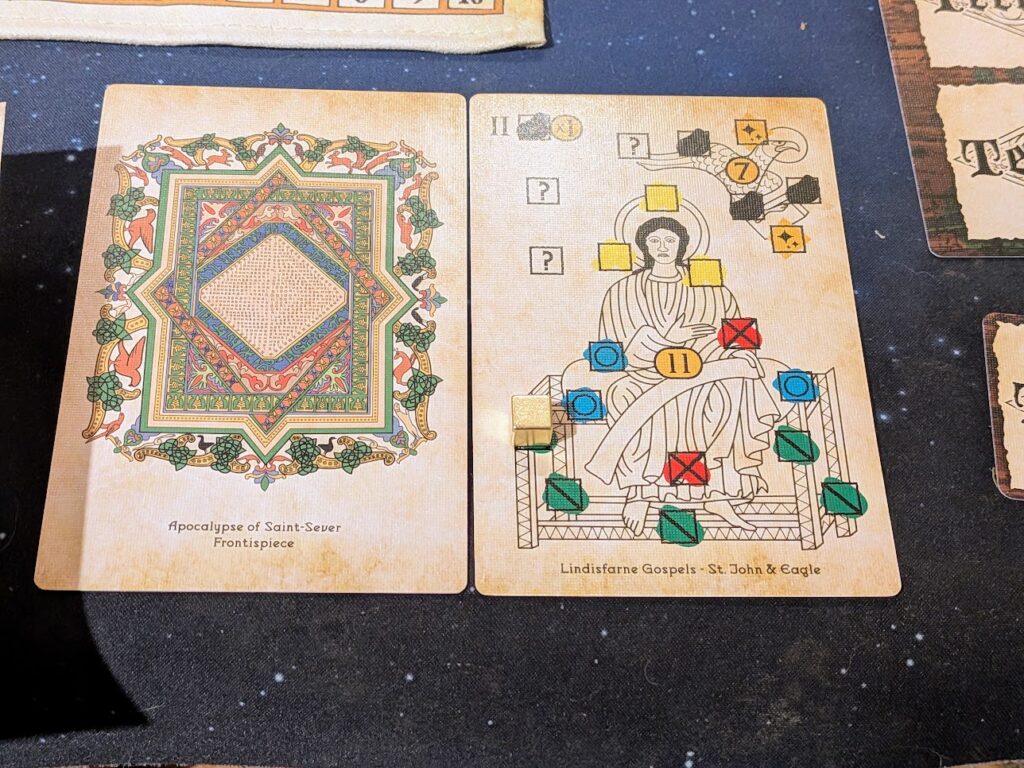
If you complete individual illustrations on each page, by filling all of the available spaces with ink cubes, it’s worth a bunch of points when you complete – or, in the game’s parlance, turn – the page. When you’ve turned three pages in total, the game ends and you check the score track to see who won. Easy.
And I think it’s probably because this core part of the game is so easy that maybe it doesn’t quite shine for me in the same way as the little golden cubes in the game do. That’s not to say that the game is bad, because it isn’t.
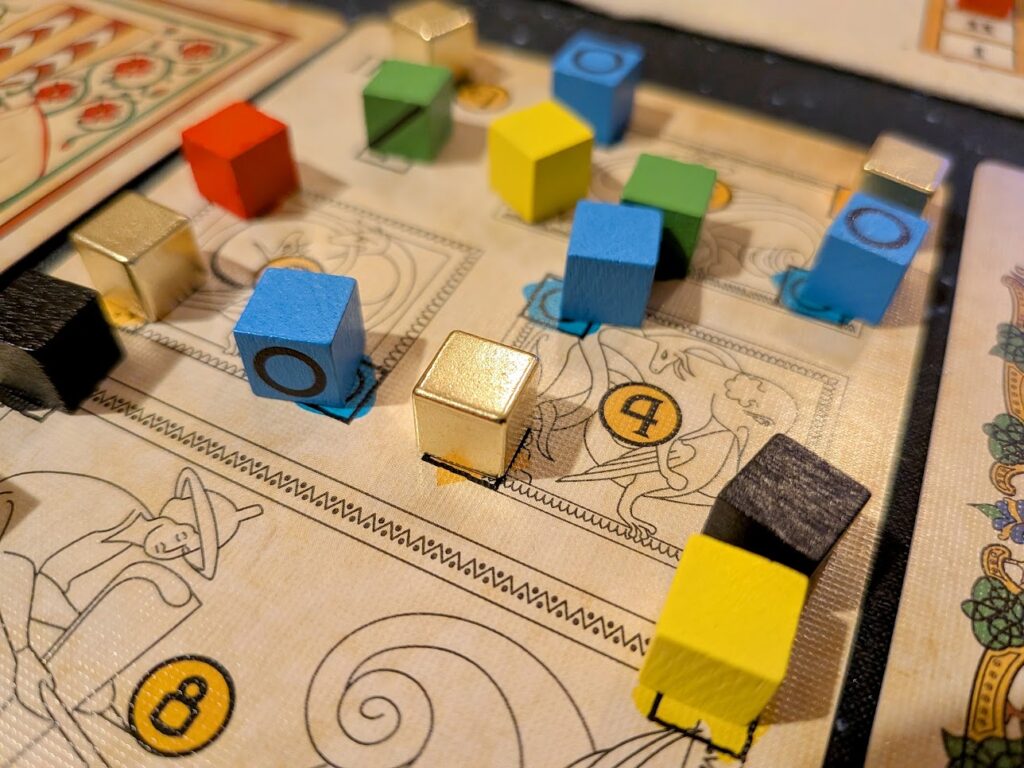
Have you ever played a game where it starts you off on something like an introductory mode? Maybe some of the full-game features aren’t in play. Maybe you have identical characters instead of asymmetric ones. Either way, it feels like the ‘lite’ version of hte game. That’s what Inkwell reminds me of.
Don’t Sweat The Technique
Don’t get me wrong. There is stuff in Inkwell to add a bit of pizazz to proceedings. If you draft cubes from the diamond shapes, you only get two to place, but you also get to take the connected Technique card. Technique cards give you either continuous abilities, like always taking an extra red cube from the bag whenever you take a gold cube, or more powerful one-off abilities, like taking all the cubes from a circular pot on your turn in addition to your normal choice.
These cards are great, and offer up some pretty sweet combo potential. The wording on the cards seems to have been written very unambiguously to make sure you can make the most of them. Whenever it mentions ‘taking’ a cube, for example, it doesn’t matter what’s causing you to take a cube; it’s just the act of taking which triggers the bonus. This is great. It makes for a game which is much easier to teach and much friendlier for newbies or people who don’t play many games.
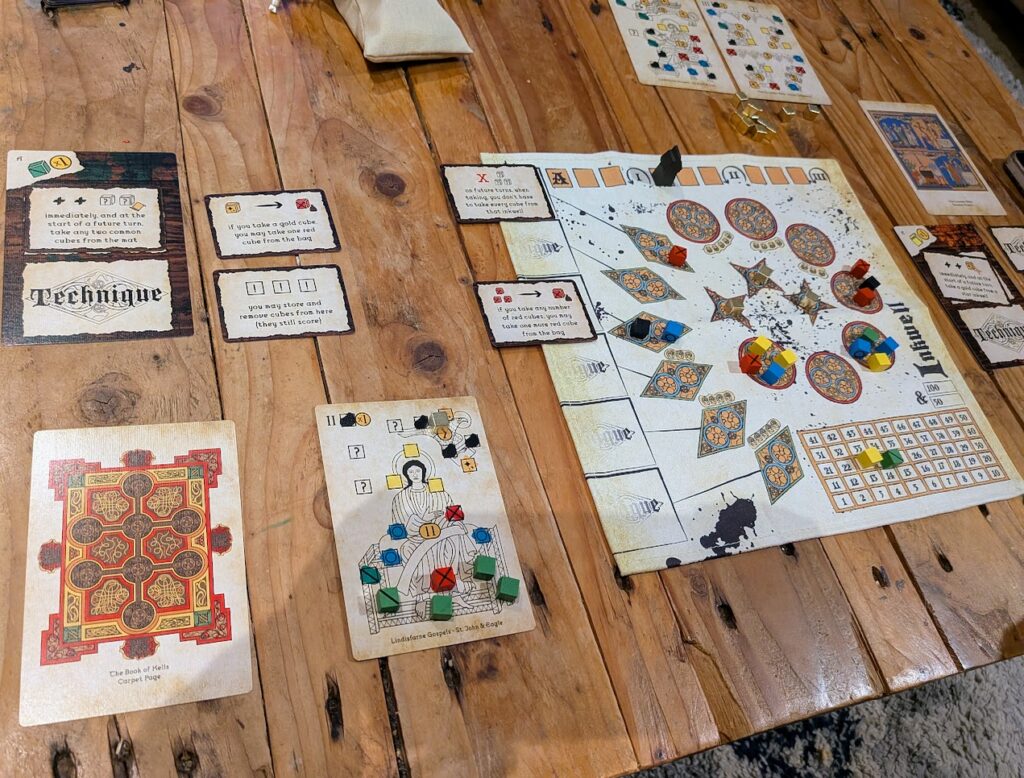
There are other considerations baked into the game which force you to think about what you’re doing. For instance, in a four-player game, there might be six technique cards on offer, but you only have space for two for each round (page) of the game. If you can’t take the technique card because you don’t have space for it, you can’t take the cubes from that inkwell either.
The same goes for the bigger inkwells. If you can’t place all the cubes, you can’t take them. It’s not even like Azul, for example, where you can take the extra but it ends up counting as negative points at the end. Once again, there are technique cards that can help with that. There’s another nice feature whereby when you turn a page, your technique cards slide off of their slots on your board, but they remain active. If you plan well and the right cards enter the game, you can trigger some really juicy combos in the late game.
All for nought?
In theory this all sounds great. Combo up your abilities, get things pinging off one another, and wipe the floor with your opponents. But the way the game is setup means that that sort of thing never really happens.
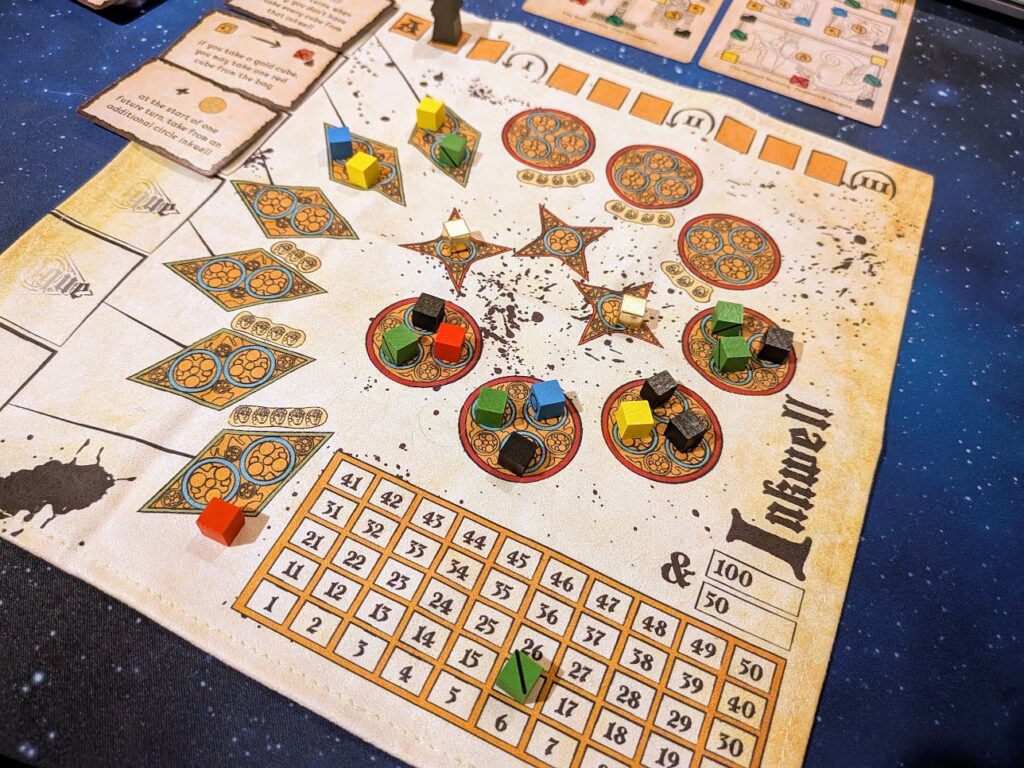
Let’s take scoring, for example. Each card tells you clearly how many points you’ll score from each of the illustrations on it. You also have a multiplier space which gives you points for each cube you have matching that colour, as well as any gold cubes which are wild. Other than those points though, the only other way to really score anything is from the player card you have.
To their credit, DVC have added a basic and asymmetric side to these cards. The basic side just scores the player 1 VP for each cube they have that matches the colour on the player card. Given that you only score points for the illustrations you complete, there’s no real impetus to collect your own colour in particular, so that feels a little weak.
The asymmetric sides feel a little more interesting, but some feel way more useful than others. Take these two for example:
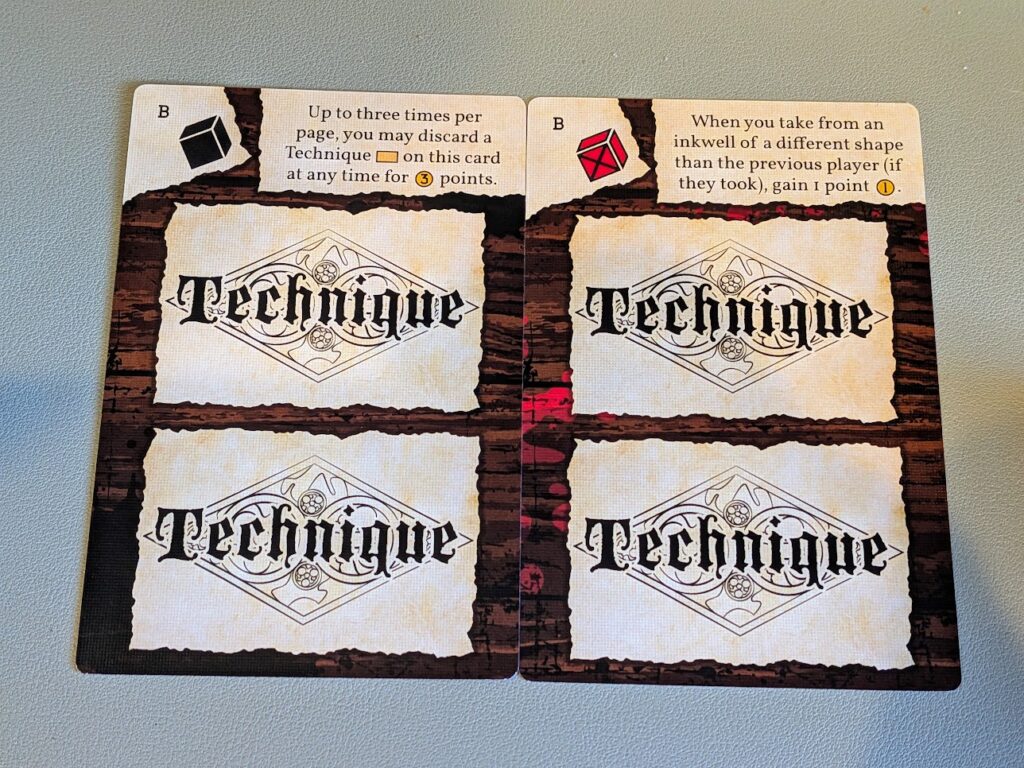
The card on the left lets you discard technique cards up to three times per page, nine times in total, for 3 VPs at a time. To make the most of the card on the right, you need to be taking a different number of cubes than the player to your right to earn 1VP each time. The card on the left you can realistically use as much as you want; there are no constraints. The card on the right is dependent on what you need on your card, what’s available on the table, and what your opponents are taking. It’s far harder to utilise strategically.
The point I’m trying to make is that even when you build a really clever machine in Inkwell, there are only so many points it can manufacture for you.
Maybe this is just me being unfair on the game, though. Inkwell is clearly aimed at a similar space in the market as games like Azul. Each time I’ve played Inkwell, I’ve had a moment where I’ve thought “Oh, this reminds me of xxxxx”, which is a compliment rather than me passing judgement on it.
Final thoughts
Inkwell, to me, is like vanilla ice cream. Well, it’s like vanilla ice cream before I became extremely lactose intolerant. Happier times. If you were given a nice bowl of vanilla ice cream, you’d eat it and enjoy it. You might not turn to the person next to you at the table, eyes wide, ice cream dribbling down your face, going “Oh my god, you have to try this!”, but you wouldn’t screw your face up earlier.
Inkwell is a nice time. It doesn’t really do much different to any other drafting and set-collecting games I’ve played, and Azul in its various guises is the obvious comparator. I really appreciate the small footprint, the beautiful production values, and the fact that it’s so breezy. Some of the pictures above were from my coffee table when my wife and I played a game in about half an hour. Games like that are great to have in your collection.
I think Inkwell would be a superb game to have at a board game cafe, or to have on hand for newbies at your local game club. I could see it played on caravan holidays, or at a beer garden table. It didn’t set my pulse racing, nor did I immediately want to get rid of it. Fans of games like Azul will lap it up, but if you’re looking for something a little meatier, you might be left wanting.
Pros & Cons
Pros
- A beautifully made small box game
- The drafting and set collection is really easy to learn
- Small footprint and quick playtime are a godsend
Cons
- There’s not too much in the way of depth
- Some of the asymmetric powers feel unbalanced
THANKS TO MY SUPPORTERS
Krissie  Craig Paul Brendan Brett Gary Becky
Gavin Chris Mark Johan Richard Simon Ben Sam (new!)
Help me keep Punchboard independent by joining the supporters

 Buy me a coffee
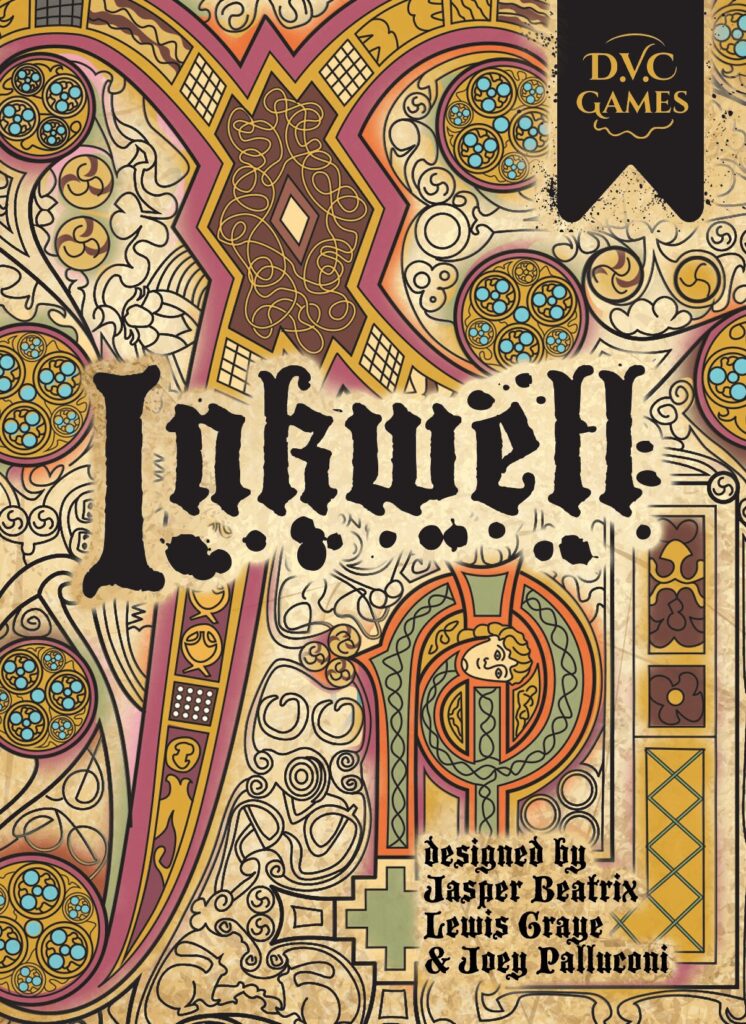
Inkwell (2026)
Design: Jasper Beatrix, Lewis Graye, Joey Palluconi
Publisher: DVC Games
Art: Zulfan Al-Akhyar, Jono Naito-Tetro
Players: 1-5
Playing time: 30-45 mins
More games like this one