

A review copy of Terraria was kindly provided by Paper Fort Games. Thoughts & opinions are my own.
Reviewing Terraria: The Board Game is a big undertaking. It’s a huge game based on a video game franchise with a big, hardcore following. So, for this review, I’ve added two separate sets of final thoughts. One for Terraria video game fans, and another for board gamers who don’t know the game. For reference, I have quite a lot of experience with the video game, so I stand with a foot in each bucket.
Terraria is a game which thrusts you into the role of an adventurer, dropped into a world with more going on beneath your feet than above. You can fight the creatures of the world, craft buildings, weapons, armour and items with the raw materials you find, and venture deep, deep underground in search of the world’s nastiest and most valuable things. As the game progresses, you uncover and discover more of the world’s different biomes, building places for the game’s NPC (non-player character) inhabitants to move into, each offering more things for you to buy and use.
A night on the tiles
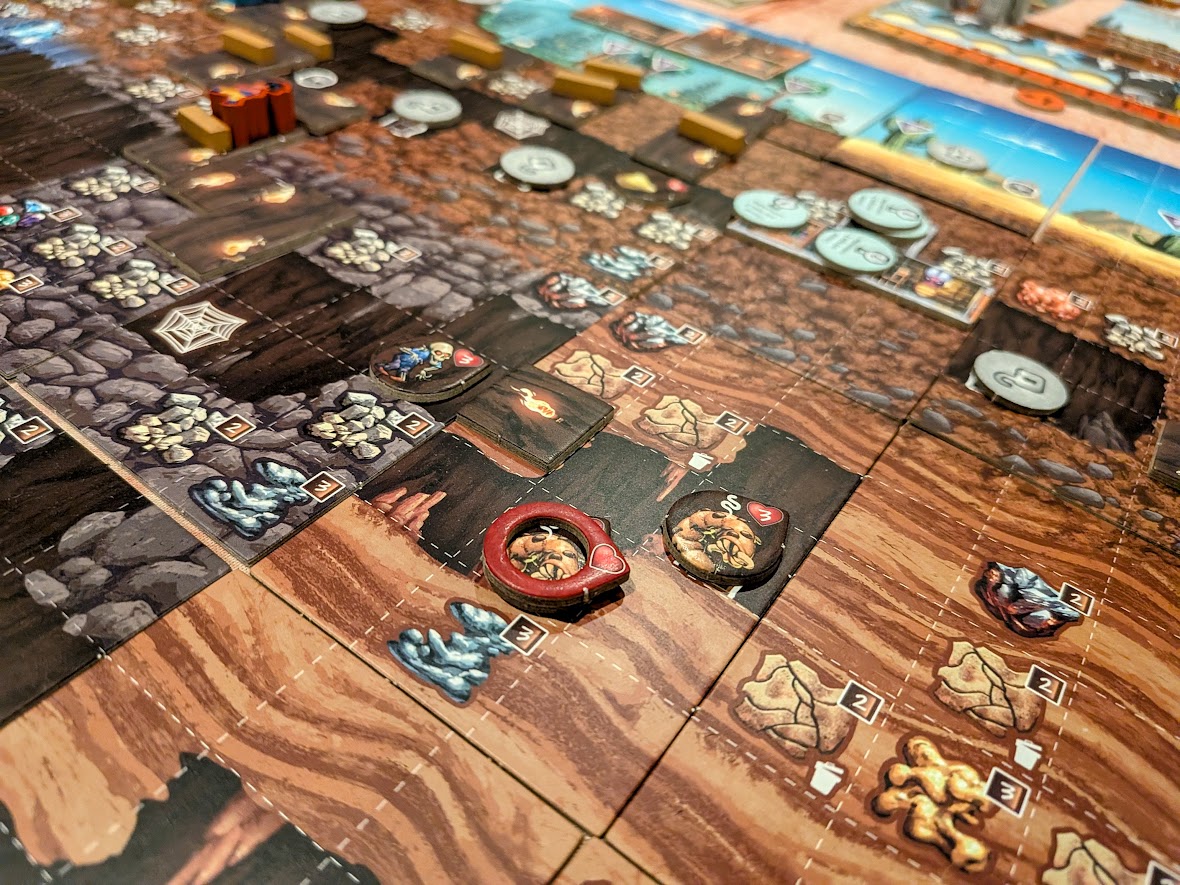
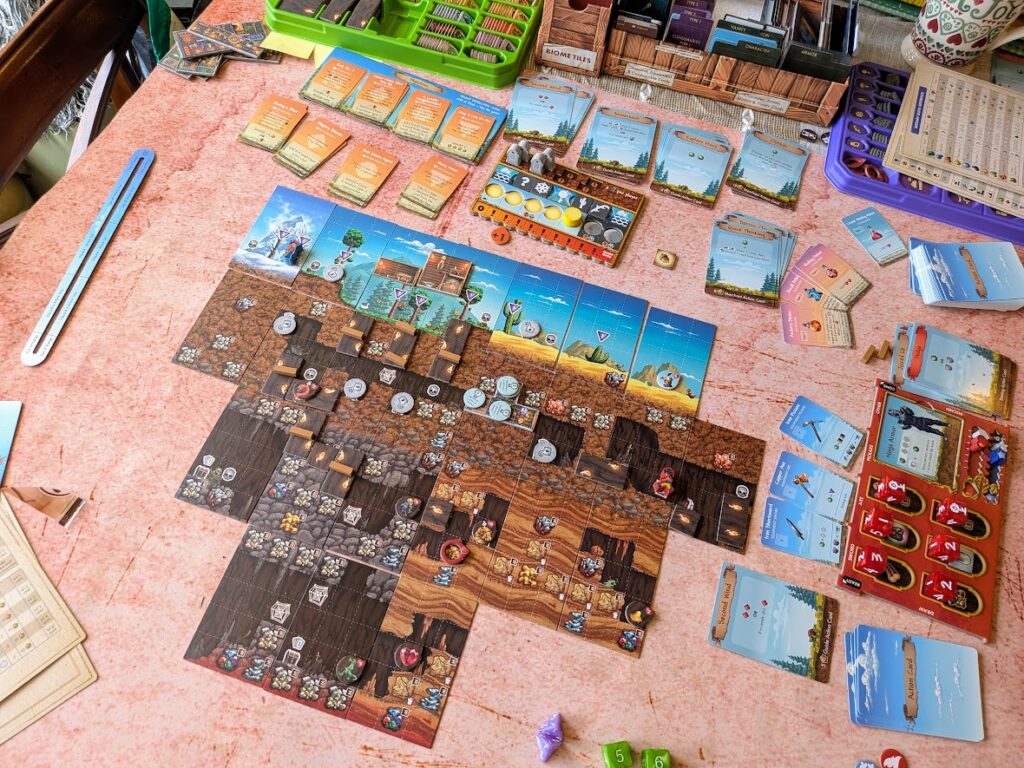
Terraria: The Board Game has tiles. A lot of tiles. The world you explore is made up of tiles that are drawn from a box as you reach the edges. The tunnels you dig (and there will be a lot of them!) are tiles that you put on top of those tiles. The buildings you build for NPCs to move into are tiles. The resources you collect and track on your player boards are represented by adding tiles to your board.
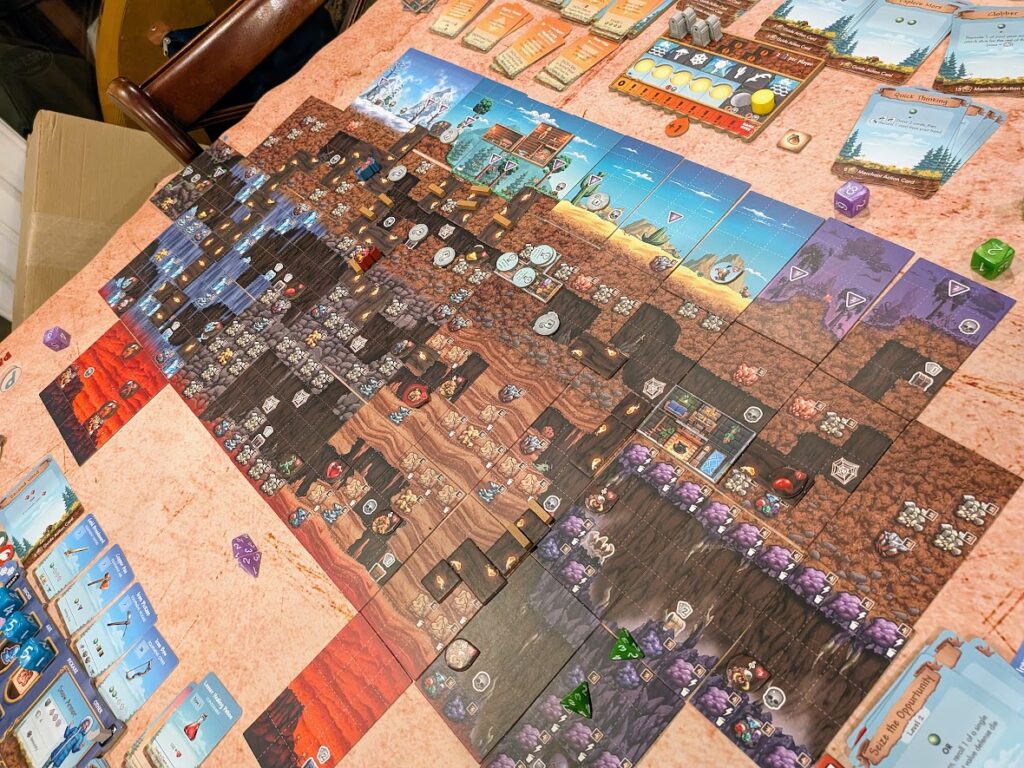
It means that the board, as such, is created as you play. The game starts in the friendly forest biome with a handful of tiles taking up as much space as a page of A4 paper, but by the end of it your table will be absolutely swamped. Each of the five biomes is three tiles wide and five deep, meaning a fully explored world is 15 tiles wide by five deep. 75 tiles! Even before you add the edge-of-the-world ocean tiles.
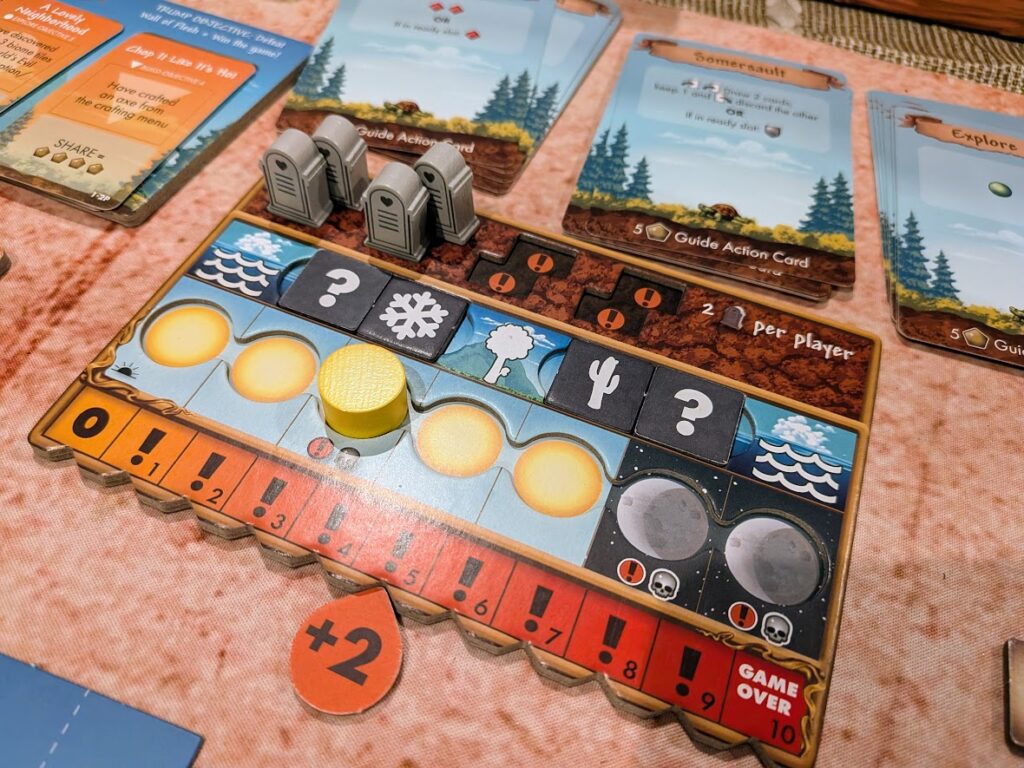
The game is split into phases. At the start of each turn the daylight tracker moves along and may ask you to increase the looming threat level (if it tops out you lose the game!) and spawn monsters into the world. Then the players get to do stuff.
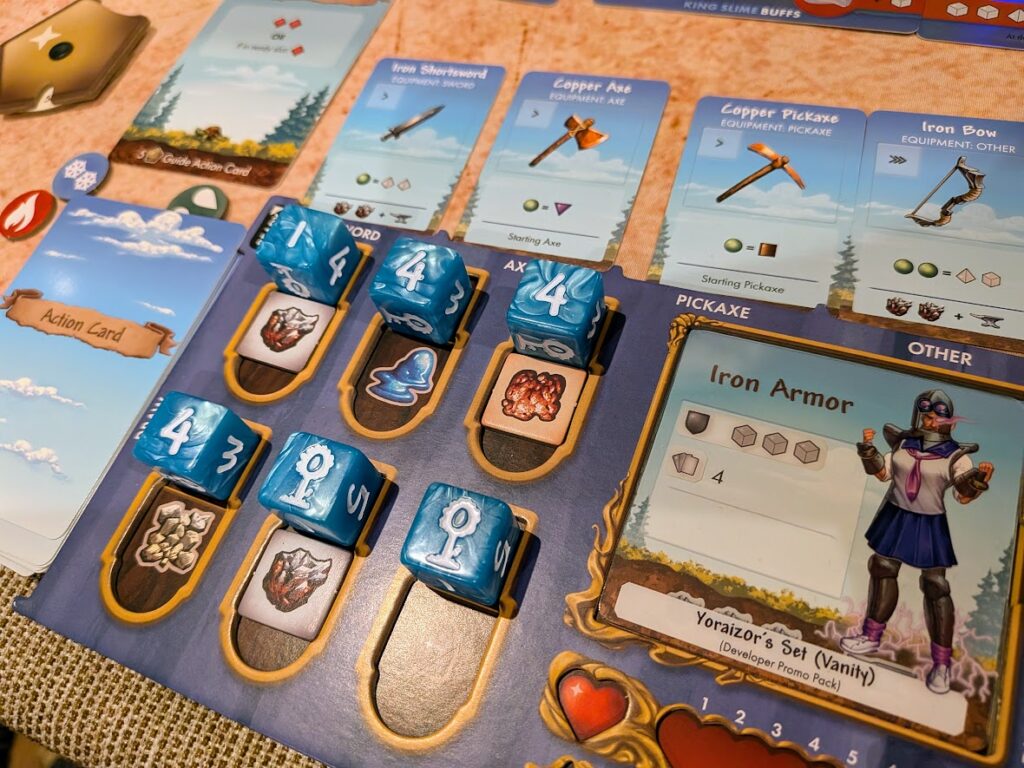
The main mechanism in the game is deck-building, because who doesn’t love a deck-builder hybrid now that The Lost Ruins of Arnak and Dune Imperium (read my review here) are doing so well. Each card in-hand will give you action points to spend on moving, digging, and fighting. Some will give you more points towards each attack, or some help with defending against enemy attacks. Unusually for a game of this type, the players’ turns are carried out simultaneously, and they need to be.
Some cards let other players draw more cards into their hand, so if you try to take turns in sequence you can plan your whole turn out based on the cards you’re holding, only for someone else to later say “Oh look, you can draw another card”, leading to someone wanting to try to undo their entire turn. It’s a nice idea to do things this way, because it reinforces the importance of table talk and working as a team, but it also means that if you try to play this with four players, those turns can take quite some time.
Time to play
While we’re on the subject of time, let’s get into that a bit more, because it’s one of the most important aspects of trying to play Terraria: The Board Game. The BGG entry says 120-180 minutes, and the box says 45 minutes per player. We all know that play times written on boxes are underestimated, but in this case, the idea of 45 minutes per player is straight-up fantasy.
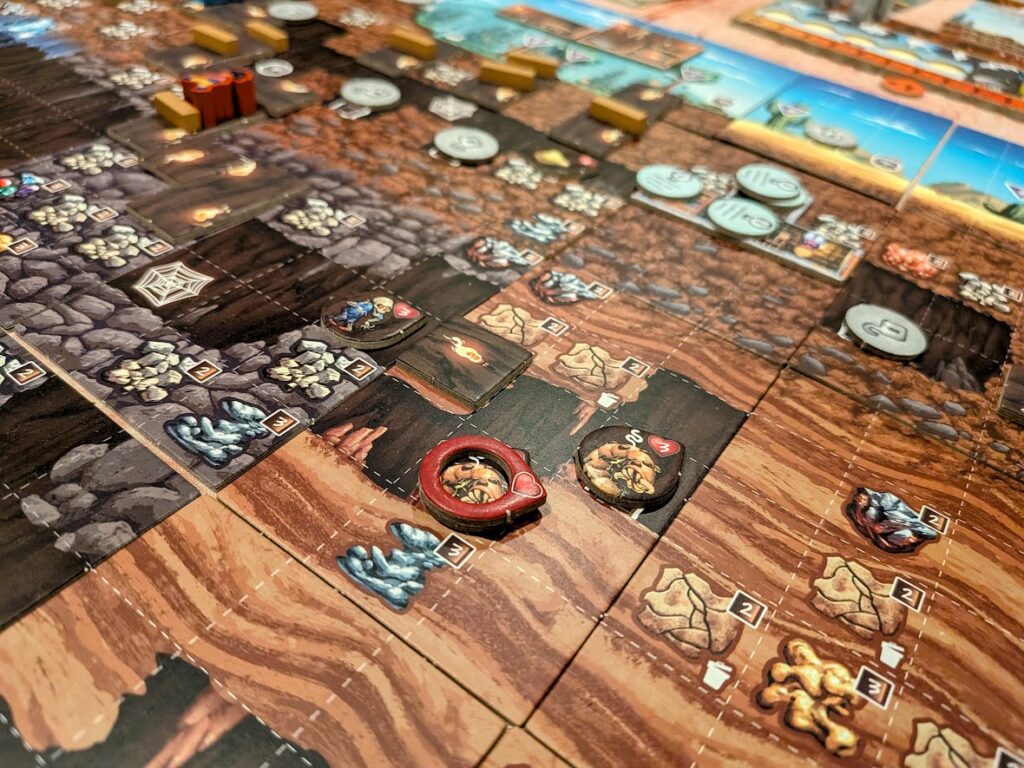
Terraria take AGES to play. My son and I played our first game over multi-hour stints over multiple days. We left the game set up on the kitchen table over the weekend while I was away at a games convention, and we played it for hours more when I was back. Playing Terraria is a big time and space commitment, particularly because there’s no game save mechanism. If you think you’re going to play a full game, even solo, over an hour one evening, you’ll be disappointed.
I guess this was always going to be one of the biggest challenges for Chris and the team at Paper Fort Games. People, including me, sink hundreds of hours into the video game. You take your time building your way up, down, left, and right through the world. You fight monsters, bosses, and play the game you want to play it. Wherever possible the board game developers have done some clever things to keep things playing quickly. For example, the anvil only needs to be present in your world to be able to craft with it. You don’t need to hike all the way through the world to get there.
Similarly, instead of ending up with hundreds of crafted chests full of the things you’ve mined, harvested and created, goods can be teleported between players. So, say for example you want to craft an item that requires gold, but you don’t have any gold, and your inventory is full, it doesn’t matter. Another player with gold can spend their action points to ‘donate’ it to you from across the world, and you can use it to instantaneously craft as a free action. No inventory management, no sorting stuff out, no meeting up to swap things. You can just do it, and that’s one of my favourite shortcuts built into the game.
Bossing your objectives
One of the biggest challenges for someone building a new type of game on the back of a beloved franchise such as Terraria, is finding a way to make sure the important things are both represented and in a way that feels right. The bosses, for example, matter. Those of us who’ve played the video game know about the battles with King Slime, the Eye of Cthulhu, and The Wall of Flesh. Fortunately, Paper Fort have done a great job of keeping this intact.
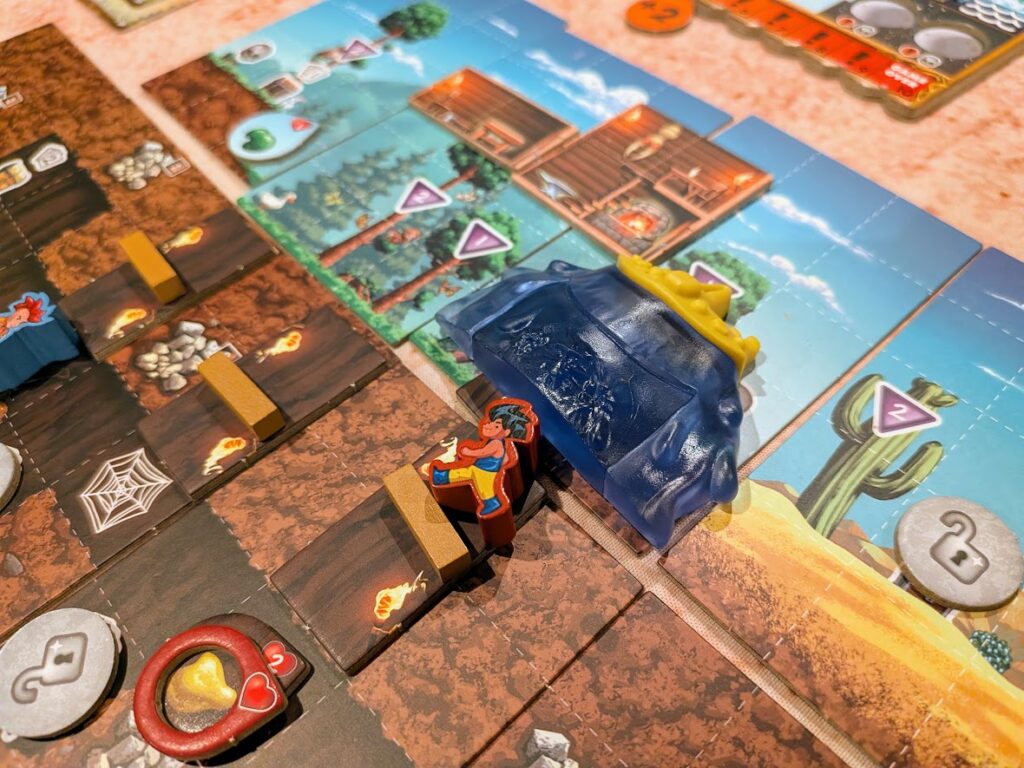
Each boss has its own little box with its cards and pieces in. When the specific spawn conditions are met, you open the box and put them into the world. The boss pieces are super cool! King Slime is huge and acts in the same way as the original. The Eye of Cthulhu has an interchangeable piece for its second stage where the eyeball is replaced with a mouth full of sharp teeth. My son, as an even bigger fan of the franchise than me, was overjoyed to see them all present, and all acting in a way you’d expect them to after their transition to the tabletop.
If you’ve played Terraria, then the biggest question you might have going into the tabletop version is “How does it end?”. The video game is essentially endless. Even when you’ve killed all of the bosses, there’s still lots to do. The sandbox you play in is just a lot messier than when you started. Terraria has different loss conditions, like the threat track I mentioned before, but how do you actually win at Terraria?
The approach Chris has taken is clever. For each of the main different types of actions in the game – dig, fight, build, and explore – there’s an objective deck. If you meet the conditions on the topmost card in each deck, you discard it, share the rewards written on it, and then get a new objective on the card below the one you just removed. The demands as you work your way down get increasingly difficult, but I really admire the approach. It steers the players towards accomplishing particular things within the arbitrary time limit, which long-time fans of the video game might need.
The Blood Moon is rising…
The biggest disconnect between the video game and Terraria: The Board Game is in the way things in the game have to happen by necessity. Combat in the video game is realtime. You jump about swinging swords, firing bows, and even pinging yo-yos around. In the board game, you use dice. Each weapon card tells you which dice to use, and the Bestiary book tells you which dice the enemies defend with. Any of your attack dice that are better than the highest defence dice cause a heart’s worth of damage. Better weapons give you access to better dice, which is a cool way of doing things.
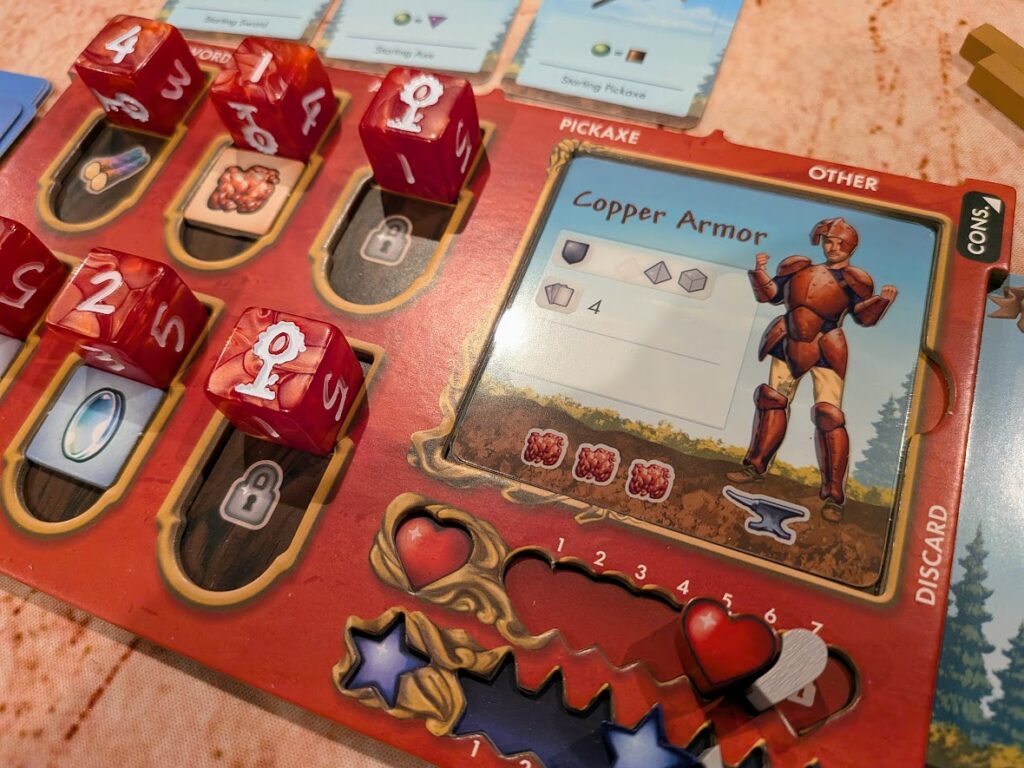
So your basic sword lets you roll D4s. As the game progresses, you get access to D6s, D8s, D12s and even D20s. If you’re defending a D6 with D4, common sense tells you that you’ll never be able to roll as high as a 5 or a 6.
Another big thing that’s missing from the board game is gravity. Sir Isaac Newton’s apple isn’t going anywhere on a horizontal table. Instead, when you fall, you’re asked to roll a die and use the difference between that and the number of squares you fell to discover how much damage you take. It removes some of the cool physics-based fun from the video game, but there’s nothing that could really be done about that. It just means your Hellevator is more like a stairlift than a waterslide.
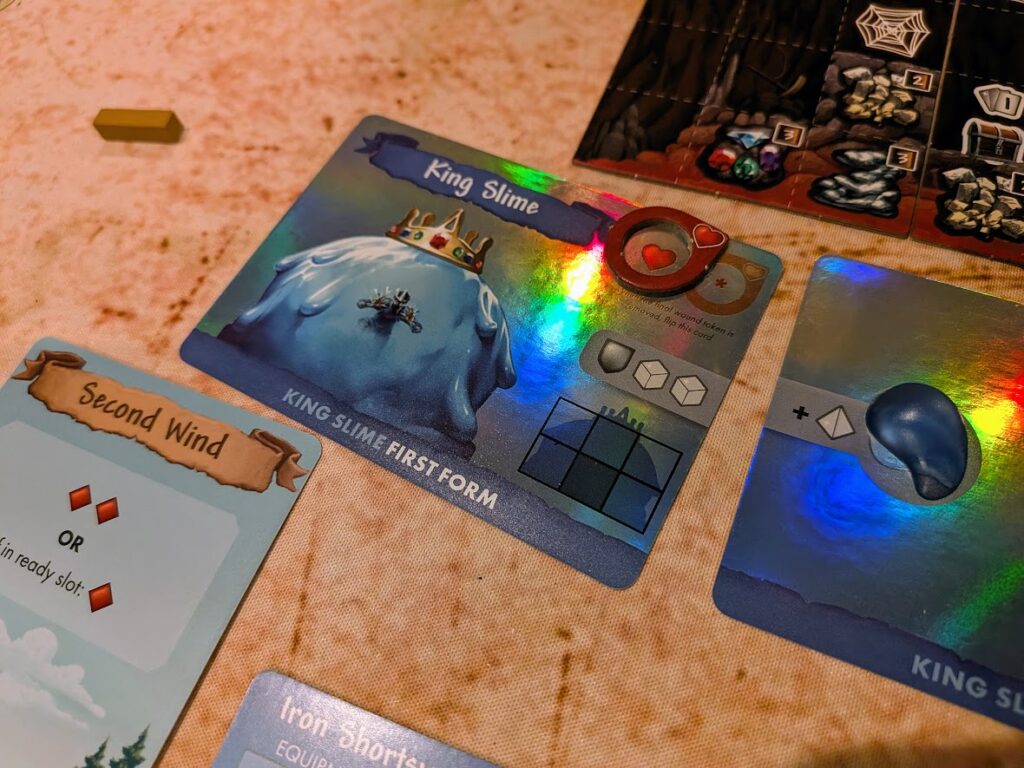
The biggest thing to be aware of is DON’T BASH THE TABLE! You’ve got cardboard tiles on top of cardboard tiles, and on top of those, you have small wooden platform pieces, wooden player tokens, small cardboard enemy tokens, and more. If you bump the table and they slide, especially when it’s late-game and you have 50+ biome tiles on the table, good luck guessing where everything was. I’m not sure what you could do to fix this without making every single piece magnetic, but when you’ve invested hours into a board game, it’s worth knowing what you need to be careful of. That includes people with loose sleeves or shirts reaching across the table, too.
Naked game night, anyone?
Final thoughts – Video game fan perspective
If you’ve found your way here because you love Terraria and want to know if the board game is for you, this section is yours.
Yes, this game feels like Terraria. The biomes are all present. In each game you’ll either have Corruption or Crimson as the evil biome. The spawn conditions and subsequent actions of each of the bosses are all familiar and largely mirror those from the video game. The armours, weapons, consumables, buildings, NPCs, enemies, and just about everything you know and love from the video game are all present and handled with attention to detail.
If you’ve never really played a modern board game, the learning curve is pretty steep. Just about everything you need to know is easy to find in the rulebook, but the gameplay loop will feel clunky and with a lot of referring to the book for the first few hours.
Be aware that Terraria: The Board Game takes a long time to play. You’ll make rules mistakes, but the spirit of the game is to just make amends as you go along. Don’t beat yourself up, don’t restart, just carry on and enjoy the experience. Just make sure you’ve got a table that you can leave the game set up on for a few days at a time so you can approach it in blocks. If you’ve never sat down to a six hour stint with a board game, it’s a lot to take on.
Is it for you?
If you’re willing to take the time to learn and go into it knowing that it’s going to take a long time to play, then absolutely. 100%. Yes. I have a hard time getting my 13-year-old son to play board games with me, but he loves Terraria: The Board Game. My jaw hung open when he asked if we could leave it set up over the weekend I was away.
There’s a huge amount of fan service in the box, and the presentation throughout is amazing. The armour and cosmetics are transparent overlays for your characters, same with the minions too. The biome and card holders are great, as are the trays holding the various enemies, resources, tunnels and ledges. Given the size of the game and the quality of everything in the box, it’s a bit of a bargain for the £60ish you can pick it up for soon, or around £100 for the Kickstarter edition available on the Paper Fort Games site.
Final thoughts – Board gamer perspective
If you’ve not really gotten into Terraria before, you might be wondering what the fuss is about. It’s a bit like saying “What’s so good about it?” to a Minecraft-loving kid. Terraria: The Board Game has had to tread a fine line to do justice to the beloved ReLogic franchise while still creating a decent board game. To be fair to the team at Paper Fort Games, for the most part they’ve done it.
It’s abundantly clear that this isn’t just a quick cash-in. This is a real labour of love which seeks to make fans of Terraria as happy as possible while still delivering a tight board game experience. The deck-building is fairly simple, but it works well here. You cycle the deck a lot, so it’s more important than in other something + deck-building games, but the focus is clearly on the exploration and digging that makes up the lion’s share of the game.
If you look at Terraria: The Board Game as a dungeon-based 4X lite game, you’re not far off the truth. I love how simplified they’ve made the crafting, I think the dice-based combat works really well, and I really like the objective-based win condition that leads you by the hand to do the things that you really ought to be doing in the first place. Some of the housekeeping feels a bit fiddly and convoluted, and you’ll find yourself reverting to the rulebook a lot for clarifications on edge cases.
I think what I’m trying to say is that Terraria is a heavier, more involved game than you might assume it to be.
Is it for you?
It’s a solid Maybe I’m afraid. The game itself is solid. The deck-building is fun, the player boards with insert slots for everything is great. The deck, biome tile, and enemy/resource trays and resources are really good and actually help, not hinder the set-up and teardown, which is a nice change compared to some games.
The issue is the time investment needed, and the lack of a save mechanism. If there was a way to pause, pack the game away as-is, then set it all up again another day and get straight back into where you were, it would be a different story. Unfortunately, if you want something with that feeling of an extended explore there are better options if you don’t care about the Terraria name. Shadows of Brimstone if you can get hold of it, Lands of Galzyr, Euthia, Earthborne Rangers, or even the daddy of them all, Mage Knight. All games with similar feels for one reason or another, but without the one-time time commitment.
Final thoughts – The last word
Terraria: The Board Game was a crazy thing to undertake, and to their credit, Paper Fort Games have done an incredible job of it. Managing the necessary changes to put the game on your table took some serious skill, and they pulled it off. It’s just a shame that the board is susceptible to being disturbed and that it takes SO long to play. Terraria diehards will absolutely love it, though. Kudos to all involved, it’s a hell of a thing.
Pros & Cons
Pros
- Somehow they’ve really managed Terraria on the tabletop!
- The presentation and components are superb
- The objective chain system is very clever
Cons
- It takes a reeeeally long time to play
- Lots of rules-checking in your first game
- If this is your first modern board game, it might be a shock to the system
THANKS TO MY SUPPORTERS
Krissie  Craig Paul Brendan Brett Gary Becky
Gavin Chris Mark Johan Richard Simon Ben Sam (new!)
Help me keep Punchboard independent by joining the supporters

 Buy me a coffee
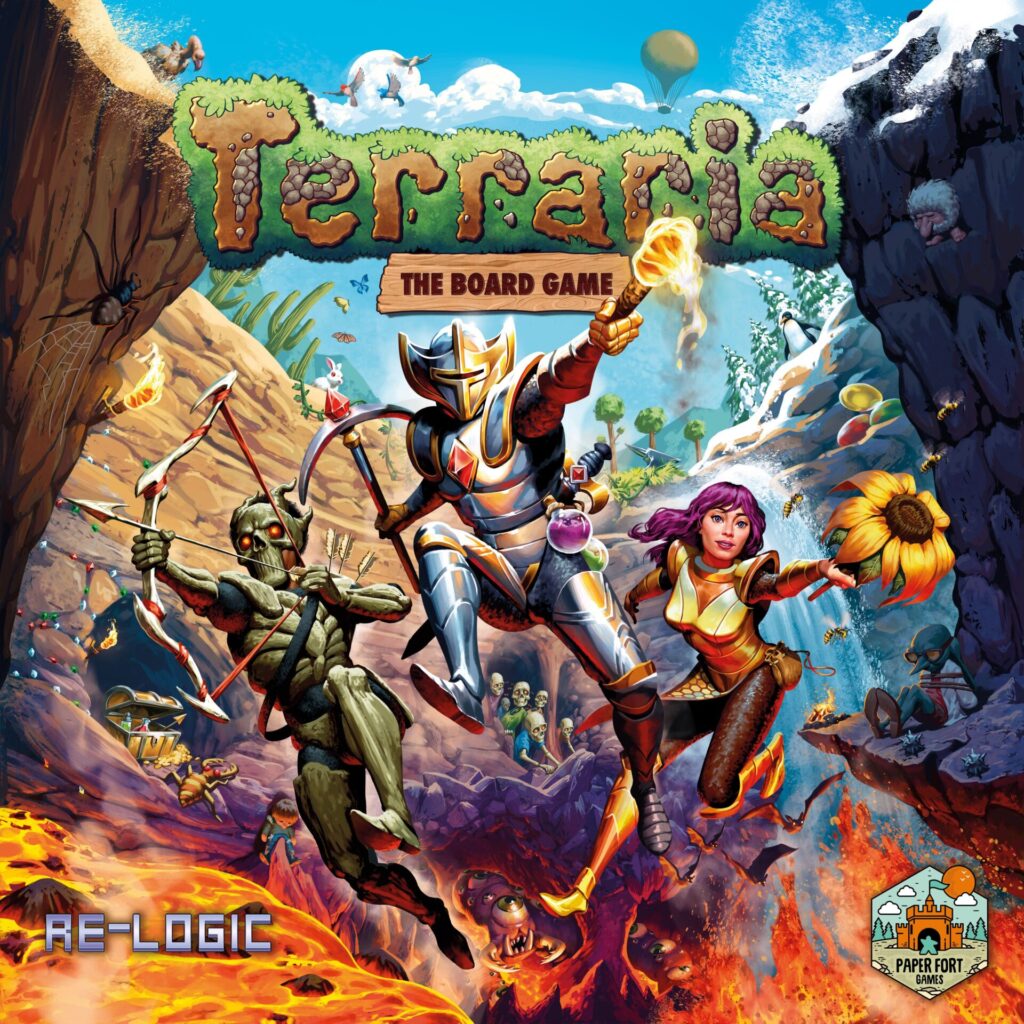
Terraria: The Board Game (2026)
Design: Chris Kingsnorth
Publisher: Paper Fort Games
Art: George Doutsiopoulos
Players: 1-4
Playing time: 360-600 mins
More games like this one



Spot on. Good writeup!
Thanks very much. Context matters with games like this one.