
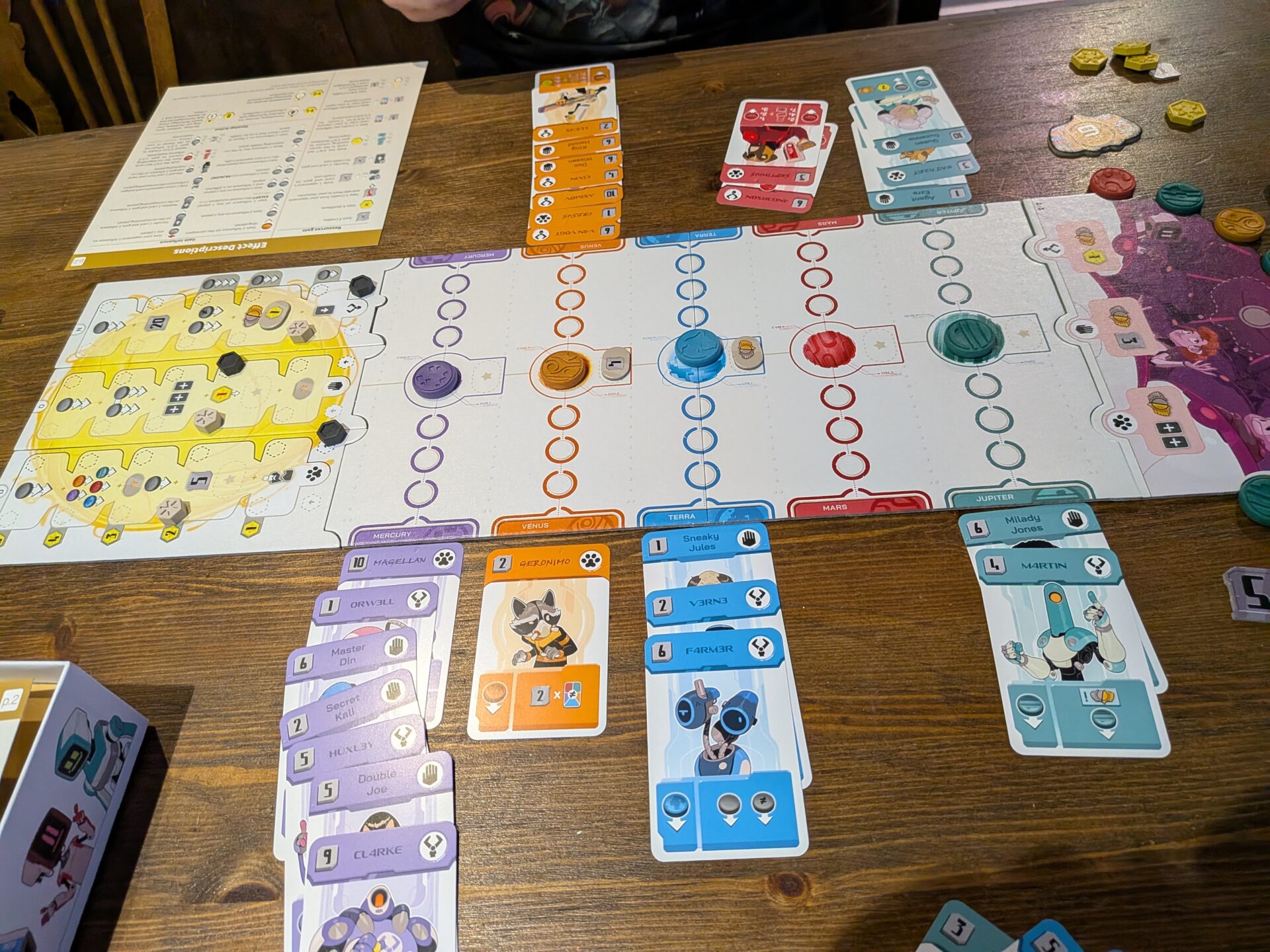

A review copy of Zenith was kindly provided by Hachette Boardgames UK. Thoughts & opinions are my own.
Zenith is a tight, hugely enjoyable head-to-head duel that’ll have you trying to do all-too-many things at once. It’s an exercise in plate-spinning that I think most people will really enjoy and wish they’d tried sooner.
VERDICT
players 2-4 | playing time 25-35 mins
Zenith is a brilliant tug-of-war, multi-use card duel with a lot going on in a fairly small box
duel
multi-use cards
tableau-building
The theme of Zenith sounds like something from a heavy Euro game or a COIN game set in space. There are three races in the game – humans, robots, and animods – who are struggling to coexist, so you’re going to step in and try to create harmony, uniting the planets of the inner solar system. With terms like Absolute, Democratic, and Popular being used to describe the victory conditions, you could be mistaken for thinking there’s deep political intrigue.
There isn’t.
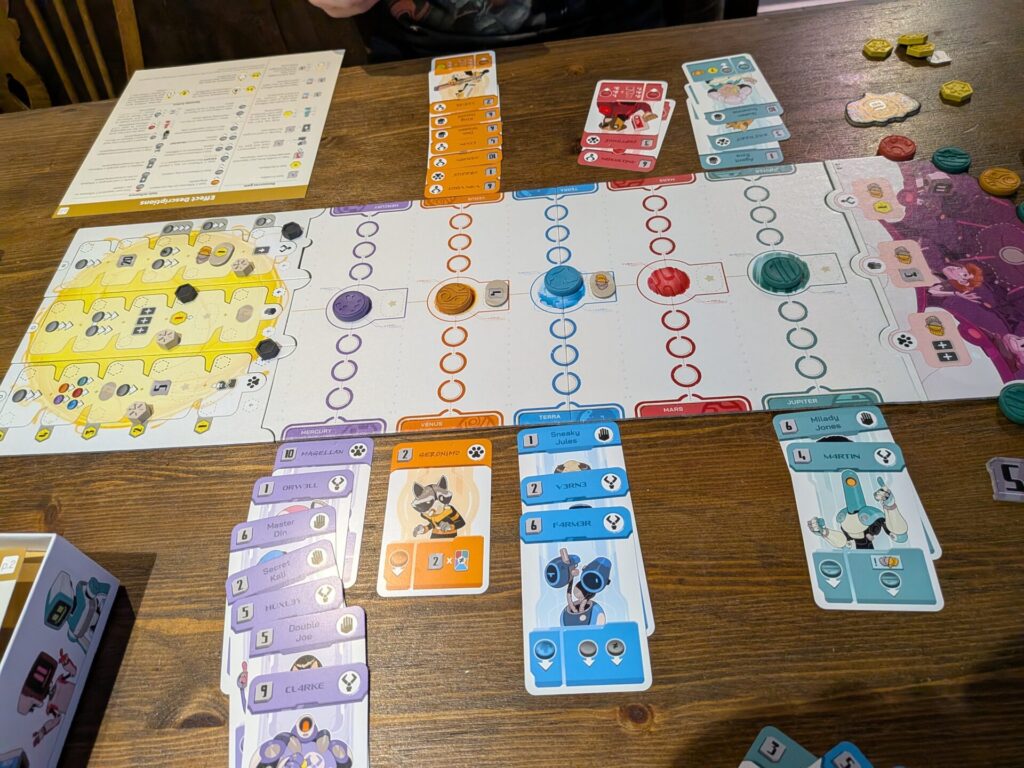
Zenith is a tableau-building game with multi-use cards, tracks to climb, and five fronts to compete on, a la Lost Cities. Phwoar! If that sentence doesn’t get your heart racing, you must be dead inside.
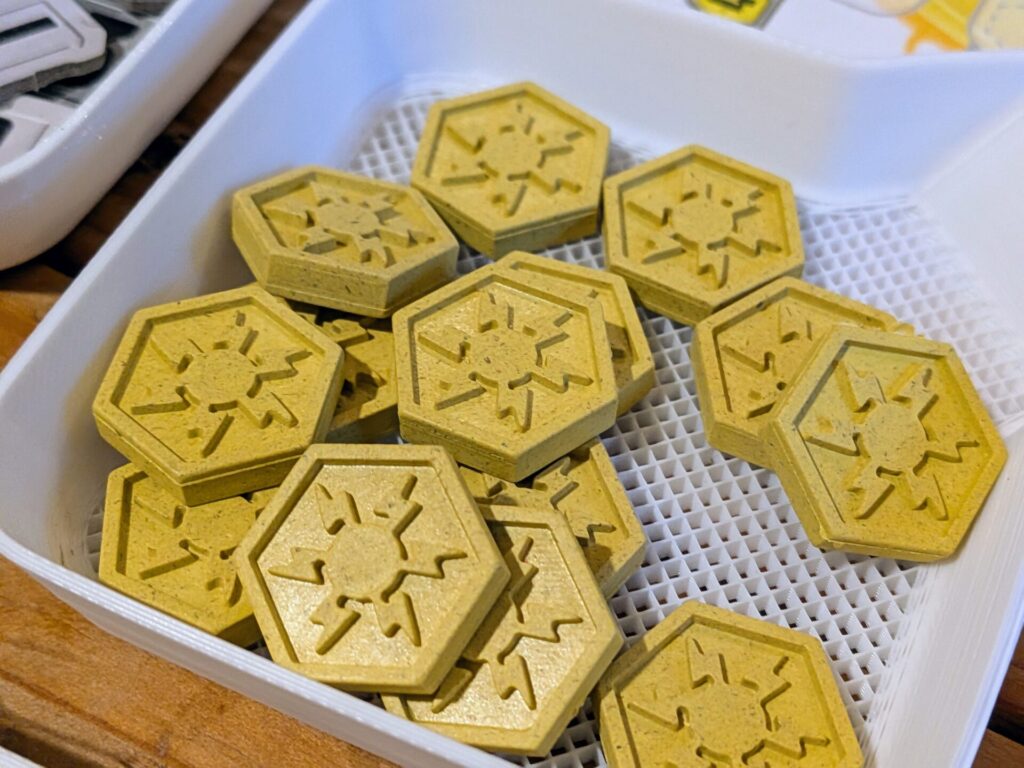
The main board has discs which represent the five planets you’re trying to sway in your favour. Play a card of the correct suit/colour beneath one of them, and you pull it a step towards your side of the board. That’s right, it’s a tug of war. It’s a bit like Watergate in that respect (read my review here), but with five simultaneous tugs going on at once. This is where it shares some Knizia DNA with the aforementioned Lost Cities. In a two-player game, having four tracks would invariably lead to an informal agreement that you’d compete for two each. By adding a fifth, it makes things really tasty. Nothing is sacred in Zenith, and your plans will get stomped on. Repeatedly.
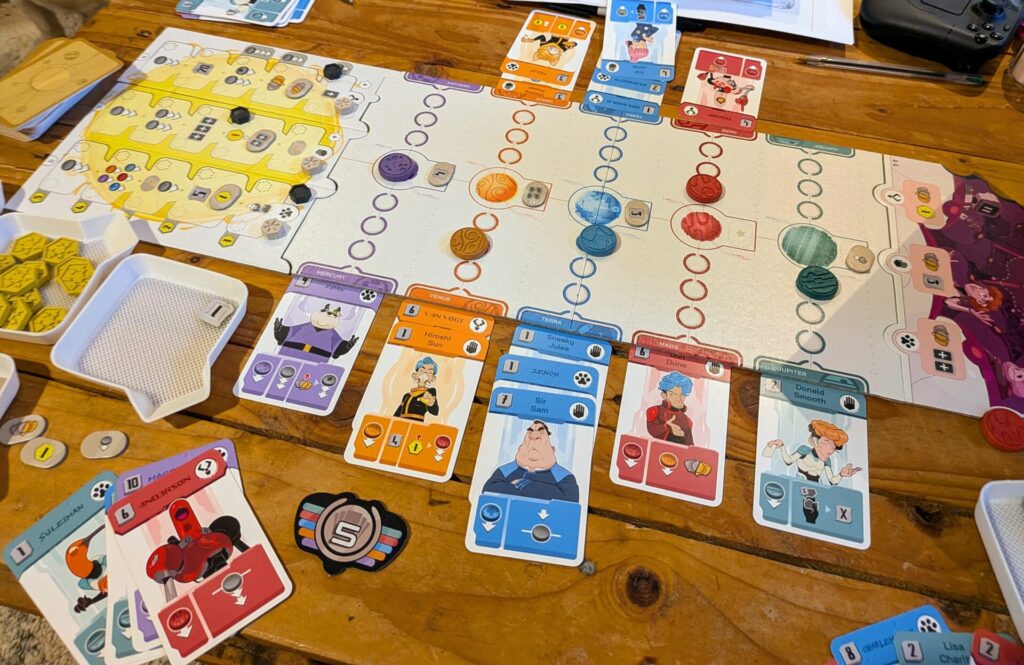
The plate-spinning I mentioned comes from some unfortunate necessity. Cards often cost money to play, and money can be hard to come by. This is where the multi-use creeps in. You can play cards to other places, either spending incrementally more of the game’s other currency, the imaginatively named Zenithium, to climb one of three tracks, or to claim a token which grants you a bigger hand size and other benefits.
Exponents
Understanding costs and rewards is key to playing Zenith. Take playing cards to the main planet board for example. Building your tableau. When you play a card and pay its cost, you not only get the benefit of dragging that planet disc closer to your side of the board, but also a bunch of other abilities on each card that can trigger. On top of that, for every card you already have in each stack in front of a planet, you get a 1-credit discount for playing the next card. So the game wants to tempt you into focusing on individual colours. But to do well, you need to make sure you’re competing on all fronts at various times, which makes this very hard to do.
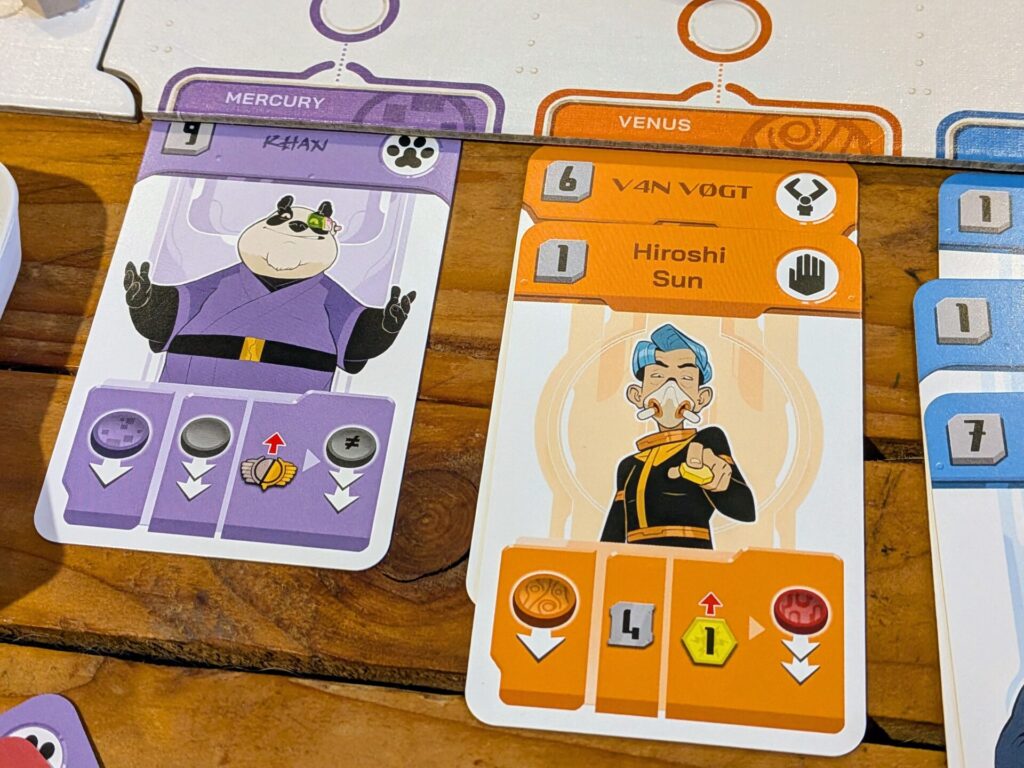
Then we look at the technology tracks I mentioned. They need increasing amounts of this Zenithium resource to advance up, but the rewards for doing so grow almost exponentially. Say, for example, you advance from the second to the third space up one of the tracks. It costs you three of this expensive resource, *but* you get not only the reward on the third space up the track, but also the rewards from the previous two spaces too. It makes the tracks really lucrative, but getting those rewards comes at the cost of not getting all grabby-grabby with the planets, which is what you need to do to win.
Zenith is brilliant at making every choice agonising at times. You want to spend every turn yoinking planets like an intergalactic Snake from The Simpsons, but you can’t. You don’t have the money. You might not have the cards you need. So you need to take these wasteful-feeling turns getting more stuff to make it all possible. They’re not wasteful; they’re necessary, but they feel wasteful because while you’re spending a card to get some more cash or something, the other player is hoovering up planets like a black hole.

If only there was something you could do about it.
Shenanigans
There’s plenty you can do about it. Plenty of cards and effects let you remove cards from the other player’s side of the board, driving up their future costs. It sounds like a small thing, but it can make a huge difference when margins are so tight. Better still, some icons let you take a card from their side of the board and add it to your own. Their costs increase while yours go down. Juicy!
The main way you’ll mess with one another’s machinations, however, is by the choice of which planets you go after.
If a planet disc makes it all the way to your side of the board, you claim it, then replace it with another of the same, fresh for another fight. To win the game you need to get three of the same kind, four of different kinds, or five of any combination. Getting to two of a colour feels powerful, because you only need one more to win, but it puts a huge target on that colour, and things start feeling personal then.
Final thoughts
The short summary here is that Zenith is great. The box and rules say you can play with four people in two teams of two, but ignore that. Zenith is a duel. And it’s a really good duel. I love the fact that you have to have your attention split between three different areas of the board. I love that you cannot do one thing in isolation, and the way it’s built in a necessity to do the things you don’t want to do. Those moments of non-productivity when you want to be desperately clawing the discs your way are just delicious.
It’s not all glazing, though. There’s a *lot* of iconography, and although it’s second nature after a couple of games, you’ll absolutely rely on the reference sheet at first. The same goes for the cards. You can pretty much guess what each does from the icons, but you’ll have questions. I strongly recommend heading to the Files section of BGG for the game and downloading THIS REFERENCE SHEET to make things easier.
Those grumbles aside, Zenith really is superb. It won’t make the same headlines as its peers, and it doesn’t look like anything special when you see it in its mid-sized box, but what’s inside that box is absolutely worth your time and money. But only if you have a regular player two and don’t mind liberal doses of take-that action. Great stuff.
Want to get this to the table?
Zenith
2, 4 Players | Ages 12+
Purchasing via this Zatu link supports Punchboard via an affiliate commission at no extra cost to you.
Pros & Cons
Pros
- The 5-way tug of war is fabulous
- Multi-use cards are great
- It feels like a much bigger game than a half-hour blast
Cons
- The iconography takes some learning
- It really should have had a card reference in the box
THANKS TO MY SUPPORTERS
Krissie  Craig Paul Brendan Brett Gary Becky
Gavin Chris Mark Johan Richard Simon Ben Sam (new!)
Help me keep Punchboard independent by joining the supporters

 Buy me a coffee
Zenith (2025)
Design: Grégory Grard, Mathieu Roussel
Publisher: PlayPunk
Art: Xavier Gueniffey Durin
Players: 2, 4
Playing time: 25-35 mins.
More games like this one