

This is probably the fastest turnaround I’ve had between receiving a game and writing a review. The haste isn’t because I’m trying to keep on-trend, or because I don’t care. It’s because I’ve played it so many times in the last few days, I want to get the words out while it’s all fresh, and because I want other people to play Carnuta. It’s a superb, gorgeously produced game which demands your attention.
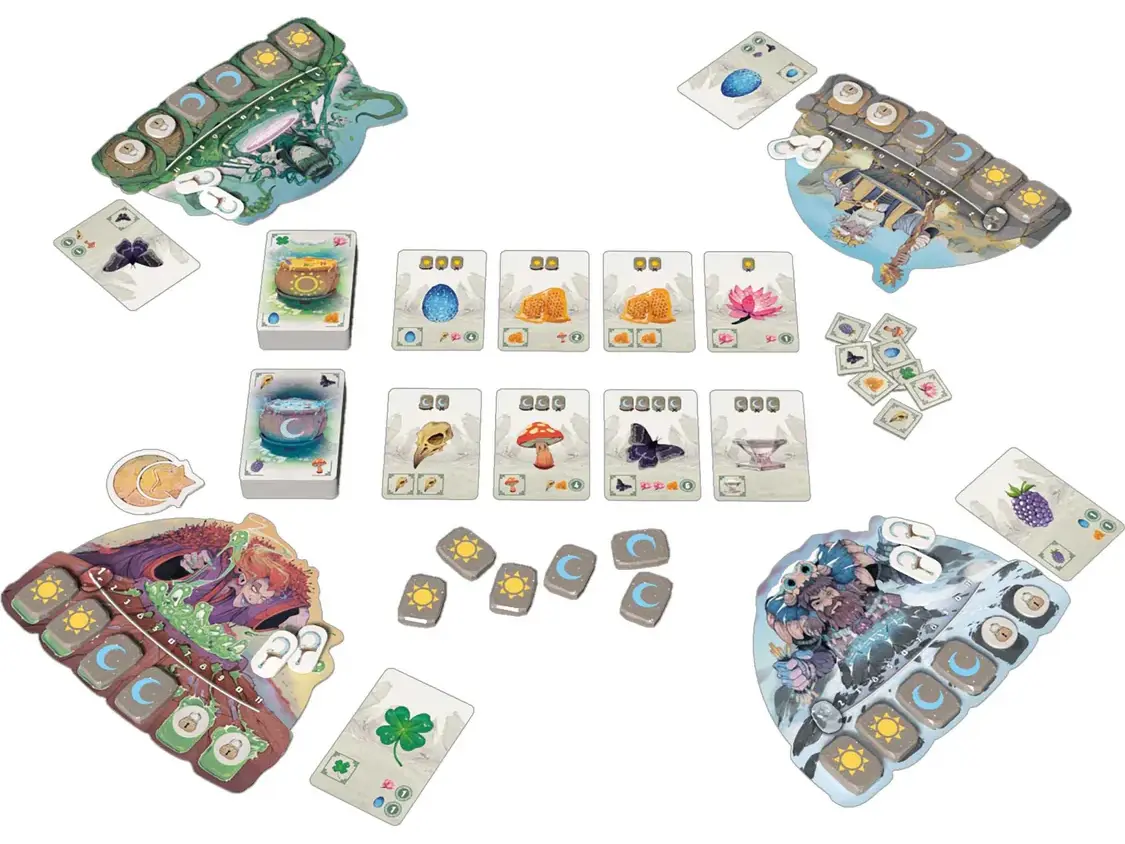
Carnuta is one of those games that was on the periphery of my attention. My brain tends to latch on to some things, while it’s just vaguely aware of other things, and Carnuta fell into the category of other things. I didn’t know much about it, but I was keen to try it because it’s from the designers behind Looot and Odin (read my review of Looot here), and because it has the Repos Productions label on it, and they tend to back winners in my experience. I’m extremely glad I went with my gut and tried it.
Are you trying to rune my day?
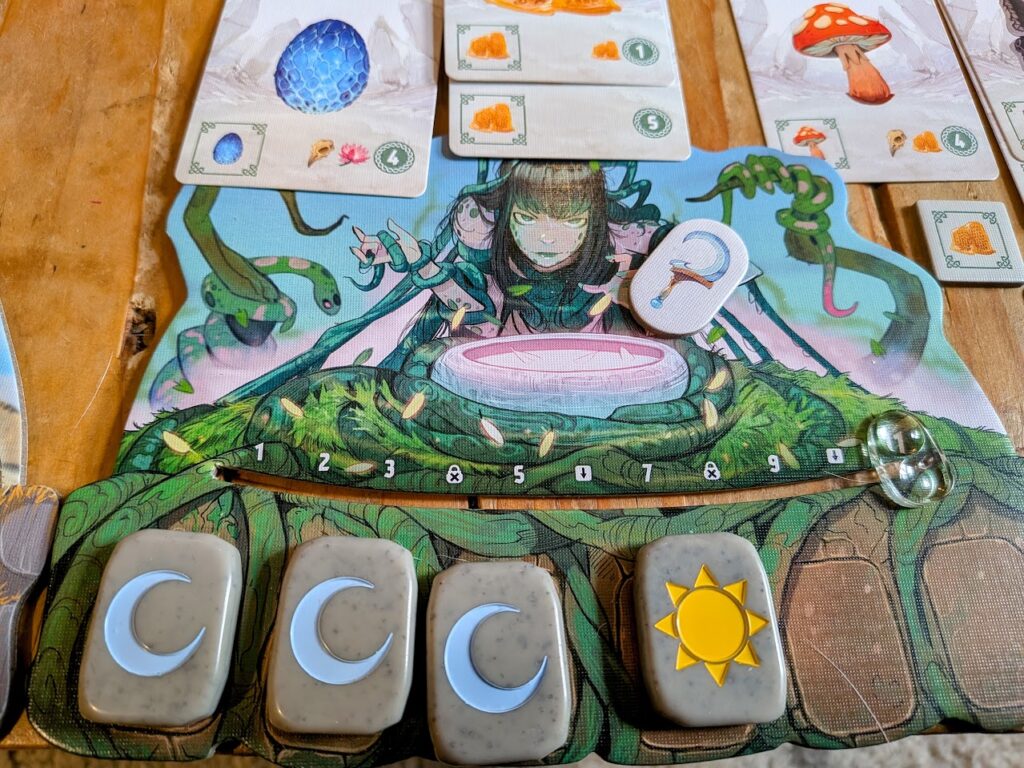
The bulk of Carnuta’s gameplay revolves around the manipulation of rune stones in the game. Each player has a natty little player board with spaces for rune stones to go. The aim of the game is to get ingredient cards for your cauldrons and to become the mightiest druid. Once you draft the cards into your hand, you can play them to your tableau by either flipping or discarding runes.
Runes have a sun and moon side, so if you play a card which requires you to flip two sun runes and discard one, you end up with two moon runes, and the rune market has more to shop from. The cards in your tableau have tags in the corners which represent one of the eight elements in the game, and many have scoring conditions too. So you might have a card which just gives you a straight 5 VPs, another that might give you 1 VP per flower, and there are also cards which require sets of ingredients to score bigger points.
If you’ve played any game with some kind of tableau-building, this probably sounds pretty familiar. Games from It’s a Wonderful World through to smaller games like Castle Combo or Faraway (read a review of Faraway here). The idea is pretty simple; it’s putting it all into practice where it gets difficult.
Evolving strategies
In a similar way to the games I mentioned above, Carnuta has an ever-changing card market to pick from. You all start with a single card which gives you something to start aiming for. It’ll say something like ‘At the end of the game, you’ll get a point for each skull and butterfly tag you have’. It’s a start, if nothing more, and it’ll start steering the decisions you make.
If you take some skull and butterfly cards and add those to the table in front of you, each of those may have other scoring conditions, which then point you in a direction for future card choices, and so on. What makes Carnuta different to some of those other games is that the churn of the cards through the market is much higher than in some games. It means that in even just a two-player game, it’s not impossible to come close to cycling through the entire deck in a single game. In a three or four-player game, it’s actually pretty likely.
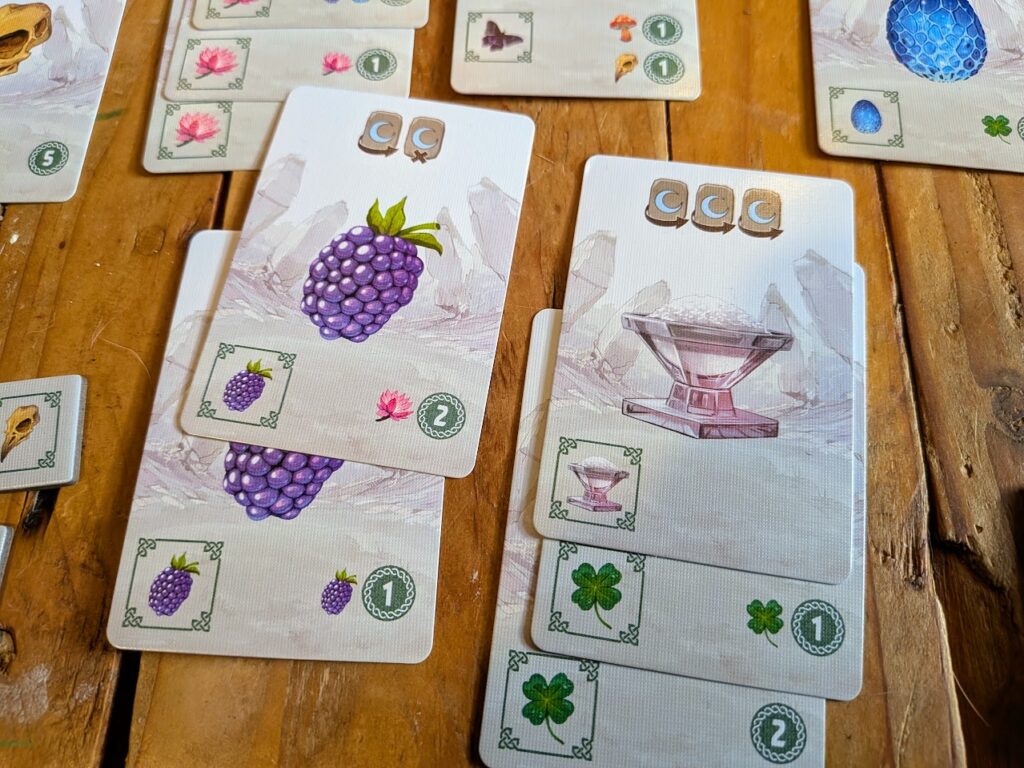
Why mention this specifically? Because in other games from Ark Nova through to Point Galaxy (read my recent review here) and beyond, they’ll throw hundreds of cards in the box. It does two things. It means there’s a ton of variety to every game, which is great, but it also means there’s a good chance the card you really want never comes to the surface. In Carnuta, this isn’t the case. If you’re dependent on collecting honey tags, you know you’ll see them, and that removes a big barrier to adoption. If you play a game outside of someone’s comfort zone, if they think they’ve done something clever, but that plan becomes impossible to bring to fruition, it leaves a really sour taste. Carnuta sidesteps this danger by showing you everything.
Enjoying this article? Consider supporting me.


It’s a nice distinction to make. It’s still a reactive game when it comes to strategy. You can still only pick from what’s in front of you, but when you set your stall out, you know there’s a good chance that you’ll see what you need. Whether you get the chance to take the card, well, that’s another question altogether.
Final thoughts
Carnuta is a delight. For the first few turns of my first game, it felt very by-the-numbers. Nothing bad, but nothing special either. The more I played it, the more I enjoyed it. I love the way the player board slowly gets better as you buy more cards, opening more rune stone spaces, or letting you claim some tiles, which add to your tags of different kinds.
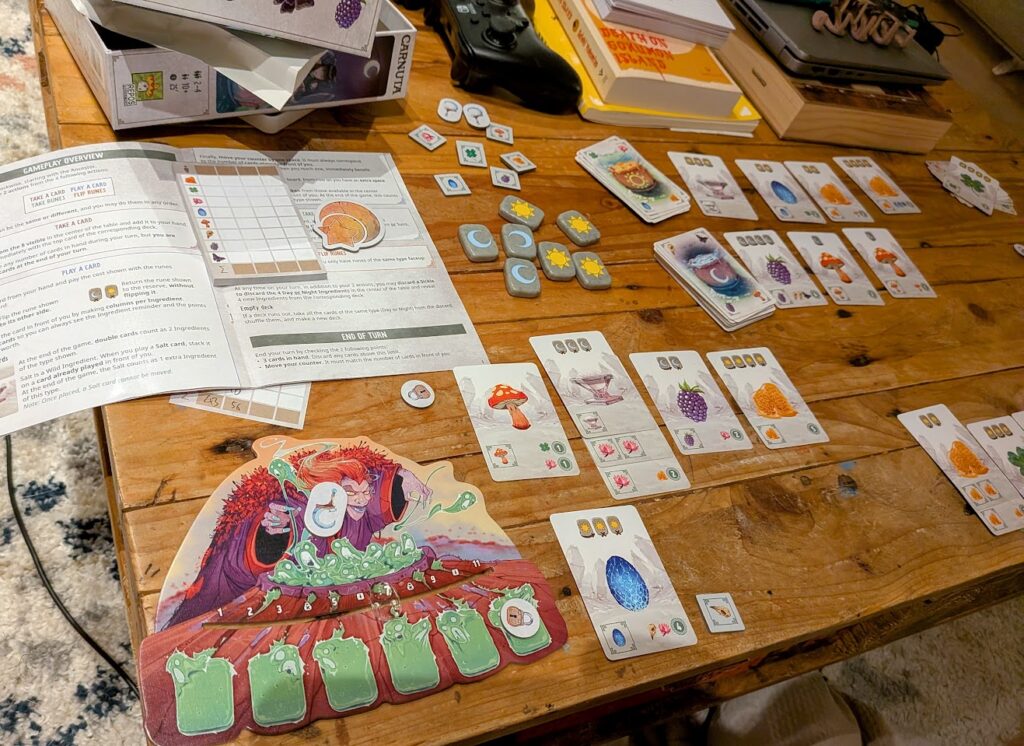
The game ticks along at a steady pace, and there’s very little downtime. Your turn is a case of taking two actions from a menu of four, so there’s a really low overhead for getting new players into the game. Show them how to play a card, claim and flip runes, and you’re 90% of the way there. Testament to this is the fact that not only was my wife able and willing to pick it up in five minutes, but after our first game, we immediately played again.
Believe me when I tell you that’s high praise indeed!
I picked this up on Friday evening. It’s now Monday afternoon, and I’ve honestly lost count of how many plays I’ve racked up. In person, and online over at Board Game Arena for free, too. Play it now on BGA. It works great at two, three, and four players, it looks gorgeous, the components are top notch, and the whole thing is just super. A wonderful little game that’s a complete bargain.

I borrowed a copy of Carnuta from my partner, Roll The Dice Cornwall. You can buy it there now for £15!
Thanks to my supporters
A big shout-out to my current Ko-fi and Patreon supporters:
Krissie, Craig, Paul, Brendan, Brett, Gary, Becky, Gavin, Chris, Mark, Johan, and Richard.
You guys are all amazing ❤️
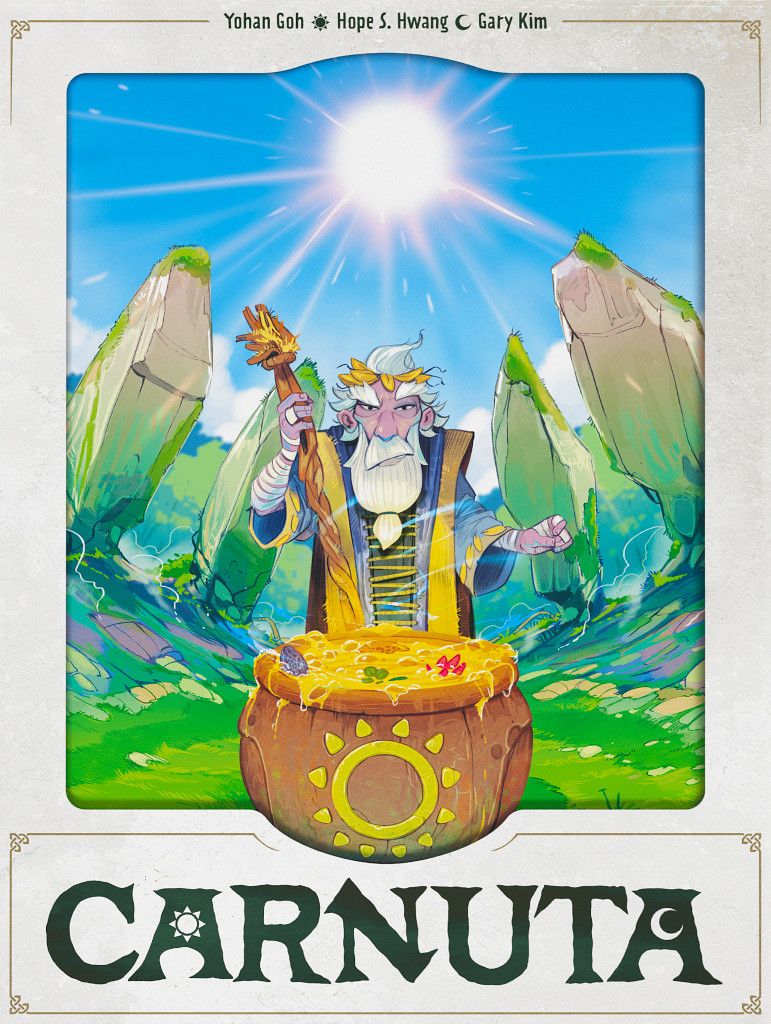
Carnuta (2026)
Design: Yohan Goh, Hope S. Hwang, Gary Kim
Publisher: Repos Production
Art: Davide Tosello
Players: 2-4
Playing time: 25 mins.

Adam is a board game critic with over 15 years of experience in the hobby. A semi-regular contributor to Tabletop Gaming Magazine and other publications, he specialises in heavyweight Euro games, indie card games and transparency in board game media.