


A prototype copy of Club Manager was kindly provided. All artwork and rules are subject to change. Thoughts & opinions are my own.
If I said ‘ChampMan’ to you, there’s a chance you won’t have a clue what I mean. But for some of you out there, some of you probably from the UK, and probably of an age, you’ll know exactly what I mean. Championship Manager, as it was, was the perennial football (soccer) management computer game, and it ate the lives of teens, twenty- and thirty-somethings around the turn of the millennium.
Board games have never really captured the same feel that a decent football manager sim manages, but they keep trying. I reviewed Eleven here a few years ago, and Superclub, which you can read here, and while both did things well, neither really scratched that itch. Could the new upstart Club Manager be the one?
Climbing the ladder
Club Manager is a campaign game which seeks to do the same thing as Championship Manager does. You start in the bottom division (three, in this game) with your rag-tag squad, and aim to get to the equivalent of the Champions’ League.
Half of the game is about the creation, development, and organisation of your club. This part of the game is the bit which first appealed to me when I read about the game, because it takes the form of a basic worker-placement game. You have staff members (workers) at your disposal, who you can place on the main board to do various things. Putting staff into Marketing increases the money at your disposal, Training can improve the ability of your players, and you might choose to dip into the transfer market, or do tactical training, or work as a physio, or a bunch of other backroom things.
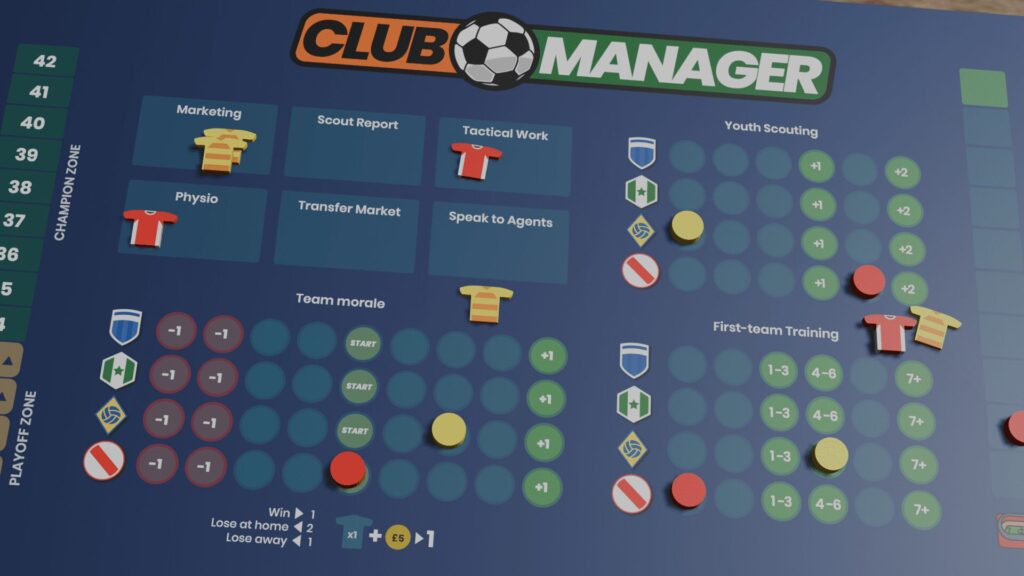
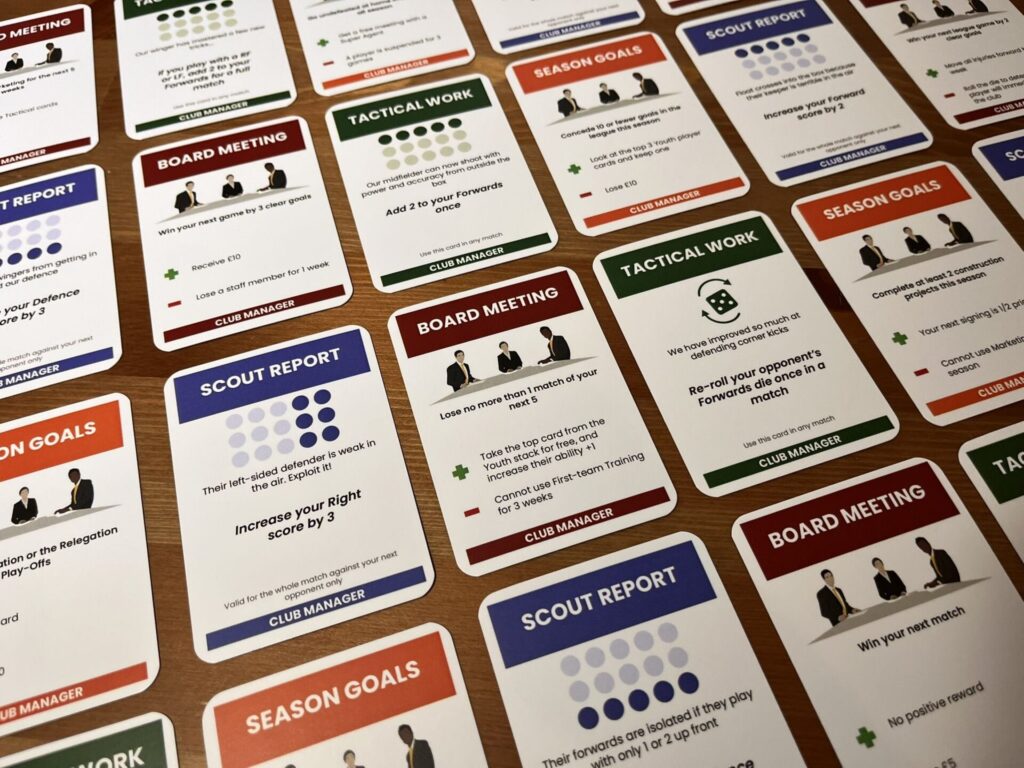
This whole part works really well. It’s easy to read, easy to learn, and not too fiddly. If you want to buy a player from the transfer market, you pay double their ability. Easy. If you want to earn money, you put staff into Marketing, roll a die, and multiply the two together. Simple. Putting someone into Scouting means you can gain an advantage against your opponent in a match week. Drop staff into Tactical to draw tactics cards, which strengthen your team during a game.
Saturday. 3 P.M.
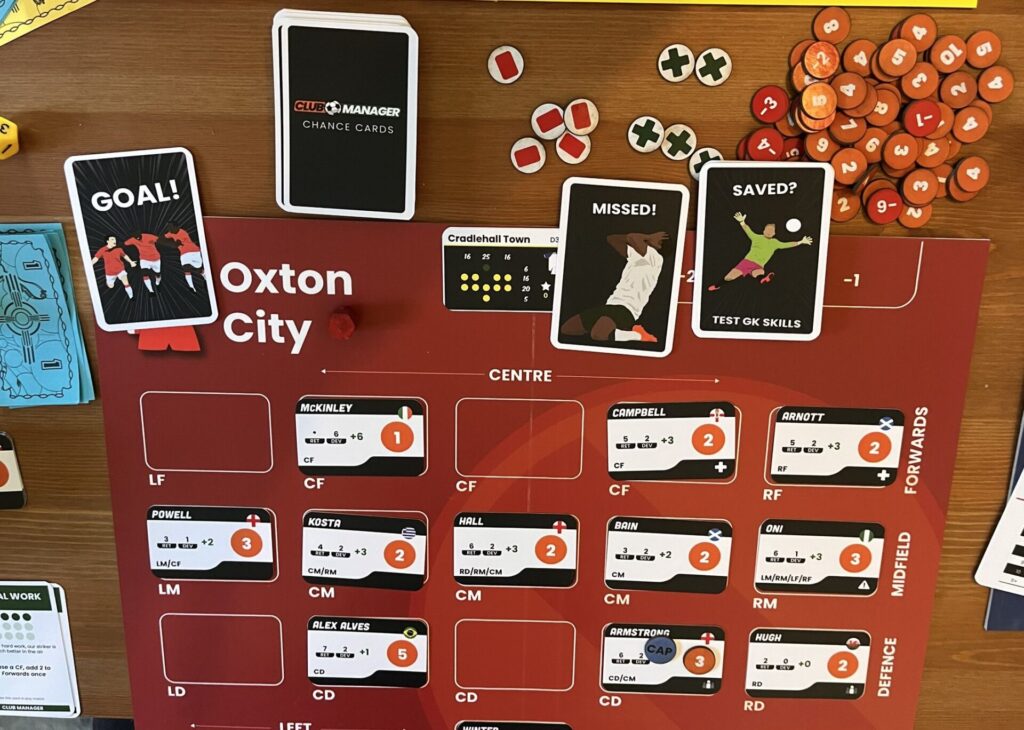
Gameday is what we’re all looking forward to. The fruition of your plans. The benefits of the hours spent on the practice pitch, or on the physio’s table. Matches are nice and easy to run in Club Manager, and reminded me of Eleven in some ways. You line your player cards up on your team board, decide who goes where, who gets to wear the captain’s armband (and get a stat bump for his trouble), and see who you’re up against.
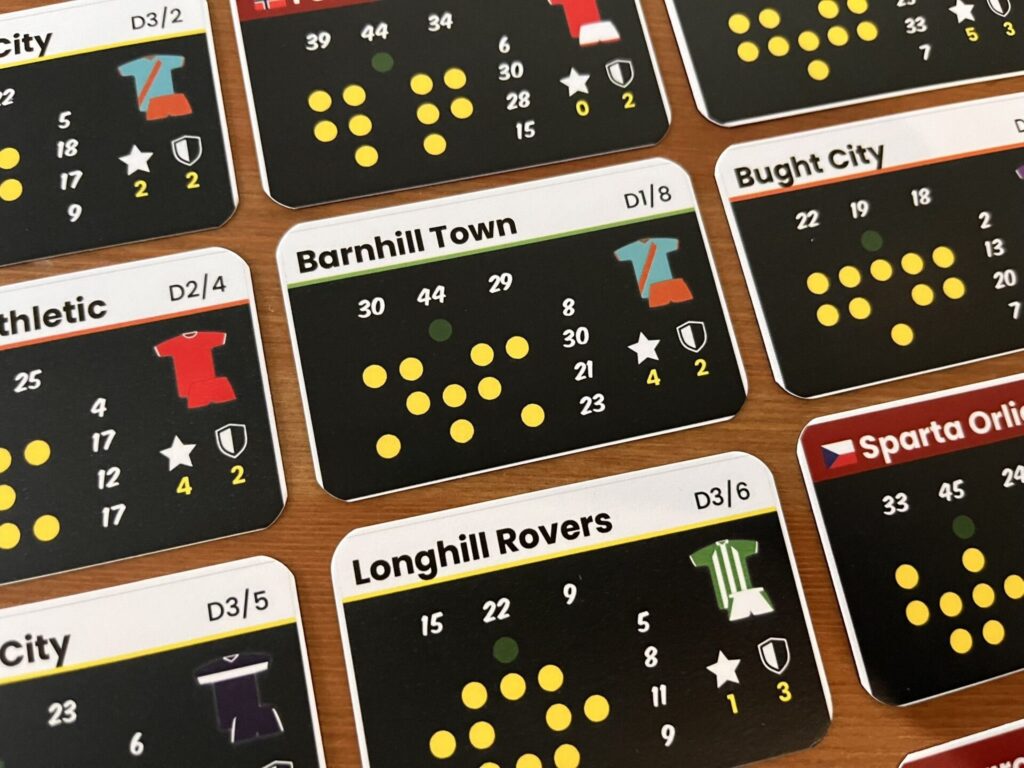
Match resolution is always going to be the stumbling block for any management game, because there’s a necessity to introduce some element of chance. You know the relative strength of your left side, you compare it to the right side of your opponent, then roll two dice. You take the difference of the dice and the difference of the squad strength, determine a winner, then flip a chance card to see what happens. It might result in a goal, a miss, a goalline clearance, or a host of other outcomes.
You do similar checks for attack vs defence, flair vs strength, and by the time you’re done, you’ll have a match result. Teams move up and down the table, and you try to get promoted. You know; football stuff.
Enjoying this article? Consider supporting me.


Where the fun lies in Club Manager is in the drama of a dice roll. The luck of a card flip. Yes, if you’re a strategy purist who likes deterministic combat, you’re not going to enjoy that. But that’s not football. That’s not Leicester winning the league. That’s not Spurs scraping the floor of the Premier League. Football lives and dies on the drama it creates, and to its credit, Club Manager does a good job of putting some on your table.
Final thoughts
Is Club Manager the physical manifestation of Championship Manager? No, it’s not. But then, nothing could be really. In order to get a game to work to that depth you’d have to be looking at the intricacies of one-on-one matchups, and let’s be honest, that’s just not going to be fun on the tabletop. Instead. Club Manager sets out to do something different, and it does it really well. The luck of dice rolls and chance cards might not be up your alley, but then this probably isn’t the game for you. If you don’t want the drama of Yeovil Town toppling Liverpool, there isn’t much hope for you.
Club management and team progression are handled smoothly and easily. Matches have plenty of space for strategy and tactics, but don’t get bogged down in the weeds. The matches have more substance to them than Eleven, for example, but at the expense of something like stadium development or sponsorship management. Chances are, though, you’re coming to Club Manager because you want the emphasis on that side.
It does a great job of capturing that feeling of games of old that were developed by someone on their home computer in their bedroom. While some folk might lament the lack of licensed teams and players, I think it just adds to the charm. What would PES Master League be without the names of Espinas, Ximinez, Burchet and Castello, after all? I won’t be at all surprised if fan-made real-world paste-ups are available by the time the game lands on people’s doorsteps. A game made by someone who’s clearly a fan of management sims, for people who grew up playing management sims. Great fun.
Check out the campaign page for Club Manager right here.
Pros & Cons
Pros
- One more game? Oh, it’s 1 in the morning and I have work tomorrow
- Quick and easy to learn
- Tons of drama at every dice roll and card flip
Cons
- You probably won’t get much from it if you don’t like football management games
- Tons of drama at every dice roll and card flip 😉
Thanks to my supporters
A big shout-out to my current Ko-fi and Patreon supporters:
Krissie, Craig, Paul, Brendan, Brett, Gary, Becky, Gavin, Chris, Mark, Johan, and Richard.
You guys are all amazing ❤️

Club Manager (2026)
Design: Colin Webster
Publisher: Self-published
Art: Colin Webster
Players: 1-4
Playing time: 60 mins (per season)

Adam is a board game critic with over 15 years of experience in the hobby. A semi-regular contributor to Tabletop Gaming Magazine and other publications, he specialises in heavyweight Euro games, indie card games and transparency in board game media.
Very enjoyable review.
Thank you.