
Prototype copy kindly provided by Sinister Fish Games. All components, art, and rules subject to change. Thoughts & opinions are my own.
Set collection meets tile placement in a game all about dinosaurs! Be still, my beating heart. I suppose if you’re being picky, it’s more about fossils than dinosaurs – the clue’s in the name – but as someone whose formative years were spent obsessed with all things prehistoric, I had high hopes for Fossilium. Julia Thiemann & Christoph Waage’s game might look like a Jurassic Barenpark or Mesozoic Zooloretto, but make no mistake, there’s a lot more going on under the dirt here. It’s a competitive, deep game which will keep your brain churning away until the very end.
VERDICT
players 1-4 | playing time 60-120 mins
Tile-laying, set-collection, and worker-placement in a game with more bite than a T-Rex sandwich.
tile-laying
set-collection
worker-placement
player interaction
I’ve always thought it must be pretty amazing to work in a natural history museum. The idea of spending my days looking after prehistoric exhibits and helping other people enjoy them while they learn more is special. While that dream of mine might never come to fruition, I can at least pretend while I’m playing Fossilium.
In the game, you play as directors of these museums, each aiming to be the biggest, best, and highest-scoring establishment. If Fossilium were a lighter game, it might only be a game of collecting fossil tiles and placing them in the best place. A bit like this year’s seaside-fest Sanibel. And while carefully choosing what to place and where are real considerations in Fossilium, there’s a lot more to consider besides.
For a start, you each have a team of palaeontologists to send out into the field in order to even have the fossils to place. This worker-placement element is a tricky sub-game in itself. Some spaces require more workers than others, often reaping bigger benefits, so there’s a balancing act when you try to decide whether you want more actions with fewer benefits, or fewer actions with bigger rewards. Sometimes that choice is out of your hands because someone else is just bound to go in the space you wanted, right?
Buy low, sell high
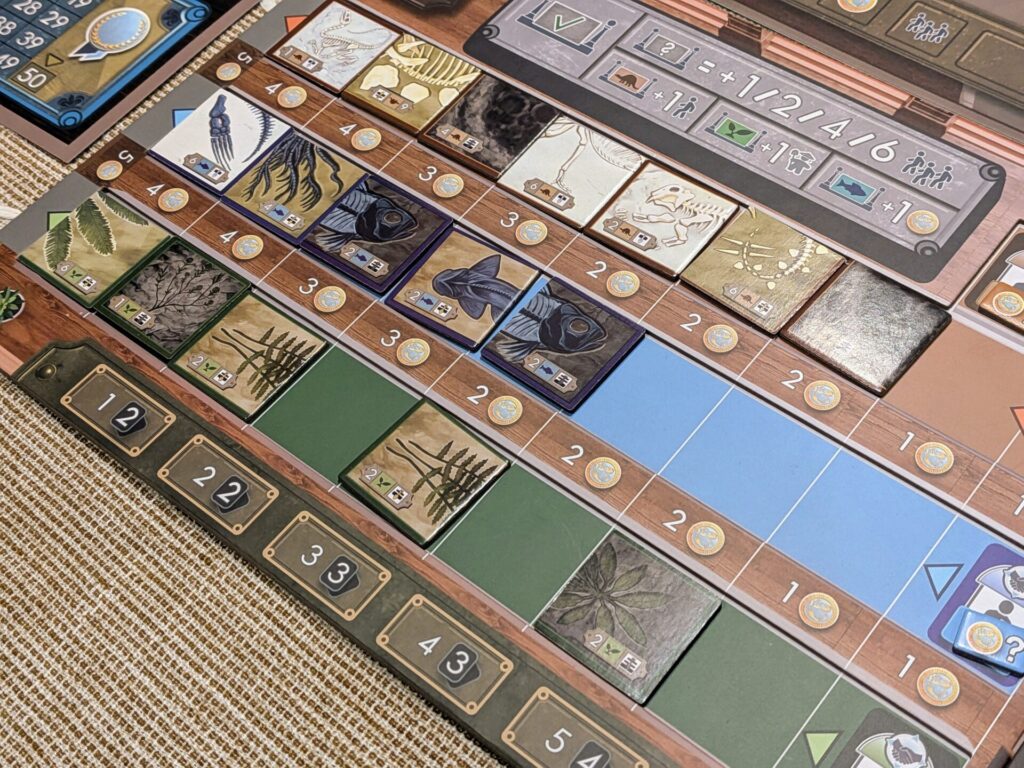
So you’re sending your palaeontologists out into the field, trowels and brushes in hand. They dig up fossils from different depths and ages, but there’s no guarantee they manage to find the parts they need to complete full skeletons. In practice, digging up fossils is done by drawing tiles out of bags and hoping for the best. Of course, there’s no guarantee you’re going to get the bits you want, so we need something else. Somewhere to buy and sell fossils. And luckily enough, we have exactly that – the market board.
The market looks like any other market from any other game at first glance, but this one has some key differences, not least of which is the way the players supply it. You can sell unwanted fossils and buy the parts you need, but the price you pay works on a kind of sliding scale. Pricing is led by demand, so the more fossils on offer, the lower the cost to buy, and the less money you’ll get when you sell to the market.
It’s a surprisingly deep economic wedge hammered into the side of the game, and another of those little extras which elevates it in terms of complexity and uniqueness above other tile-layers. What makes it especially interesting is that when you come to buy, all of the fossils you buy in one go are all at the lowest cost, so timing your trades can be crucial.
By far my favourite piece of interaction in Fossilium is the Donate action.
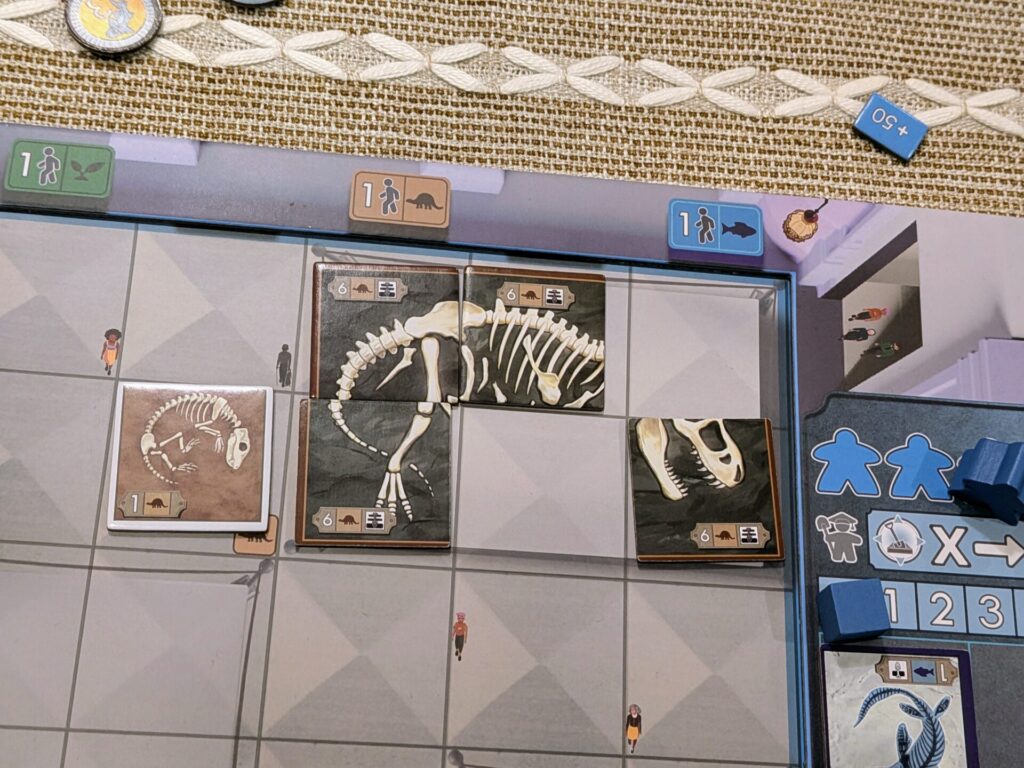
Some of the fossils you put together can have up to six pieces in them. As long as you’ve got at least half the pieces you need, you can put your partial skeletons on display. The donation actions throw all your planning in the bin, though. Let’s say we’re playing a game and I can see you’ve got a six-piece fossil nearly finished. If I hold the sixth and final piece, I can make a forced donation to complete it. I come along and play Pin the Tail on the Plesiosaur and finish it. You get the completion bonus for your newly completed fossil, but I get the VPs from finishing it. On top of that, you might be holding a now-useless plesiosaur tile in storage.
It’s a wonderful layer of interaction that’s absent in so many modern Euro games. The best part is that it’s not pure take-that either. You get something out of it when someone donates. They do too. It’s like someone’s come along and given you a swift kick in the beanbags, then given you an ice pack and somewhere comfy to sit.
Public exhibition
We’ve already got these juicy mechanical morsels on our plate, and the waiter at Fossilium just keeps bringing more to whet your appetite. You’ve been out digging and shopping. You’ve got the perfect stash of fossils to display, but now you have to choose whereabouts in the museum each is going to go. Space is limited, and there are some difficult decisions to be made.
Your boards have marked entrances and shops on the side of the tile grid that correspond with the different types of fossils in the game: flora, terrestrial and aquatic. During income and tour actions, you can get a bunch of money and guests based on how many matching fossil tiles are in line with each. These are important, guests especially, because during the Opening phase in each round you’ll get VPs based on the number of guests who come through your doors.
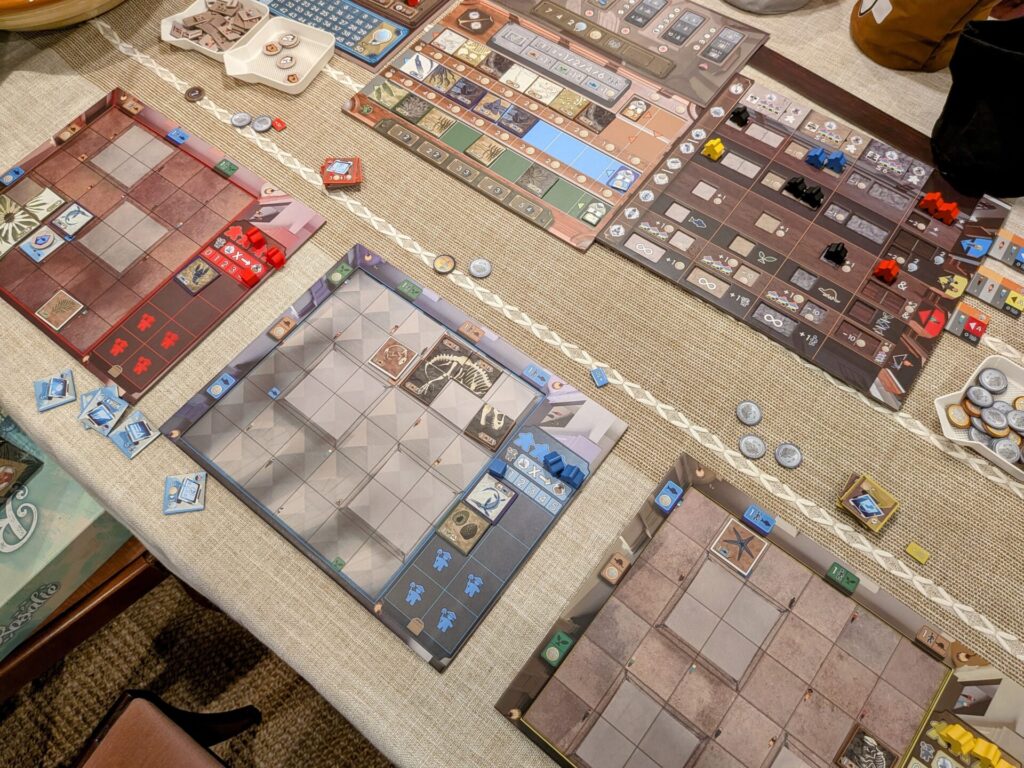
I really like the way tracking guests is handled in Fossilium. You have slide-out tracks under the edge of the board, and every time you gain another visitor, you just slide it out a bit. It’s a really neat visual tool; it looks like you have a queue of people just desperate to come through your doors and spend their hard-earned cash after staring in awe at your prehistoric exhibits.
All of this chatter, and I still haven’t even touched on intern workers, end-of-round objectives, bonus actions, and a bunch of other stuff too. Fossilium ties all of these pieces together to make a cohesive whole, rife with interaction, laughing, and curses hidden beneath sharp intakes of breath.
Final thoughts
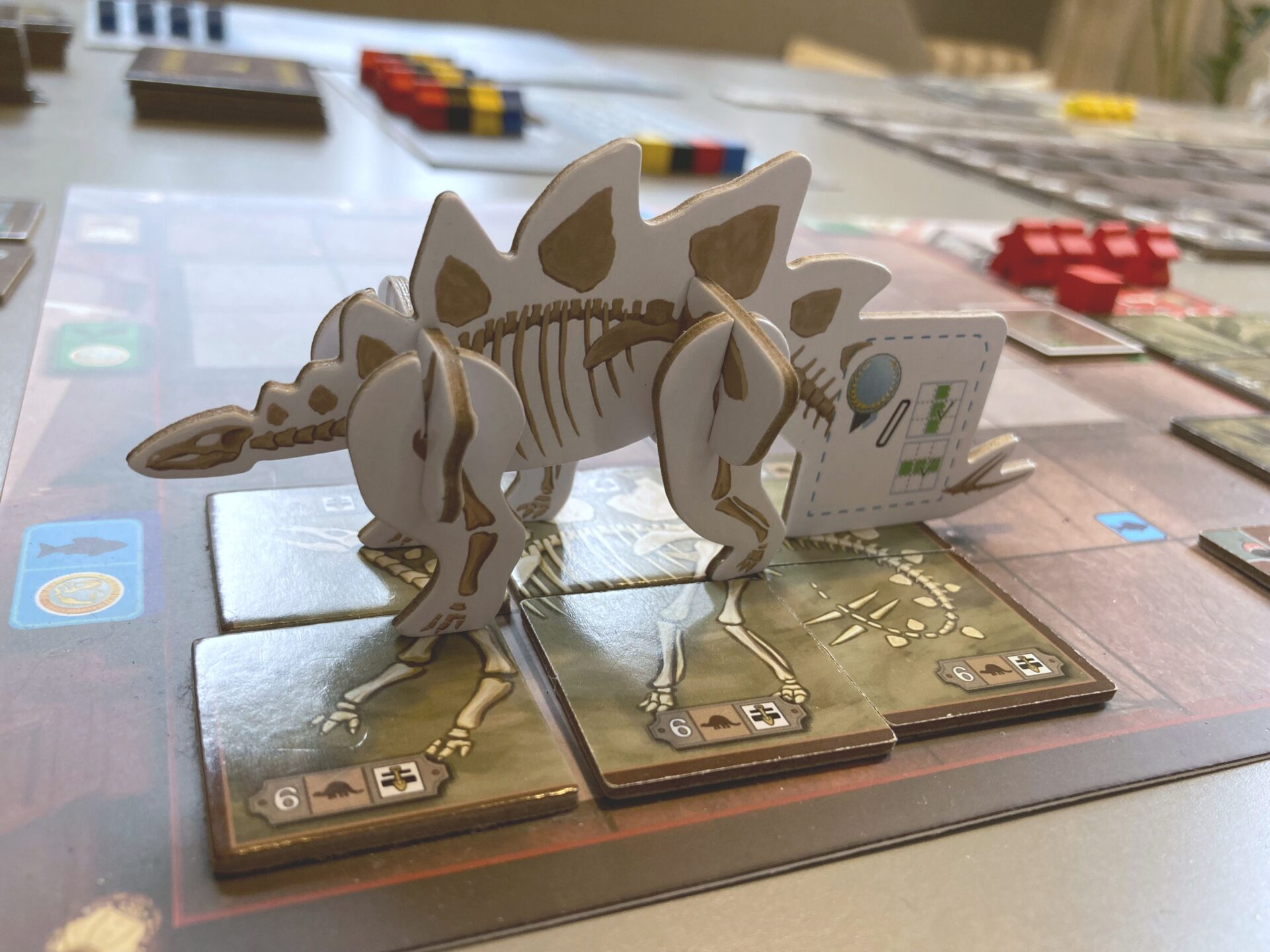
Fossilium really surprised me. I was expecting a middle-of-the-road, tile-laying, set-collection game. What I got was a tightly woven tapestry which manages to make a really thematic game about developing and running a dinosaur museum. I didn’t even mention the cool (if unnecessary) 3D cardboard dinosaur skeletons you can build and put on the completed exhibits.
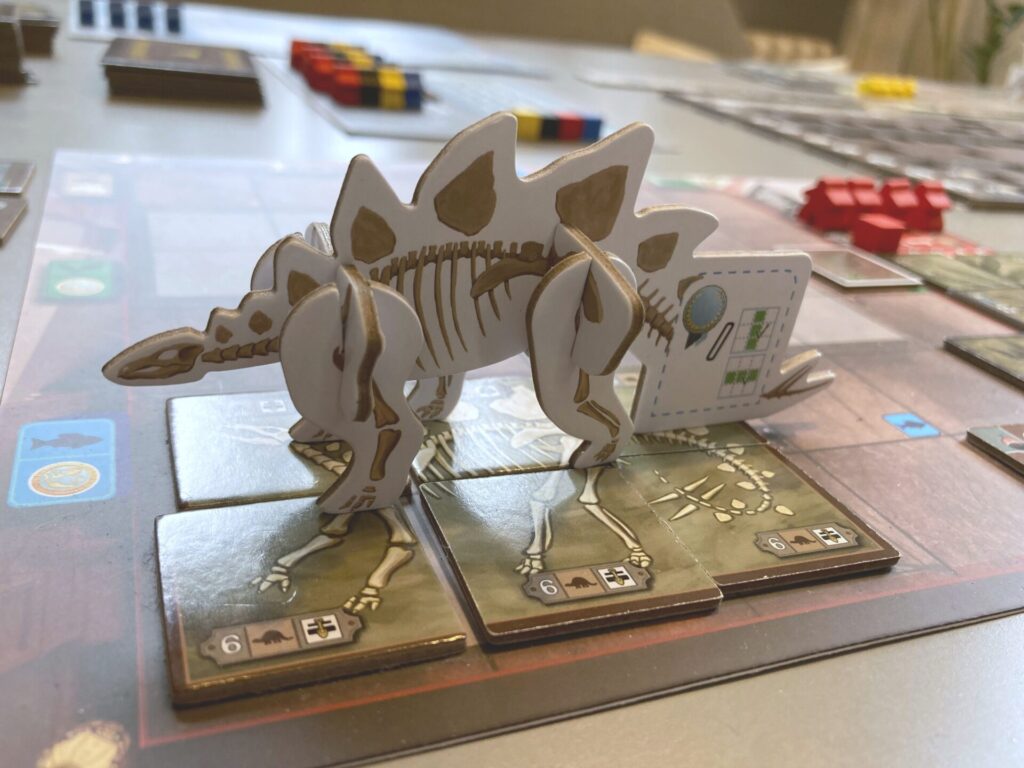
I should mention at this point that the copy of the game I was supplied with was a pre-production version with two important problems. Firstly, once punched, the game didn’t fit back in the box. Secondly, the entire thing is in French. Despite these being problems you won’t face in the final game (unless you’re French and buy the French version, I guess), I should note that there are a LOT of bits in the box, so set aside some punching and sorting time.
Importantly, though, despite having to work from a PDF on a tablet instead of a normal rulebook, I was able to learn the game from start to finish and to teach others, with minimal trouble. Shockingly, this is the second game about finding fossils and displaying them I’ve reviewed (go and check out my First Giants review) this year, and both of them have been absolute belters.
Don’t let Fossilium slip you by when it launches on Kickstarter very soon. Head over to the campaign page and sign-up to be notified.
Pros & Cons
Pros
- A great mix of tiles, sets, and worker-placement
- I love how much player interaction there is
- The theme absolutely sings to me
Cons
- It might be more complex than some people would expect
- It takes up a lot of room on the table
THANKS TO MY SUPPORTERS
Krissie  Craig Paul Brendan Brett Gary Becky
Gavin Chris Mark Johan Richard Simon Ben Sam (new!)
Help me keep Punchboard independent by joining the supporters

 Buy me a coffee

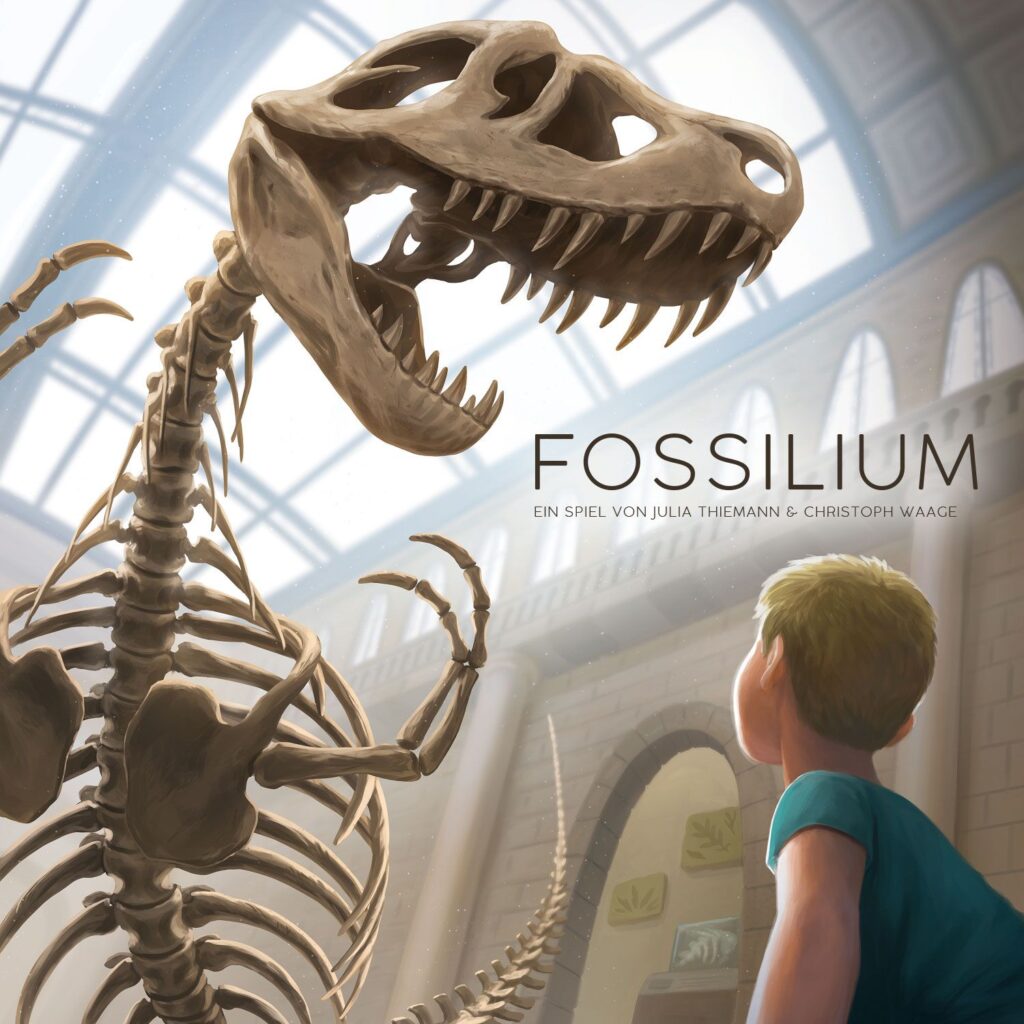
Fossilium (2025)
Design: Julia Thiemann, Christoph Waage
Publisher: Sinister Fish, Giant Roc
Art: April Borchelt, Gastón Santibáñez Engemann, Dennis Lohausen
Players: 1-4
Playing time: 60-120 mins
More games like this one