
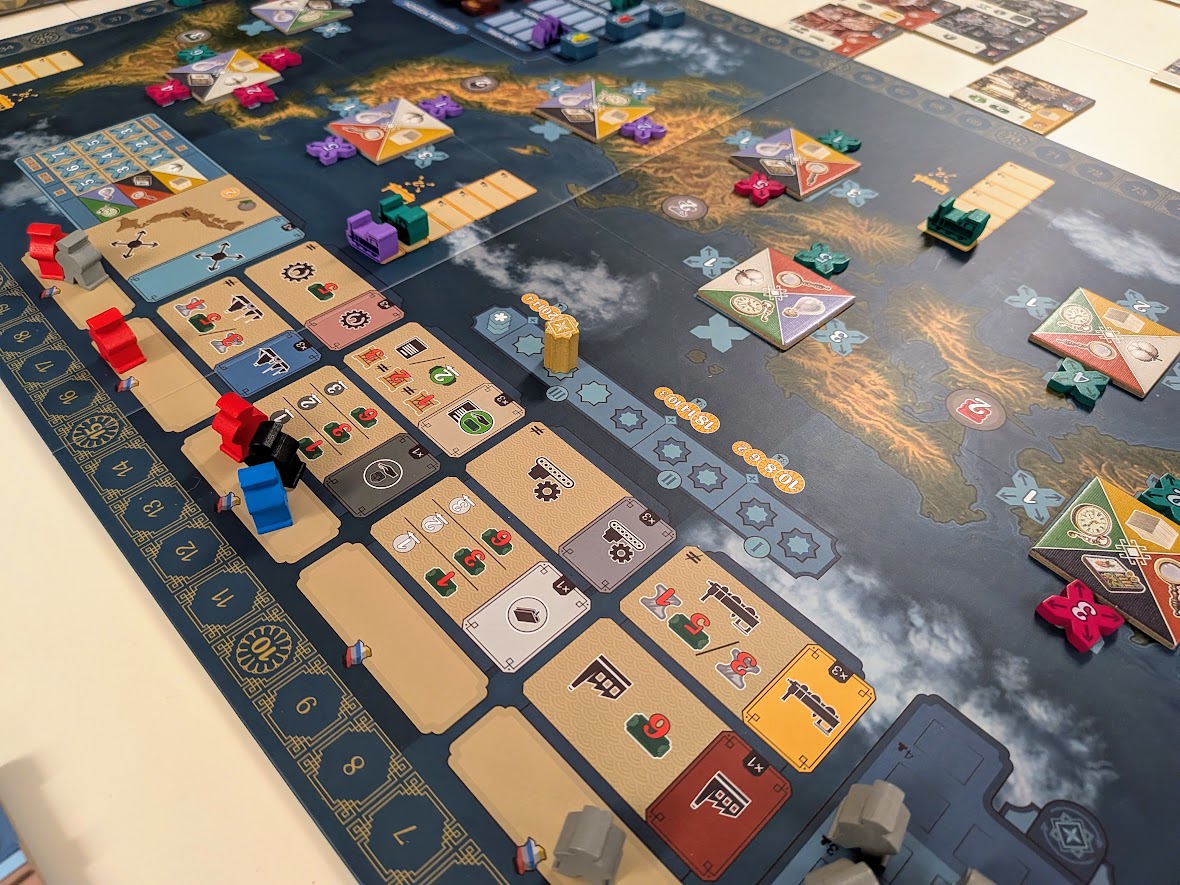

Nippon Zaibatsu is a reimplementation for the tenth anniversary of the original game, Nippon. I’ve never played the original because it was hard to find, which was frustrating as I’d heard a lot of good things about it. Fortunately, its younger, more refined sibling is out now and is much easier to get your hands on. The components and design have had a bit of a makeover, and some of the rules and mechanisms have had the rough edges knocked off of them. So while I can’t tell you directly how one compares against the other directly, what I can tell you is that Nippon Zaibatsu is fantastic, and already looks like being one of the forever games in my collection.
VERDICT
players 1-4 | playing time 60-120 mins
Nippon Zaibatsu streamlines an economic classic, adds a great solo mode and a huge amount of replayability. It’s a fantastic game.
economic
supply & demand
solo
player interaction
Let me tell you why.
Talkin’ bout a revolution
Nippon Zaibatsu is set in an era riding the crest of the wave of Japan’s industrial revolution. The country wants to be reliant on itself for the things the nation needs. From basics like cotton and paper, through to more modern necessities like clocks and lightbulbs.
As players, you each control a Zaibatsu (a conglomerate) looking to make your fortunes in these industries. You create factories to produce goods, build trains to move freight, mine for resources, and even send ships to the other side of the world to get specialist training for your workers.
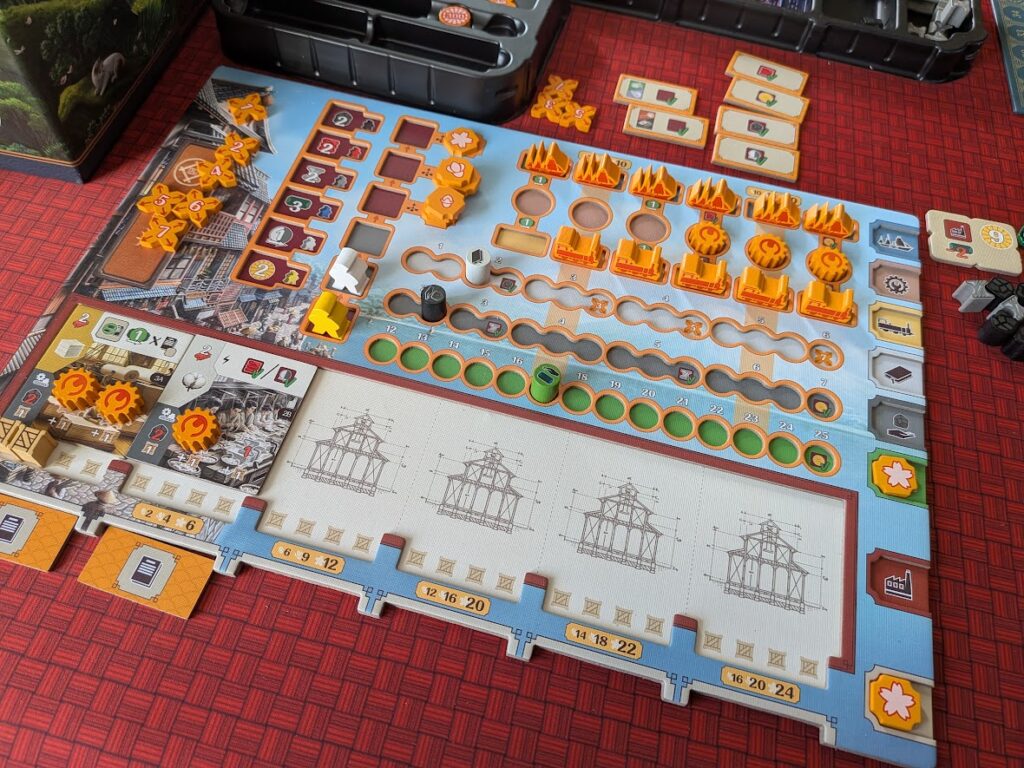
In practice, what we’re talking about is a kind of reverse worker-placement game. A worker-displacement game if you will. Each player has a (rather swanky) dual-layer player board full of potential. Space for factories and goods, trains, ships and machinery just waiting to be built and used, and spaces for workers.
At the top of the joyfully small main board (please publishers, do this more often. Bigger isn’t always better), there are action areas with a group of meeples standing above them. To take an action, you take a meeple, place it on your board, and carry out one of the actions from the area it was in. Easy stuff. Each of the meeples is one of six colours, and while it doesn’t matter which colour with regards to the action you take, it matters a huge amount when it comes to the income round, or as Nippon Zaibatsu calls it, consolidation.
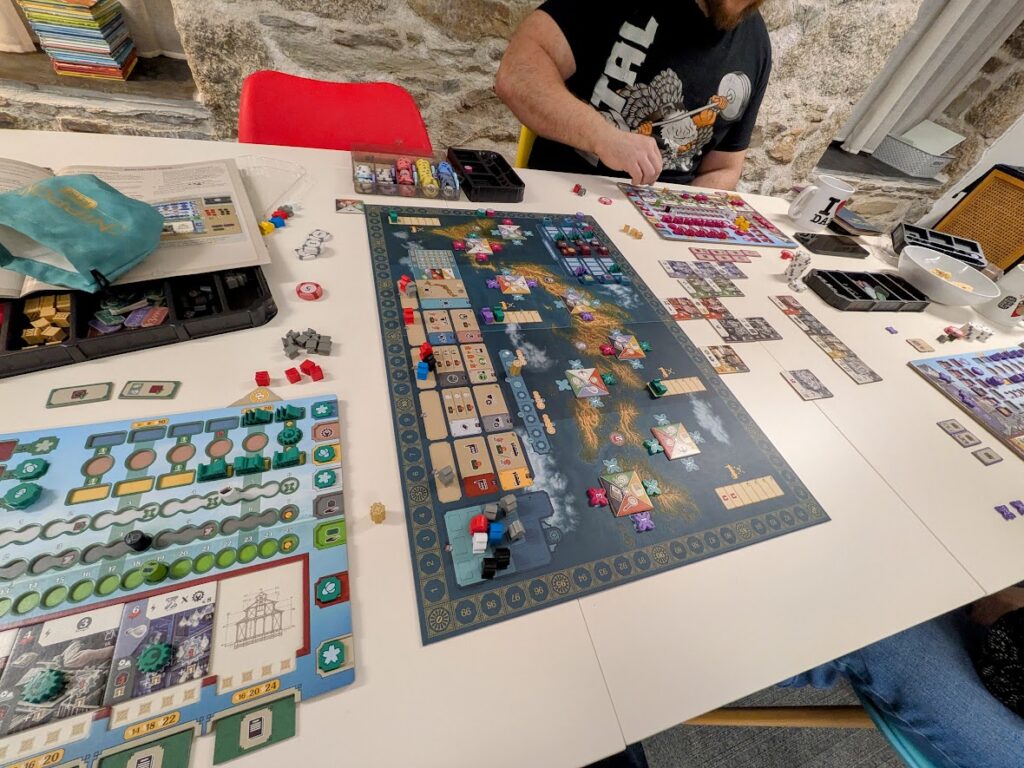
You see, on your player board, you have space for up to six workers. When those spaces are full, or when you run out of resources, you can consolidate. You’ll get income of coal (used for running factories) and money, but some of that money is absorbed in wages. The wages depend on the number of different coloured workers you have. The more colours, the less money you have at your disposal in the next round, and money is this game is tight. This is made tighter still by the rule that says the first thing you do when consolidating is to discard ALL of your leftover money and coal. Use it or lose it.
So it makes sense to always take workers of the same colour when you can, right? Well, yes and no. While a lack of variety keeps costs down, during income you get the associated income of the colour of the bottommost worker. A red worker gets you silk, a grey one gets you steel, etc. But if you manage to get a different coloured worker in the topmost spot, you get that income too. And of course, sometimes there’s just no choice. If you want to take that action, you’ve gotta take one of the workers there regardless of colour.
Just writing about this mechanism makes me itch to play the game again. It’s such a simple concept, but so engaging. And all of this preamble is just the grease that smooths the gears of industry. With a relatively small number of different actions available, Nippon Zaibatsu feels incredibly open and sandboxy.
Supply and demand
As I mentioned right at the start, this is a game about making stuff and shipping it. Each local market across the map of Japan on the main board has a tile denoting its demand, and the current supply strength from overseas. If you’ve got the funds, you can build factories from the market and add them to your board. On a later turn, if you’ve got the coal, you can produce goods in those factories. You remember the machines I mentioned? If you add those to your factories, they become more efficient and make more things.
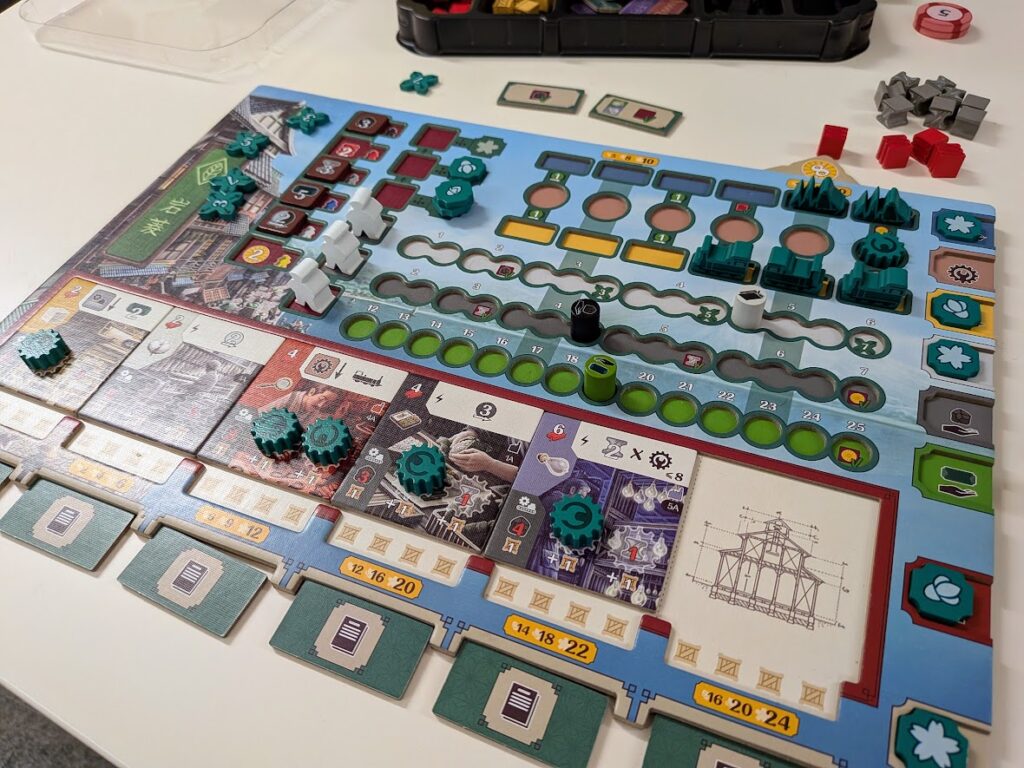
The amount of a particular thing you can provide is important. The biggest part of the game, and the part where all of the player interaction comes from, is in supplying Japan.
Let’s use a hypothetical. My bustling paper factory has produced two crates. When I take the local markets action, I can trade those two crates in and place my number 2 marker on a paper space. I’ve now got some influence in that quadrant of the map, which becomes really important during each of the three scoring rounds during the game.
There are a couple of really important things to note at this point, though. Firstly, you only get one marker with each number on (there are some extras unlockable on a track later in the game). So now my 2 marker is gone. If I want to supply two cotton later, I can’t. Worse still is the fact that a rival paper factory can produce three and knock my 2 marker off the board with their bigger 3. I get my 2 back, but at what cost?
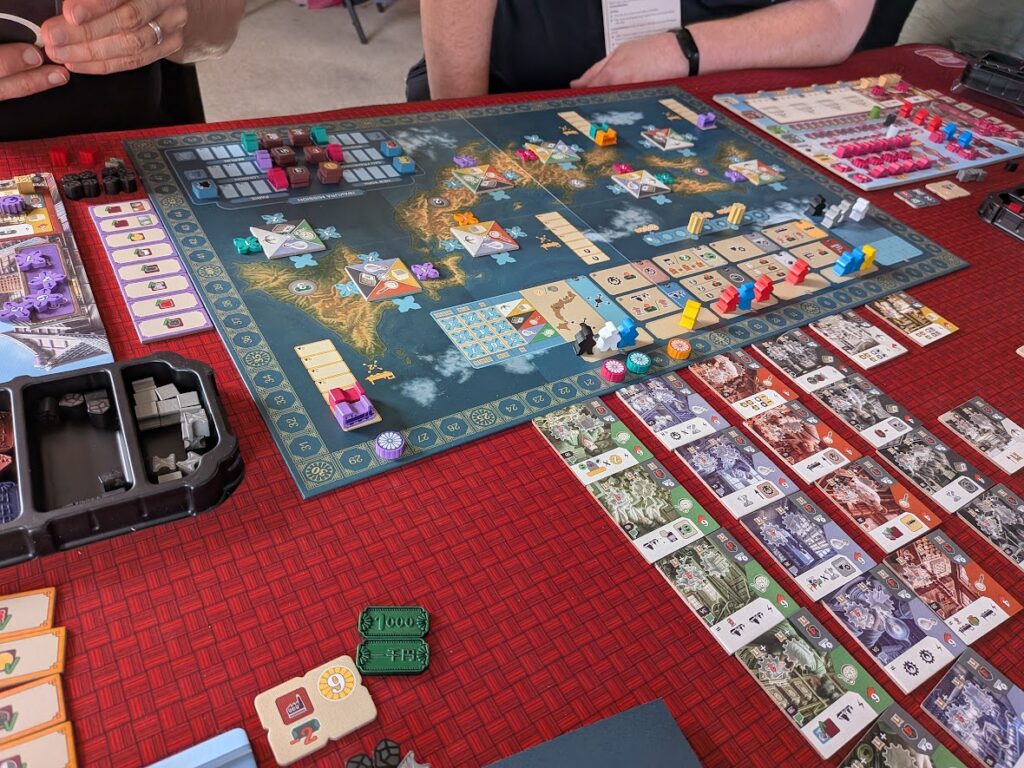
There’s this glorious tug of war across each of the four regions as players vie for supply dominance. While that seems like a relatively light area-majority mechanism, there are even more things going on beneath the surface.
I’m not going to explain every last nuance here, but even in that local markets action, there’s so much at stake. When you place a marker in a region, you get that region’s associated bonus. So if you need some steel, you can supply a steel region and get some more steel. That steel can be used in a future action to build a train. Trains get placed in map regions to boost your total, which in turn helps you win the scoring there. Getting trains off of your player board helps with getting bonuses from your board, and can help towards your unique end-of-game scoring conditions, too.
I didn’t even mention that part yet. The Consolidation action unlocks marker tiles, which you can plug into the edge of your player board, and these dictate which things you score points for at the end of the game. If you think you’re going to max out that R&D track (your R&D level dictates which level of factory you can build), stick one of the max value tokens in that part of your board.
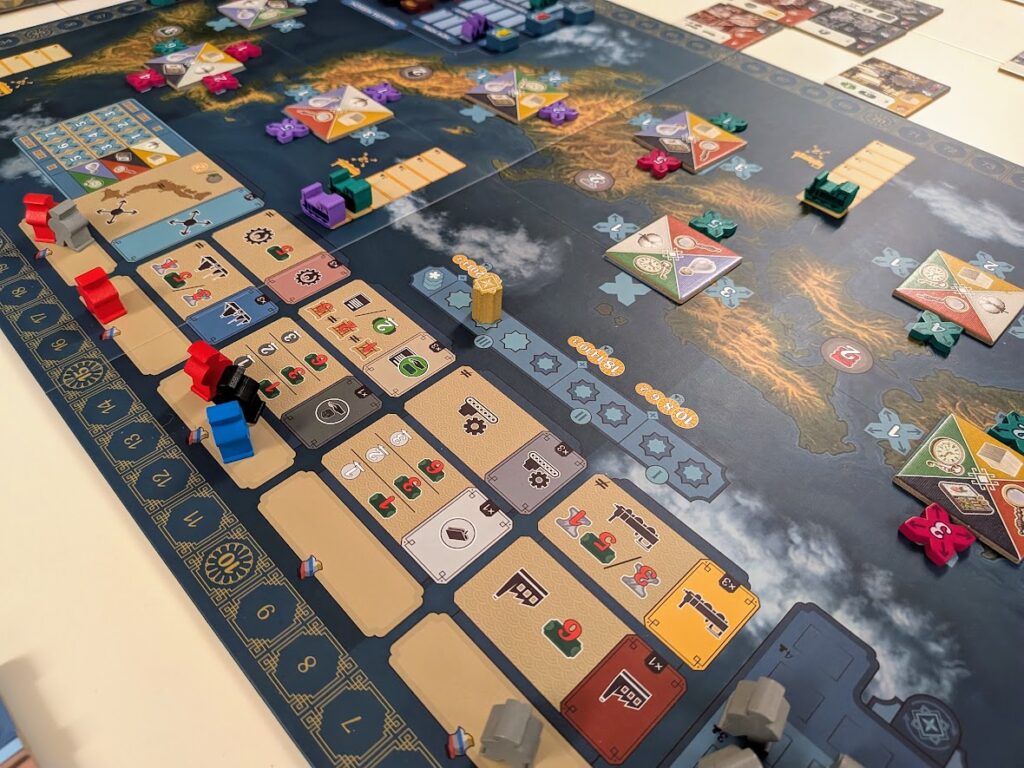
That’s the wonderful thing about Nippon Zaibatsu. Nothing is done in isolation. Every single thing you do touches the game in multiple ways. Resources are tight throughout the game, so even just getting an extra piece of coal for placing a train in one of the top two train spots on the coal region can make the difference between eking out one more turn and consolidating early.
Heavy industry
While I want to wax lyrical about Nippon Zaibatsu and get everyone playing it, there are things about it which, while not objectively bad, might mean it’s not the game for you or your group.
Firstly, it’s definitely a game where a lack of planning can see you screwing yourself over badly. We’re not talking Food Chain Magnate levels of self-sabotage, but just going into it with a ‘push the buttons and pull the levers and see what happens’ approach can see you doing poorly. If you’re okay with that during a learning game, that’s fine, but it is something to be aware of.
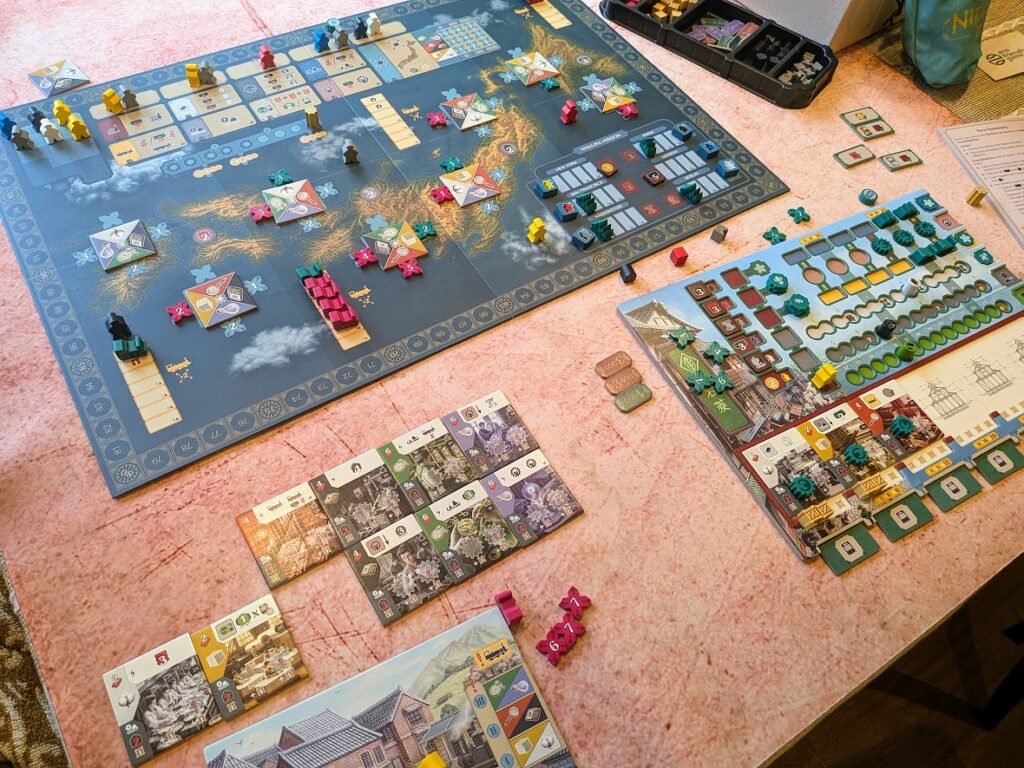
Secondly, those of you who don’t like bumping shoulders with other players aren’t going to enjoy the hustle and bustle of the local markets dynamic. You’ll have your markers bumped off the board, and you’ll do the same to others, but you have to go into the game knowing that it’s an inherent and important part of its DNA. It is possible to play and focus on completing your private contracts (another way of using your factories’ goods to get bonuses and end-of-game scoring), but you’d be missing out on a lot of what makes Nippon Zaibatsu unique.
If you hadn’t already guessed, this is a heavy game with a lot of moving parts. Its small board and cheerful colours belie a game with a lot of strategic depth.
Final thoughts
If it wasn’t already obvious, Nippon Zaibatsu is a firm favourite of mine. I love it when a game does simple things and says, “There you go, do what you want with it”, which is exactly what it does. Factories cost six money. Machines cost five money. Boats and trains cost either three steel or five money and a steel. The cost in coal to produce is either two, three, or four, depending on the level of the factory. The point being, you don’t have to do the mental gymnastics of converting one thing to another, and running some kind of convoluted supply chain in your brain.
This is a game of fine margins and timing. You know what the triggers are for the round marker to advance, and when the scorings will happen. You can see which colours of workers will fill the empty spaces. The thing you don’t know is what things will look like when it comes around to your turn again, and the skill comes in how well you can adapt on the fly. If you want to shake things up a bit, there are two included, optional modules. One is a shared objective board, and the other introduces some late-game optional factories which can really boost your score.
Solo fans will be pleased to hear there’s an easy-to-run automa bot to play with. It’s a beat-your-own-score affair with three difficulty levels, but it’s so simple to use that it serves as a great practice aid if nothing else. Three and four players is where Nippon Zaibatsu shines. I’ve loved every play of it so far, and the fact that it’s so relatively compact and quick to setup and put away means it’s a game I’m going to come back to for a long time.
We’re not even halfway through 2026 at the time of writing, but Nippon Zaibatsu is an early frontrunner for my heavy game of the year. Wonderful stuff.
Where to buy Nippon Zaibatsu
As an affiliate, I may earn a commission from qualifying purchases made through these links, at no extra cost to you. This helps support Punchboard.

UK

US

EU/International
Pros & Cons
Pros
- Quick, easy actions which don’t take much to learn
- A hugely entertaining battle for supply supremacy
- The production values and presentation are great throughout
Cons
- It’s not very forgiving of mistakes
- Those of you who dislike direct interaction might not enjoy this
THANKS TO MY SUPPORTERS
Krissie  Craig Paul Brendan Brett Gary Becky
Gavin Chris Mark Johan Richard Simon Ben Sam (new!)
Help me keep Punchboard independent by joining the supporters

 Buy me a coffee
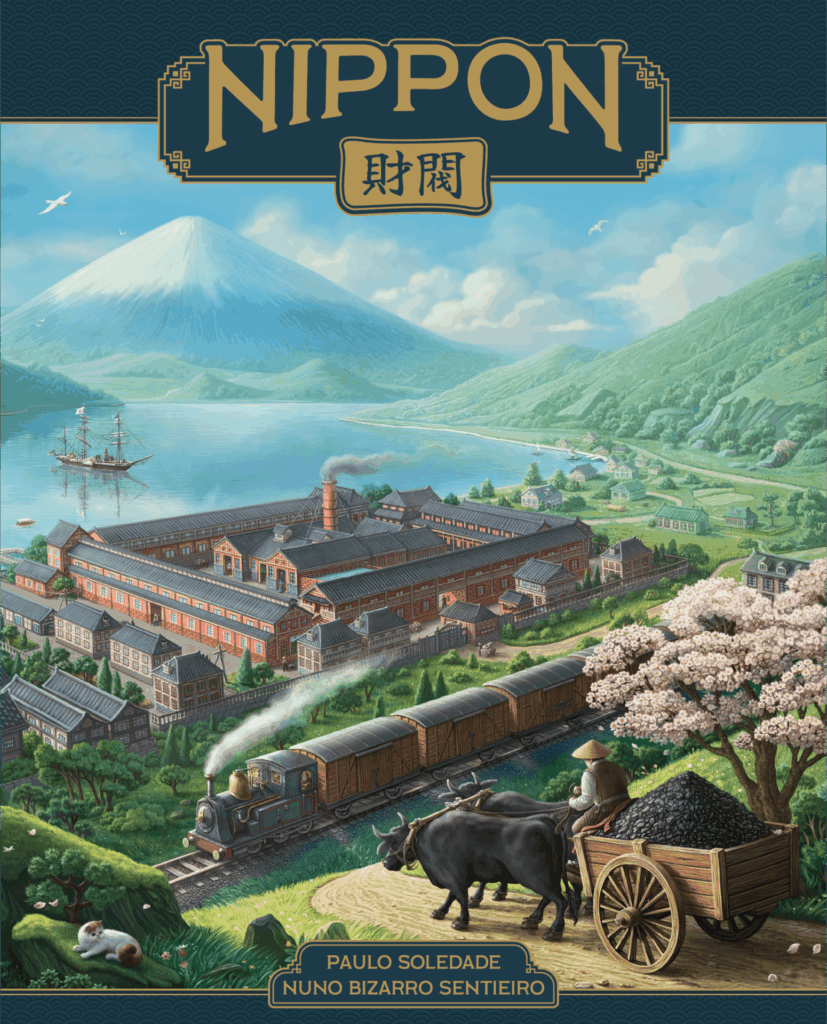
Nippon Zaibatsu (2026)
Design: Nuno Bizarro Sentieiro, Paulo Soledade
Publisher: CrowD Games
Art: Maya Kurkhuli
Players: 1-4
Playing time: 60-120 mins
More games like this one



Totally agree. Nippon is fabulous. Played friends’ copies a couple of times but had to get one of my own. Can’t see it ever leaving my collection and I’ve just backed the expansion too.
The small main board is a definite plus, especially compared to Recall which I also received recently and has a silly big main board plus equally obnoxiously sized player boards. Should’ve expected this after Revive I suppose. I’m sure I’ll still love it regardless but being able to play four player on my small table is impossible.
I backed the expansion too, I’m looking forward to having even more reason to get the game played again.