
A copy of Salamandra was kindly provided by Hachette Boardgames UK. Thoughts & opinions are my own.
Salamandra is a worker-placement game with a twist, and that twist is just the sort of thing that might make you take a second look if you’re feeling overrun with worker-placement games. The added change of workers being stuck in place once they’re on the board adds a new layer of planning, leading to cascading, almost exponential levels of chaining and blatant shenanigans as the game heads towards its finale. Really interesting, really fun, and a ton of ways to build your strategy.
VERDICT
players 1-4 | playing time 60 mins
Salamandra’s twist on worker-placement combined with its clean ruleset and engaging gameplay, makes for a super solid middle-weight Euro.
worker-placement
set collection
permanent placement
sucker dart!
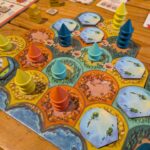
The first thing you’ll notice when you play Salamandra is that there’s no board. Instead, the game relies on modular tiles. Large, octagonal tiles represent the areas of the land and contain the spots where your workers go to work, and smaller, square grove tiles that fill the gaps between them. Being modular means that the players choose where the new tiles get added, and while there’s an inherent impetus to make sure you keep it all kinda square, be aware that you might need some room on your table if someone decides the board should branch out.
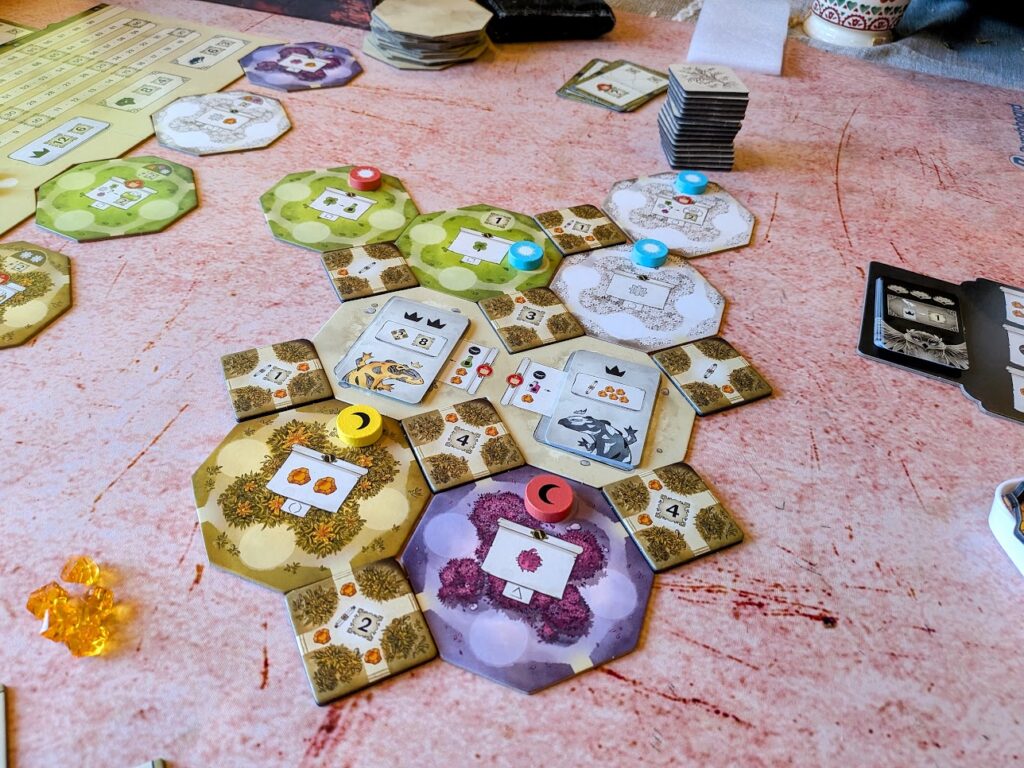
The idea behind the game is pretty simple, but how many times have you heard me say that? Salamandra is played over the course of two days, with each day having a daytime and nighttime phase, meaning there are four rounds in total. In each round, you get two or three worker discs to put out on the board. Each tile of the board has different benefits on it. Green billhook tiles, for instance, might allow you to harvest leaves. White ones give you flowers. Cauldron tiles let you transform your various ingredients into things like potions, which you can then use to gain other bonuses. Et cetera, et cetera.
The first big difference between this and other worker-placement games is that placing a worker doesn’t actually do anything. They just sit there, out in the wild, waiting for a task. A bit like an Uber Eats driver. When you do actually come to use one, they don’t actually produce anything tangible. You don’t get little cardboard chits or wooden tokens. Instead, you create a kind of verbal story. You know the way you narrate your turns normally in a game? “I’m going here to make a brick and a wood, then using that brick and wood to make a church, which in turn bumps me up the faith track…”. Yeah, that. That’s what you do in Salamandra.
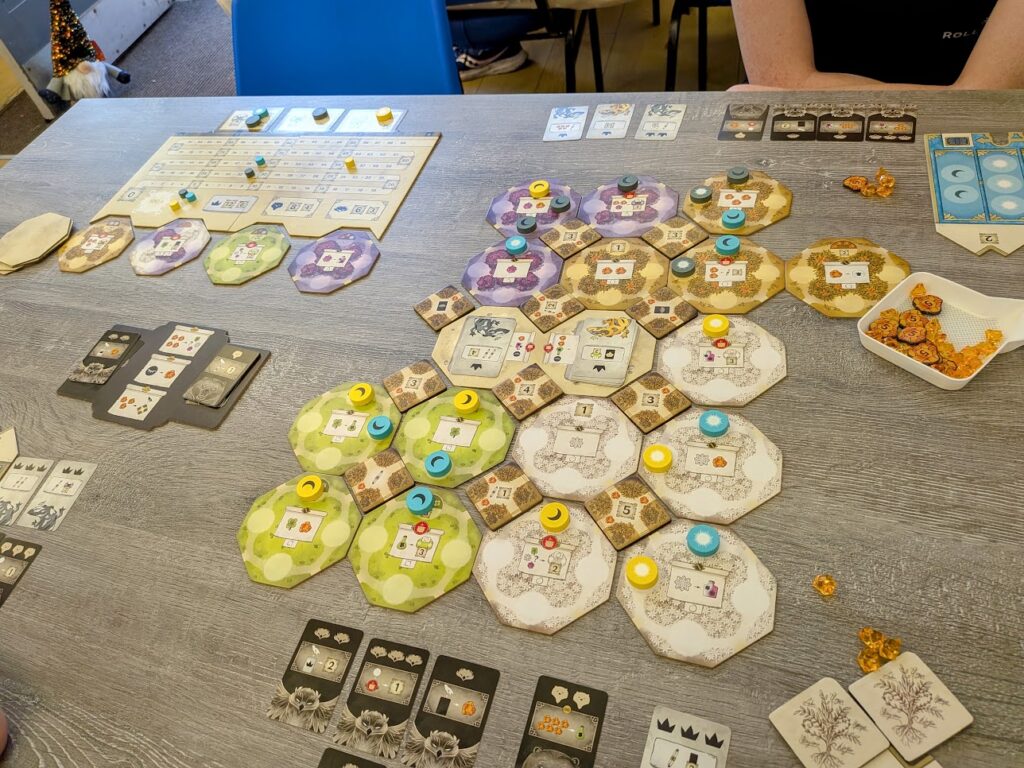
A really simple example is making a green potion. Let’s say you have a worker disc on a tile with a leaf billhook (billhook tiles are just ones that can be harvested to make a resource), and another on a tile with a cauldron, which can make a green potion from a leaf. You flip the worker disc on the leaf tile which means you have a leaf. You then flip the worker on the cauldron tile to turn that leaf into a green potion. Even then, that green potion isn’t something you physically gain, it’s just another thing that you’ll use somewhere else on that turn to make something else.
I’ve gone down this particular rabbit hole a little way because Salamandra looks and feels a bit different to other games, and it’s worth understanding what’s going on and why it makes a difference.
Flipping heck!
I mentioned before that a worker tile is flipped once it’s used. If it was on its day side, it’s now on its night side, and vice versa. That’s a visual clue that it’s ready to be used in the next phase which it matches. In the first round, you plonk down three day-side discs, and when you use them, they flip to the night side, and they stay there. In the next round – the night phase – you have two new night-side discs, PLUS the three that you placed last round. And that happens again, and again. So eventually you place ten discs out and try to figure out how to best combine them to get you stuff.
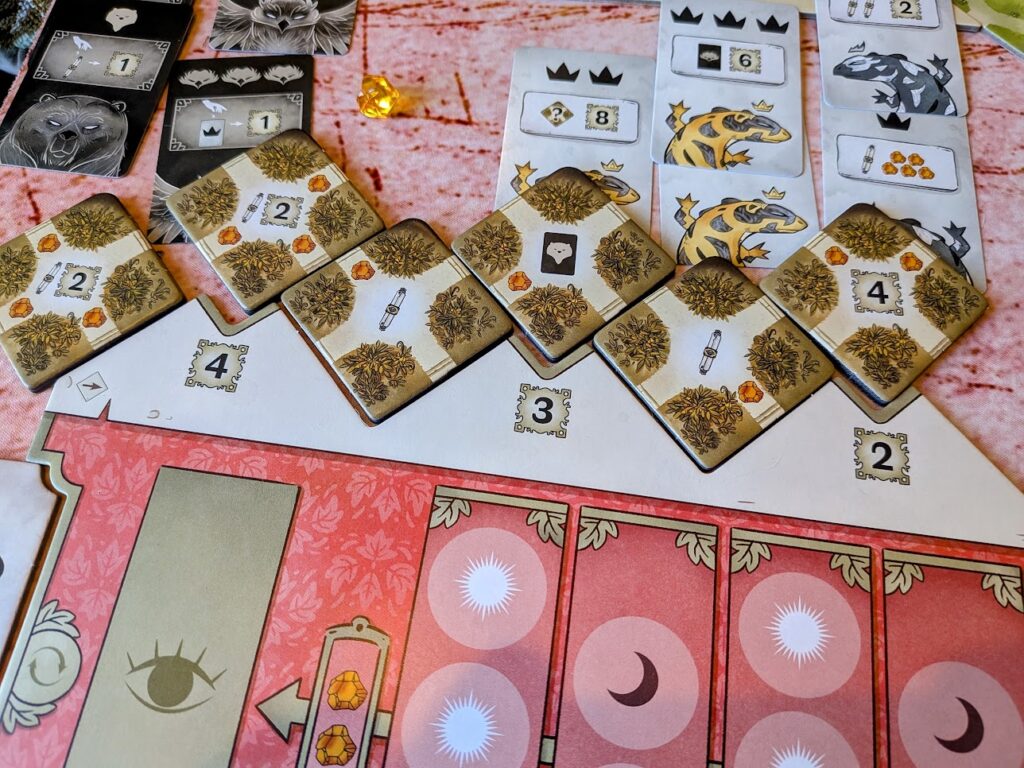
Stuff, in this instance, is things like divinity cards. Cards which get you ongoing powers, one-off bonuses, end-of-game bonuses, and icons which help towards majority scoring rules for the end of the game. One of the things I like is the way there’s no set round length. If a player wants to pass before the others because they don’t have workers to place or actions to activate, they can spend their precious crystals to harvest (take) the square grove tiles, get bonuses from them, and insert them on top of their player boards to get even more bonuses.
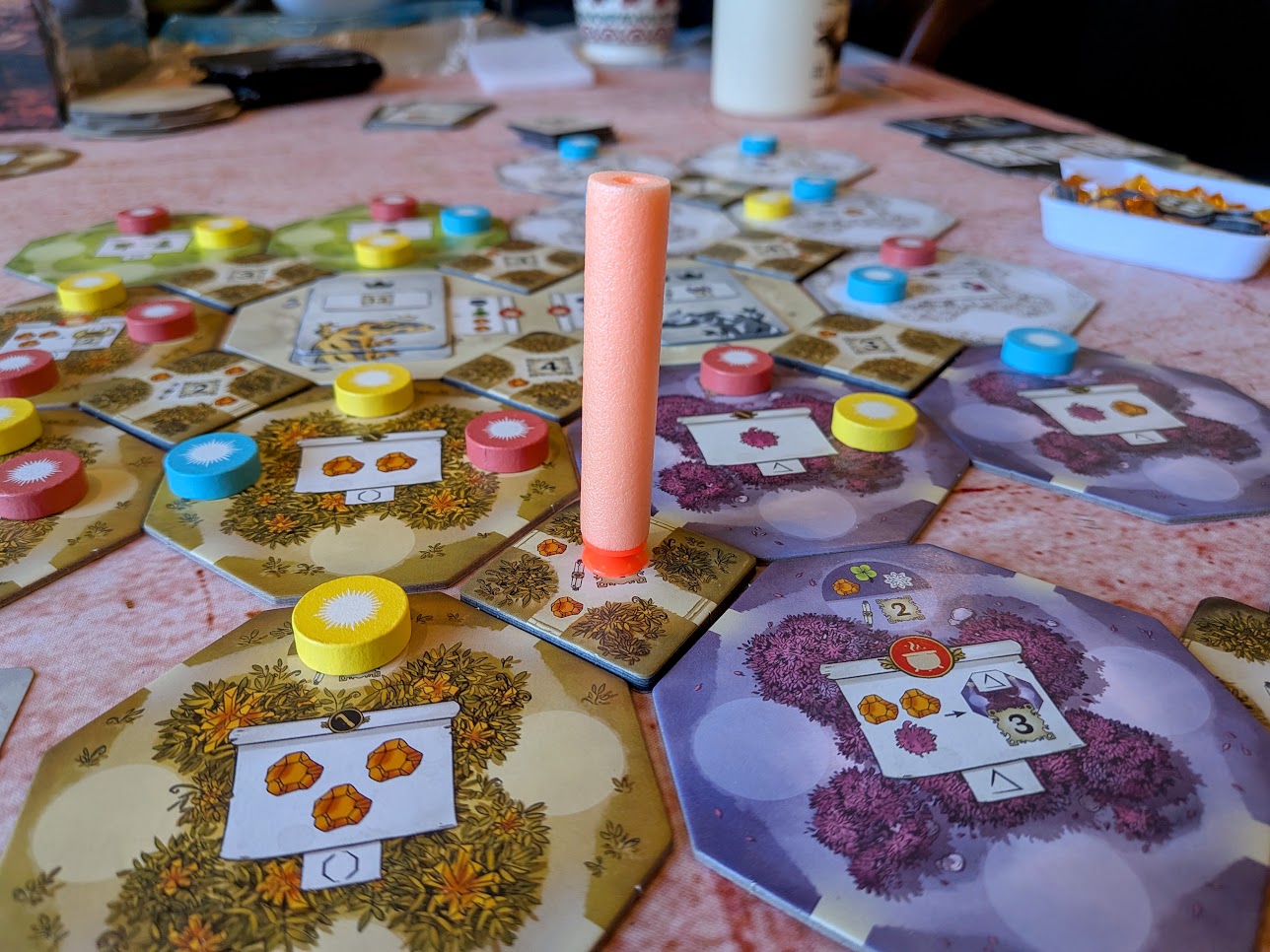
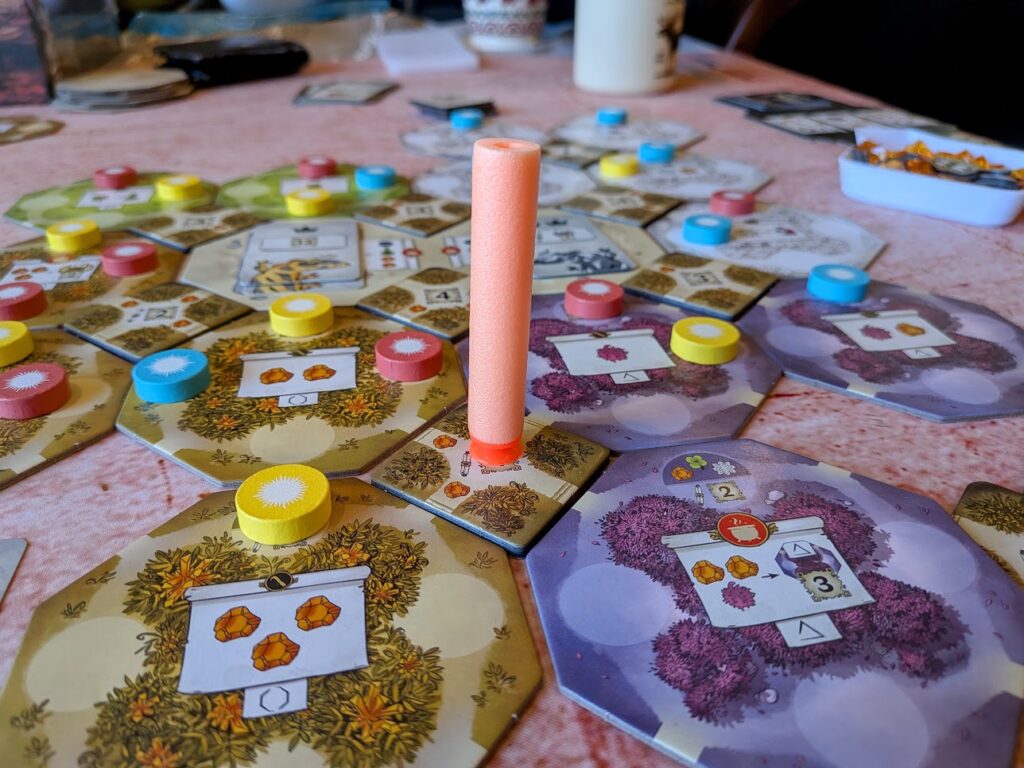
This leads me to my absolute favourite thing included in a board game for many years. Call it a toy, call it a gimmick, call it a quality-of-life improvement, call it what you want, but the sucker dart in the Salamandra box is genius. The little grove tiles are tightly tessellated in the bigger tiles, and you need to get them out without dismantling the board.
SHLUCK!
Stick the sticky Nerf dart on the tile and just lift it out. Words can’t explain how needless, how trivial, nor how much fun this thing is. More suckers in games, please, publishers!
Final thoughts
Salamandra is a very good game. I love the way that it offers an alternative for doing worker-placement if you want the feeling without the usual ‘place, gather, return’ loop. The planning is really rewarding, and if you’re one of those people who likes chaining things together, like in Vital Lacerda’s Inventions (read my review of Inventions here), you’ll get a kick out of Salamandra. That’s not to say it’s as heavy as Inventions. Salamandra is smack-bang in the middle of medium weight.
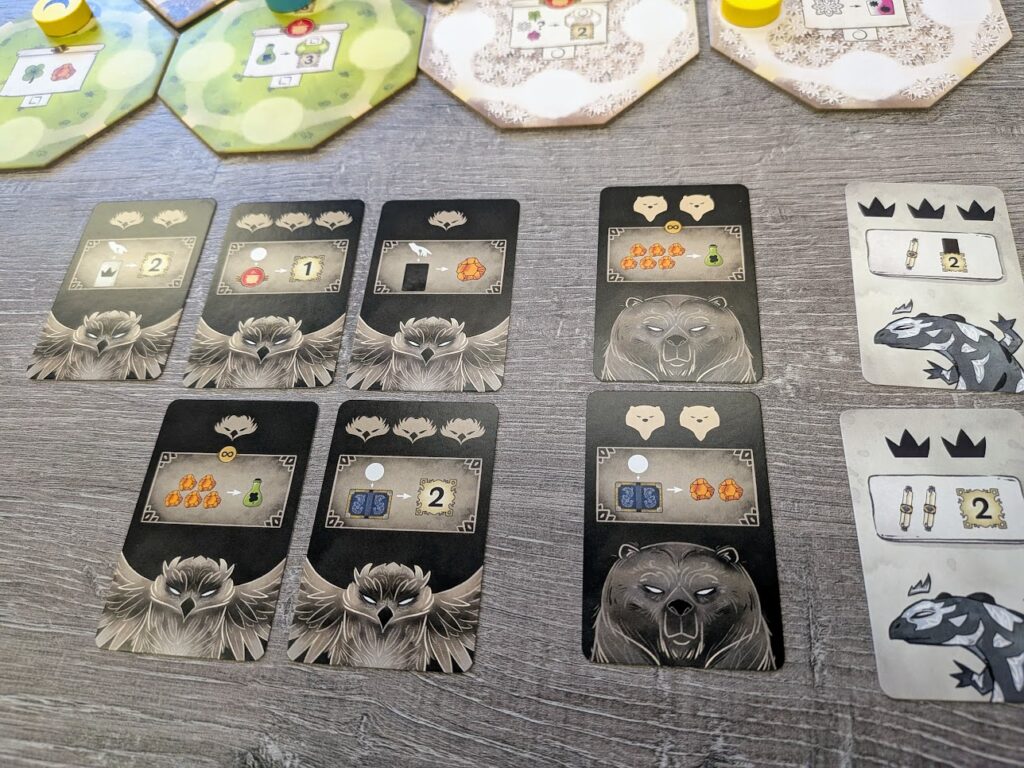
Salamandra’s biggest problem, for want of a better word, is that it doesn’t scream for your attention. The box is really pretty, but gives you no idea what sort of game it is. When you see it on the table, you have a mosaic of pretty bland tiles with flat discs on them. It’s not the sort of game that’s going to make you look twice. It also doesn’t do anything that’s going to make you go, “Wow, that was incredible!” It sounds like a strange thing to criticise a game about, but the market is SO crowded that it’s hard to make a lasting impression.
That said, everyone I’ve played Salamandra with has said that they really enjoyed it. That they want to play it again. That it’s simple to understand and that there were almost no occasions where we had to refer to the rules for clarifications or iconography lookups. The rules themselves fit on a double-folded page, which is such a nice change in a world of convoluted actions and appendices.
Salamandra might not set your world on fire, but if you’re looking for a clean, refined mix of worker-placement and set collection, it really ought to be on your radar. Especially because of the sucker dart!
Want to get this to the table?
Salamandra
1-4 Players | Ages 10+
Purchasing via this Zatu link supports Punchboard via an affiliate commission at no extra cost to you.
THANKS TO MY SUPPORTERS
Krissie  Craig Paul Brendan Brett Gary Becky
Gavin Chris Mark Johan Richard Simon Ben Sam (new!)
Help me keep Punchboard independent by joining the supporters

 Buy me a coffee
Pros & Cons
Pros
- A unique take on worker-placement
- Really clean rules and iconography
- Sucker dart!
Cons
- Not visually striking
- It’s hard to argue why it demands a place in your collection
Salamandra (2026)
Design: Pierre Giroux, Johannes Goupy
Publisher: GRRRE Games
Art: Camille Chaussy
Players: 1-4
Playing time: 60 mins
More games like this one