
A review copy of Snow Planner was kindly provided by Hiroki Ishi. Thoughts & opinions are my own.
Snow Planner’s success is because it keeps things plain and simple, not despite it. Once you dip your toes in the pool of Japanese Eurogames, you start to notice these things. Components are simpler. Boards are smaller. There’s very little bling to speak of. It’s the way European games used to be 15-20 years ago. If you’re not used to it, it can seem a little underwhelming when you first open the box, but don’t let that influence your opinion, because Snow Planner is a clever, engaging dice-as-workers game which could be right up your street.
VERDICT
players 1-4 | playing time 60-120 mins
Snow Planner takes the concept of a dice-as-workers game, layers on a lovely theme, and delivers a really solid Japanese import special.
worker-placement
dice-as-workers
asymmetric
engine-building
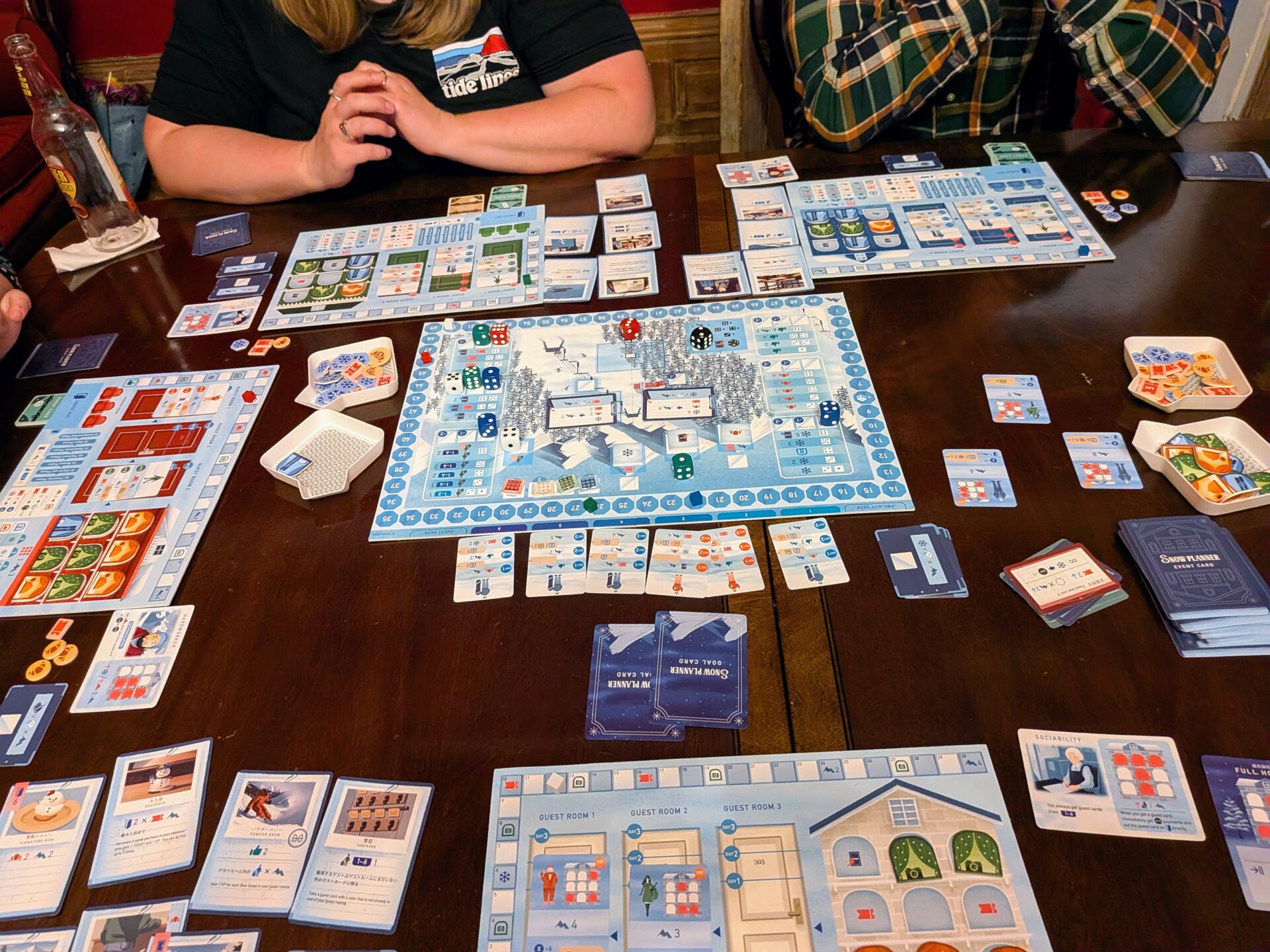
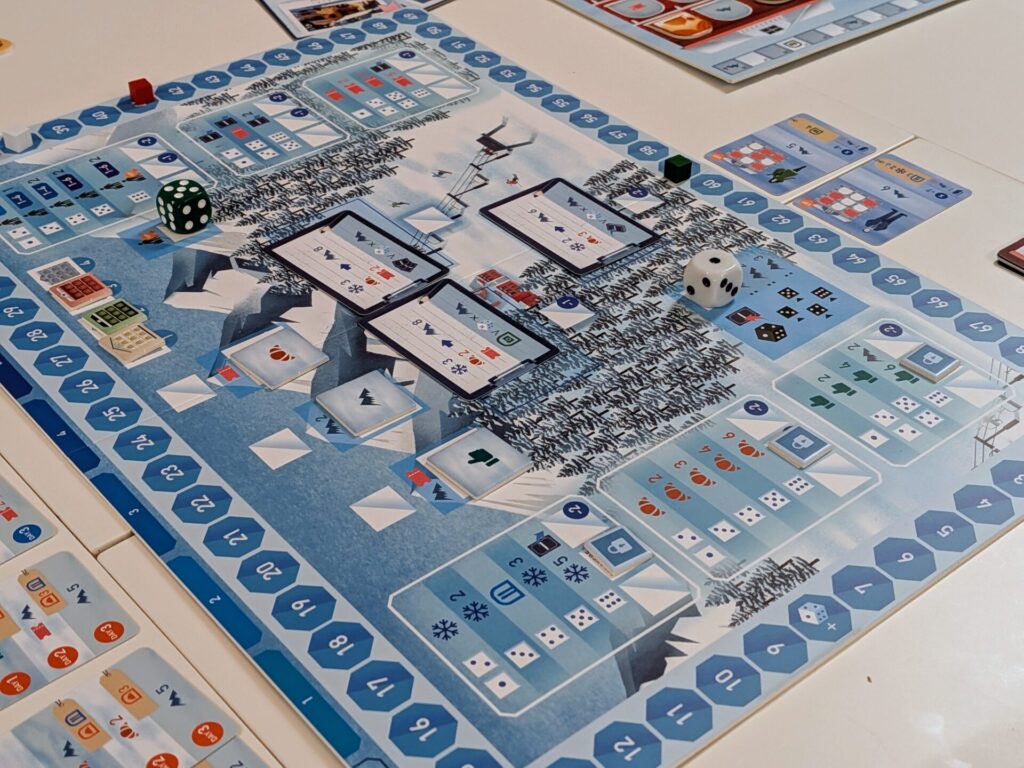
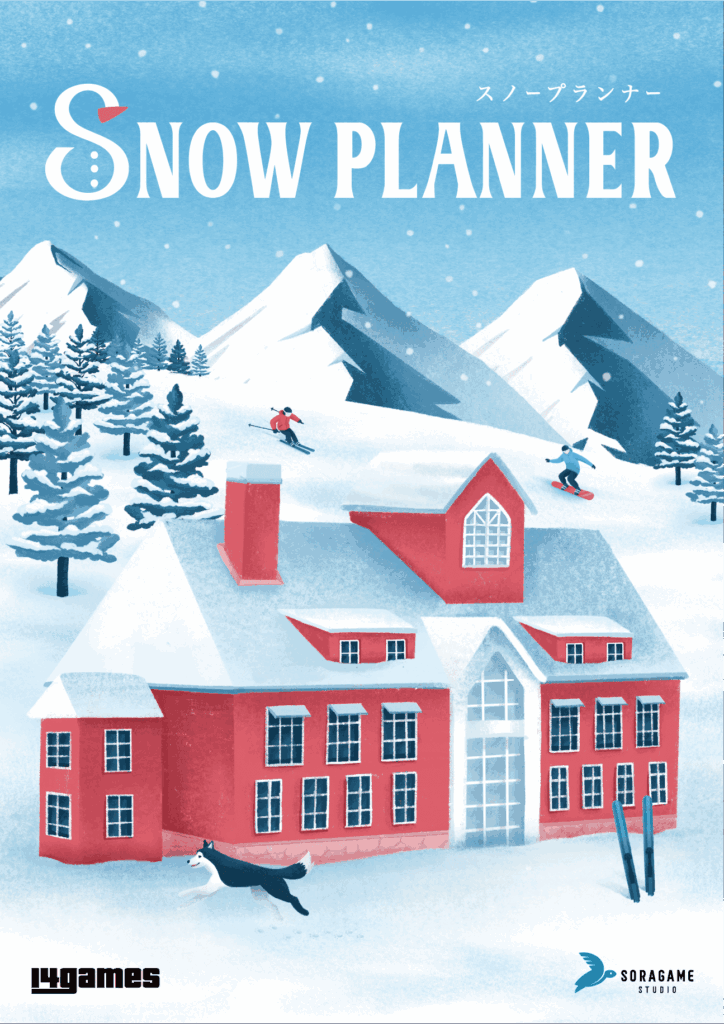
The premise is cute. You’re each running ski lodges somewhere up in the mountains. It’s your job to bring guests in and to hopefully keep them there, scoring lots of points along the way. It’s a worker-placement game of the classic kind, with the twist being that the workers are dice. Dice that you’ll never roll. The pip value on the dice represents the worker’s strength, and that strength determines what you’ll get when you visit a worker space on the board.
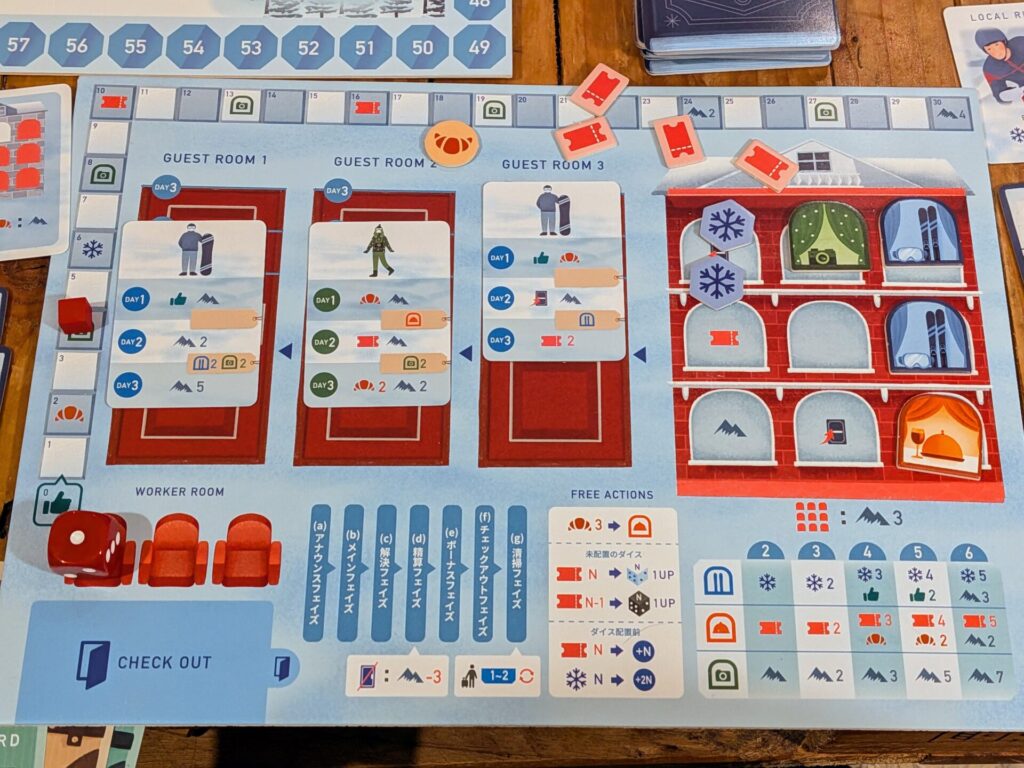
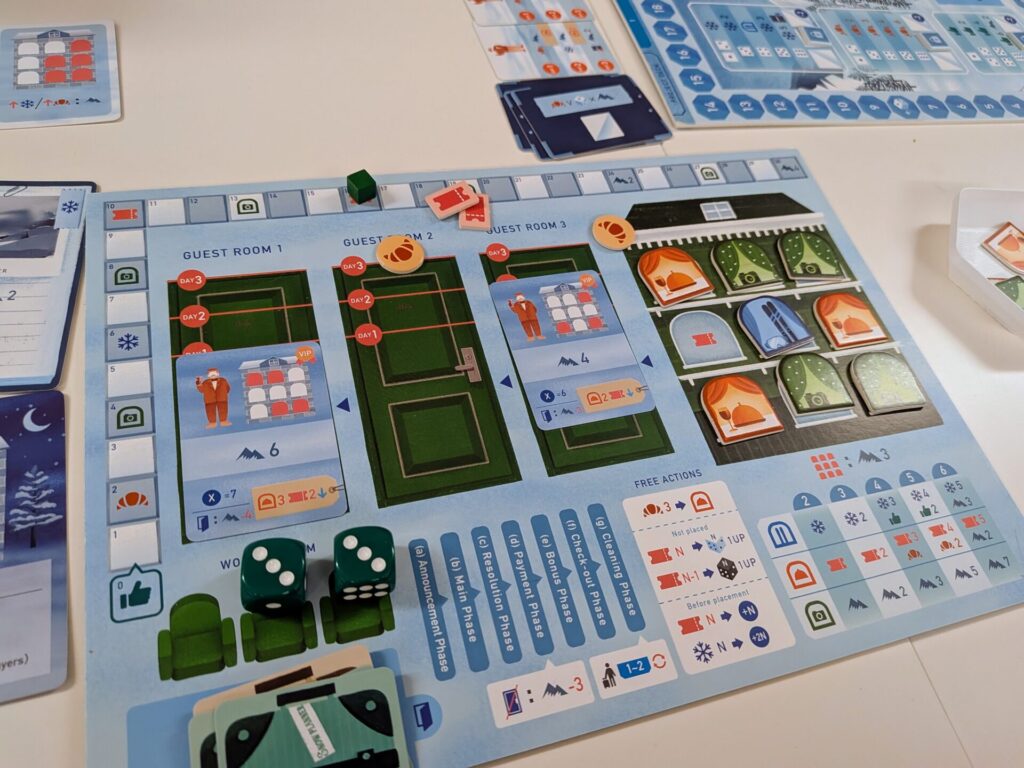
You have a little player board that represents your hotel/lodge. In your hotel, you have space for three guests at any one time, and each of the guest cards that you manage to get has to pay their way, which creates your income towards the end of each of the game’s eight rounds. Guests are fickle, however, and have certain demands that have to be met to keep them with you for a second or third night.
I really like the way that Snow Planner keeps things pretty simple. There are three main resources in the game, each with a primary use. Snowflakes are used to boost the strength of certain actions, like getting the prized VIP guest cards to stay with you. Croissants (yes, really) can be used to build the orange rooms that go on your board (there’s a 3×3 grid to add room tiles to for bonuses), and finally, Tickets can be traded in to boost the strength of your workers.
First come, first served
The first time you play Snow Planner, turn order doesn’t seem that important. Everyone is kinda doing their own thing. However, you soon realise that this is just an illusion. If you’re the first person to place a die in most of the worker spots, you can consult the tables printed on the board and just take what you need. Putting a 3-pip on the Snowflake spot? No problem, you get two snowflakes. If you get there afterwards, there are still spots available, but they have penalties. If you’re the last one to most spots, your die value is reduced by two.
While that’s a real pain in the backside, it’s not the end of the world. You can still get something, just not what you were expecting. You can, however, offset the penalty by spending tickets and snowflakes. Each snowflake you discard reduces the penalty by two, which is great. But it means you a) need snowflakes, and b) need to use a worker to get those snowflakes in the first place.
Or do you?
Not necessarily. Snow Planner likes to drip-feed you little bits all over the place. You play a card, you get some stuff. You move along the popularity track (the ‘like’ track in my groups), and you get things. During the payment phase, each of your guests gives you something. When you place a window tile on your player board, most of the time you get something.
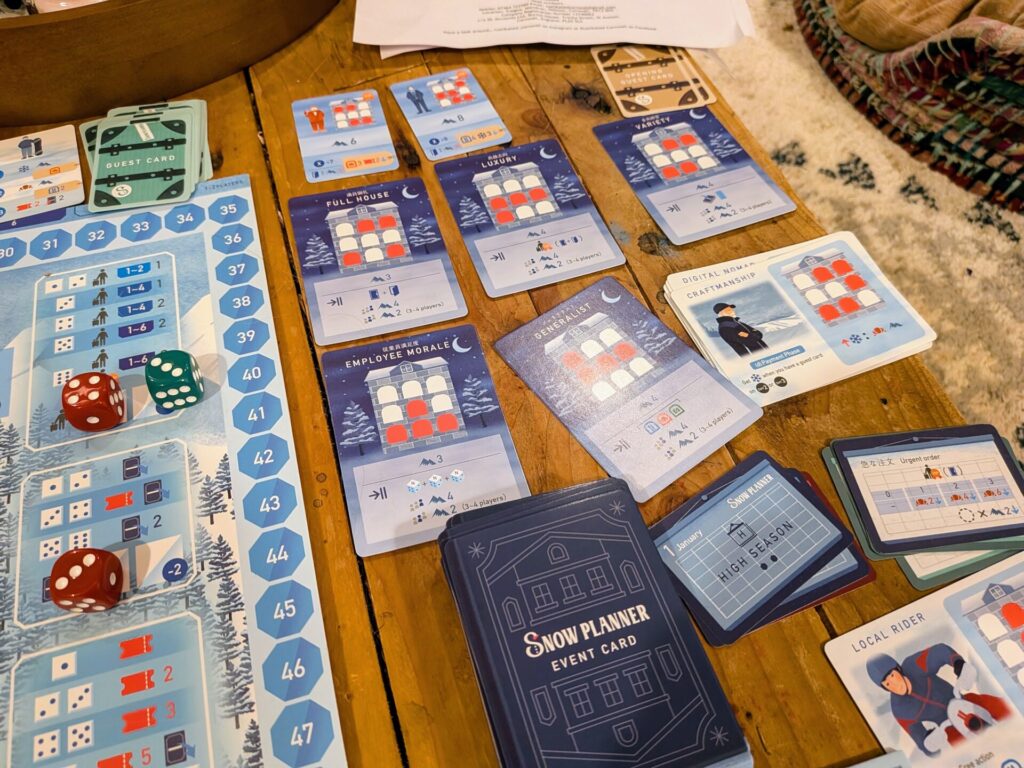
At first it seems a little bit like added extras. Something nice, but not decisive. That’s when it hits you. Snow Planner is an efficiency game. If you can get your brain working properly, you can just about do most of the things you need to do by banking on all of those little extras hitting you, like bugs hitting your windscreen as you barrel down the road to victory.
Micro management
Despite Snow Planner seeming to be smack-bang in the middle of medium weight when it comes to complexity, it’s actually a tricky game to play well. You can chip away at it and have fun without understanding exactly how everything is tied together, but when you really get it, there’s a lot going on under the fresh powder snow.
Each player has a unique Talent card they choose at the beginning of the game, which gives them some kind of asymmetric benefit. It might be that you gain croissants when people stay in your rooms for days 2 and 3. It might be that every time you take guest cards you get to choose from any of the six slots, not just the ones that correspond to the die value you placed. To do well, you should really lean into these abilities and try to play event cards which either boost those benefits or to fill the gaps left by concentrating on them.
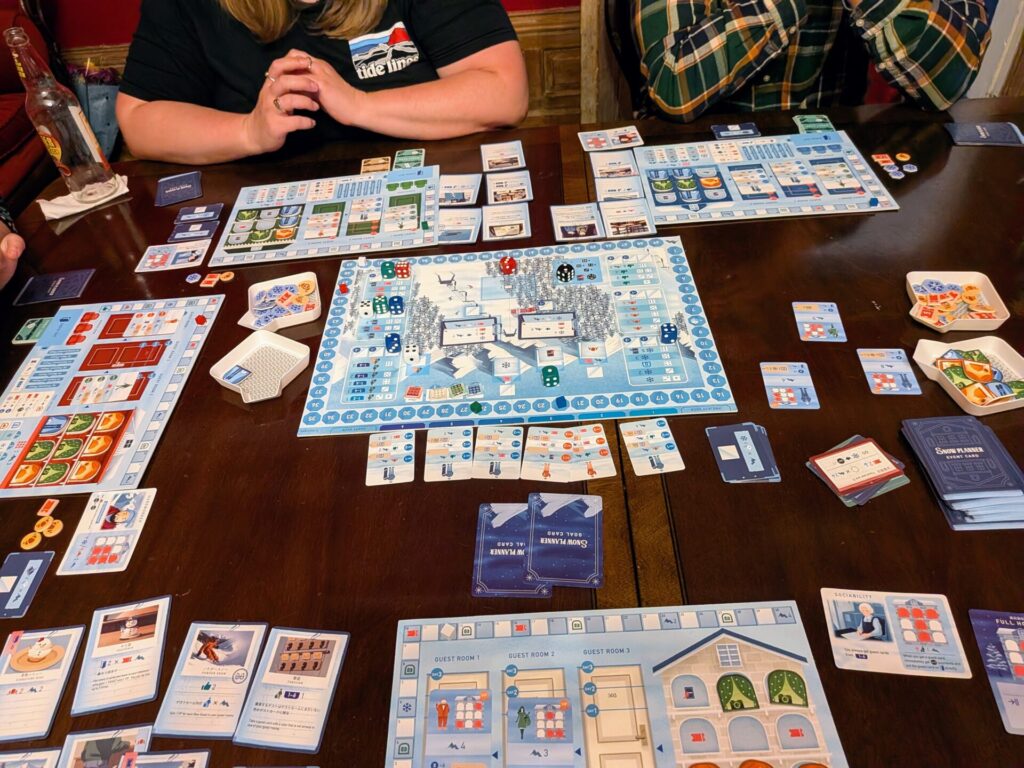
I haven’t touched on the project cards, which have high costs but offer big VP boosts, and further turn into your own private worker spots to use to add more VPs. Nor have I gone in-depth on the VIP cards, which have a high cost to gain, but if you can keep them happy, they are a great source of VPs for rounds on end.
Perhaps the most interesting thing which Snow Planner does which other games don’t is the way the end-of-game scoring cards are determined. Rather than choosing some at random during setup and letting everyone work towards them, it adds a Market. Five end-of-game scoring conditions are on offer, and during the course of the games the players will, between them, play up to three of them. The other two are gone. It adds a unique twist and adds an impetus to choose what you’re going to concentrate on early, and make sure that card ends up in play.
The point being that there are all of these little tendrils attached to the main core of the game, and doing well at Snow Planner depends on your ability to tickle these tendrils and to milk every VP along the way. Not the nicest imagery, I apologise, but I hope it gets the point across.
Final thoughts
Snow Planner reminds me of games like Troyes, Caylus, and even Orleans. Not because it plays like any of them, because it doesn’t, but just the presentation. The small board, the small tokens, the easy ruleset. It feels like it could have been made in 2009, not the 2020s. That’s not to detract from it; in fact, I think it’s one of its biggest strengths. It doesn’t feel imposing, complicated, or too dry.
The two biggest problems Snow Planner has are the language and its availability. It’s dual-language, so there are Japanese and English instructions, cards, and a bunch of dual-language cards too, which is great. But some of the wording on some of the cards leaves room for interpretation. It’s not a huge issue, but it’s worth knowing. Getting hold of the game is harder. It doesn’t have wide distribution outside of Japan – yet – but 14Games are hitting Kickstarter with new games, so hopefully we’ll see Snow Planner in the add-ons.
Snow Planner feels like it sits somewhere between The White Castle (review here) and Teotihuacan (review here). The small number of workers to try to get the most from feels like the former, but with more room to breathe, and the dice value. Determining the strength of the action is like the latter, but not as complicated.
I’ve had a great time with Snow Planner every time I’ve played it, and even after playing it with 11 different people, I haven’t come across a single person who didn’t have a good time. If you want something imported and unusual from Japan, but don’t want another card game, Snow Planner should be firmly on your radar.
THANKS TO MY SUPPORTERS
Krissie  Craig Paul Brendan Brett Gary Becky
Gavin Chris Mark Johan Richard Simon Ben Sam (new!)
Help me keep Punchboard independent by joining the supporters

 Buy me a coffee
Pros & Cons
Pros
- A mid-weight euro in a smaller box
- So many interesting decisions at every turn
- Really charming and unusual theme
Cons
- Bling fiends might feel hard done by
- Some of the rule edge cases might need clarifications
Snow Planner (2024)
Design: Akashi
Publisher: 14Games
Art: Uncredited
Players: 1-4
Playing time: 60-120 mins
More games like this one