
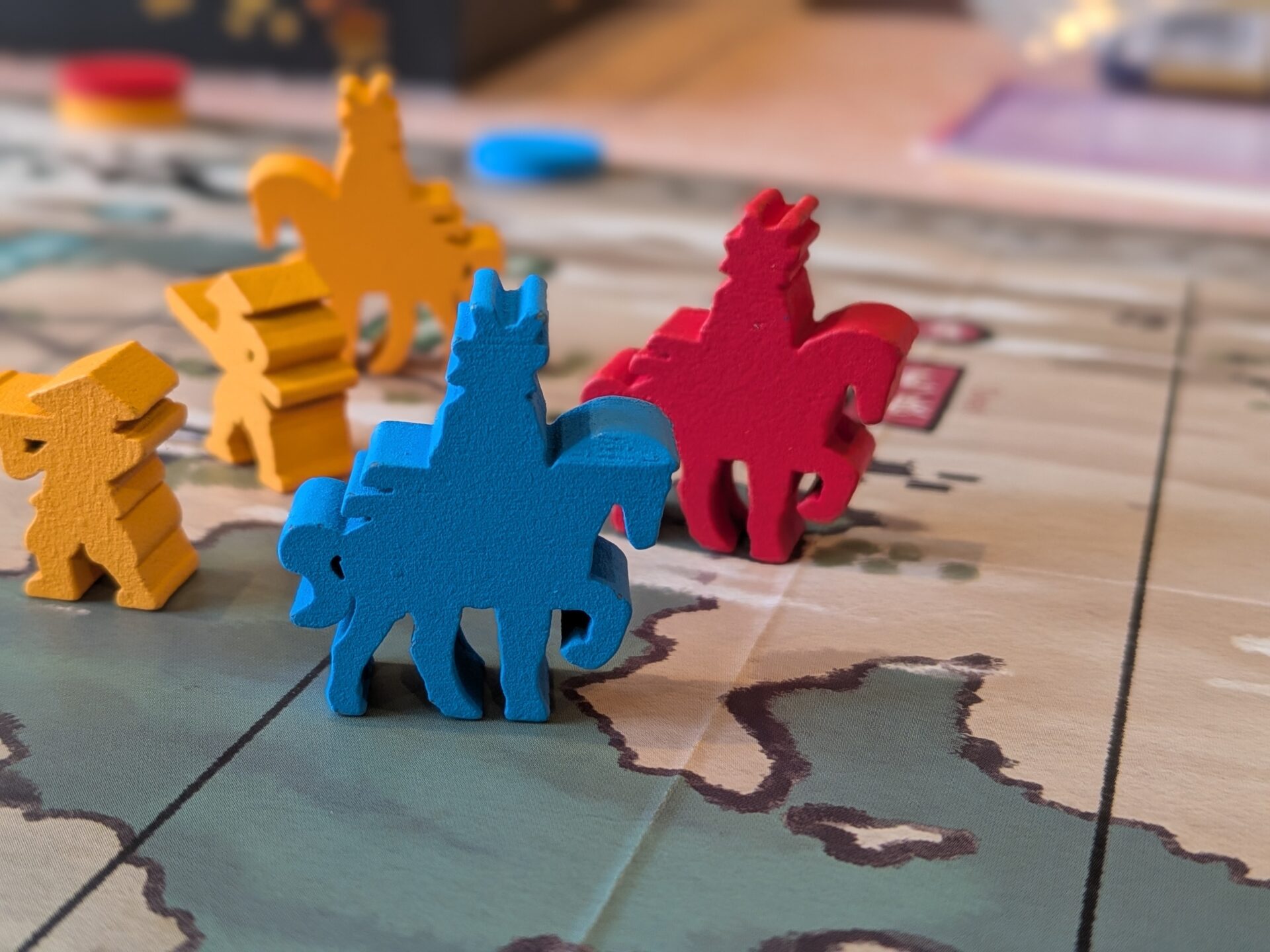

A review copy of Joraku Deluxe was kindly provided by Moaideas. Thoughts & opinions are my own.
Joraku takes the threads of a traditional trick-taking system and combines them with area control and action selection to weave a tight, intricate fabric. Joraku didn’t make waves when it first arrived and was desperately difficult to get hold of. It’s well worth tracking down a copy though, with the Deluxe edition being easier to find (even that big, bad online shop that sells everything has it), because Joraku is superb.
VERDICT
players 3-4 | playing time 30-60 mins
Joraku combines area-control and trick-taking and does both with real flair.
area-control
trick-taking
quick
My first introduction to Joraku was a tease. I bumped into gamer & author Tim Clare at the UK Games Expo a few years ago, where he was carting around a copy. In the end we played Let’s Make a Bus Route: The Dice Game, which was great, but I was left wondering about Joraku.
Fast-forward a couple of years and a friend of mine brought a copy to our local games night. We played it, and I loved it. I really wanted a copy, but it was so hard to find without spending a small fortune or entrusting international shipping for a second-hand copy. However, after talking to publisher Moaideas (also responsible for the wonderful Mini Express, read my review here) they agreed to send me a copy of the deluxe edition, only for it to arrive courtesy of Amazon of all places!
On the march
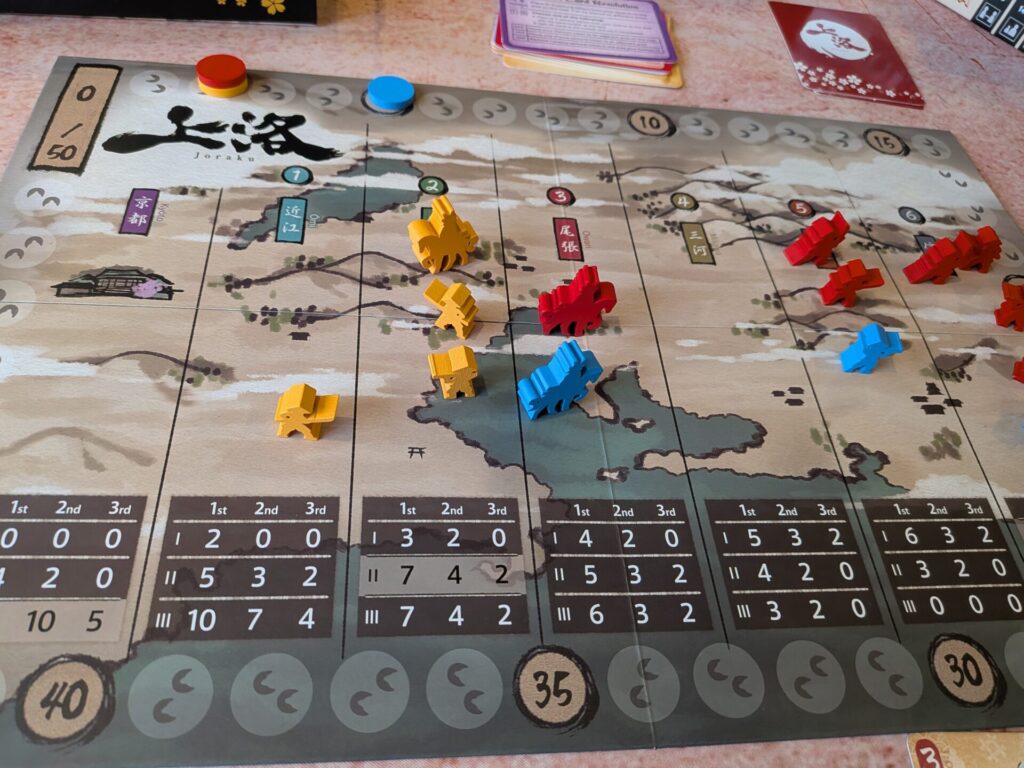
‘Joraku’ loosely translates to ‘March to Kyoto’, which is apt because that’s exactly what happens during the game. In the game, you add your armies to the game board, which is a map of most of Japan. To do well, you need to start in the East and, as the game progresses, march westwards towards Kyoto, defeating any rival Daimyo (other players) on the way.
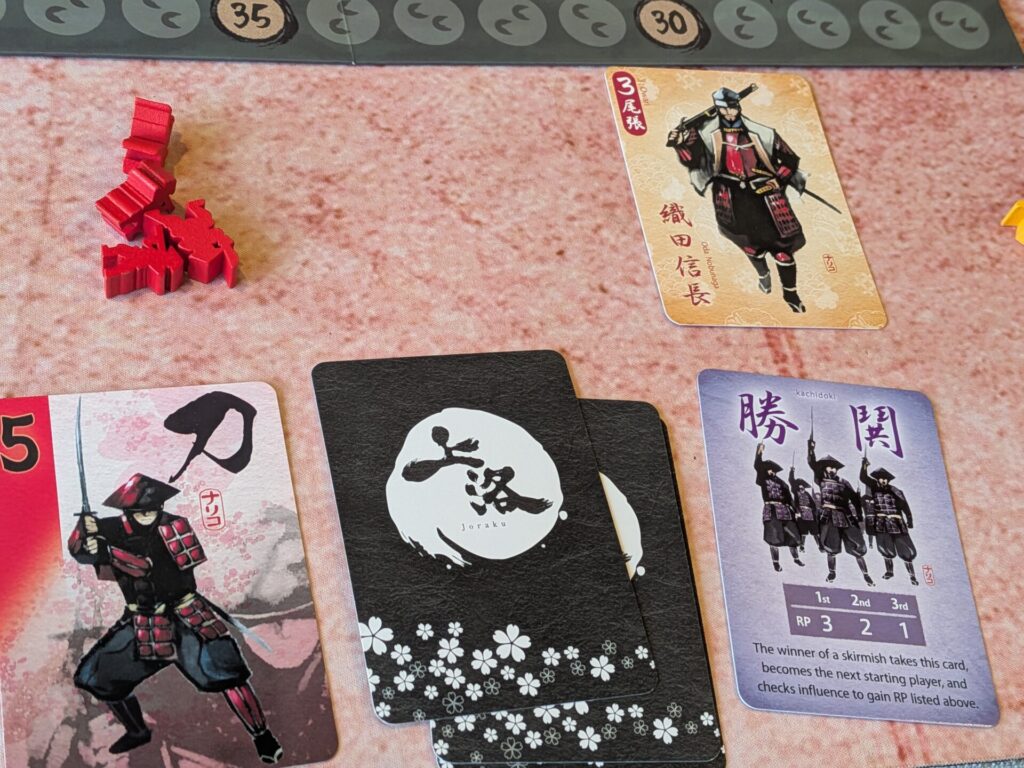
Gameplay takes place over three rounds of trick-taking. The tricks are must-follow (if you want to know more about trick-taking lingo, I’ve written a handy guide), but crucially the highest value – regardless of the led suit – wins the trick. There are also Ninja cards in the mix, which don’t have a value but win a trick if any other player played a 6, the highest value in the game.
Each player has a big Daimyo token on the board which moves during the game, and the winner of the trick takes the Kachidoki card, which means the region where that player’s Daimyo is will be scored for majority at the end of the trick. So you get these five or six mini scorings during each round, which don’t seem that important at first, but those points all add up. Slowly-slowly catchy monkey.
Each of the three rounds concludes with scoring each region on the board in turn. What’s really interesting here is that for the first round the easternmost regions are where the most points are, while Kyoto out in the west is worth nothing. In the second round, the big points are in the middle, while in the third and final round it’s all about what’s happening around Kyoto.
I love the way the fight for dominance moves across the board, following the armies’ march westward. If you try to set your stand out early and dominate the west in preparation for the last round, you’ll miss out on a lot of points, and also face the prospect of not even being there at that time.
How does that happen?
The art of war
Joraku’s exciting twist is the immediate resolution of the cards you play. As you play each card, before the next person even plays a card into the trick, you get action points to spend, or get to add new samurai units to the map. If you choose actions, you get as many action points as the number on the card you just played. Play a 4-value card, and you get four action points.
You spend these action points on three main actions. You can move your Daimyo to an adjacent area, kick enemy units out of the area where your Daimyo is, or move your samurai units to adjacent areas. So in my 4-value card example, I could move my Daimyo (2 APs), get rid of an enemy unit from that new area (1 AP), and then move a unit of my own into another area (1 AP).
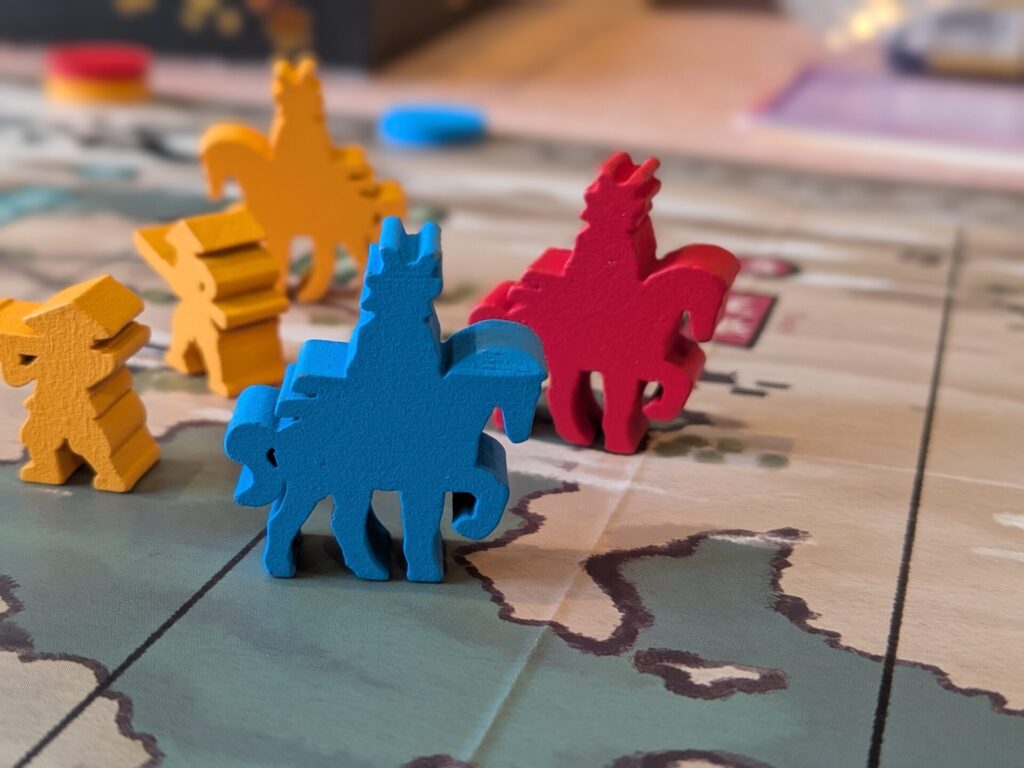
Adding samurai – the other option – is just a case of choosing to add between one and three of your remaining units to the area that matches the number on the card.
What makes this all really interesting is that all of the actions – the moving, adding and removing of units – happen as the trick unfolds. The person who won the previous trick gets to act first, but they end up in the weakest position in terms of determining what happens for the rest of the trick.
I can’t express just how juicy and interesting this makes things. Every single flip of a card can have a big influence on the state of the board. Even if you lose a trick, you still have skin in the game.
Final thoughts
Joraku’s a bit of an oddity. It’s a superb game, but its designer is relatively unknown. Iori Tsukinami doesn’t stir up the same embers of recognition and excitement as names like Hisashi Hiyashi or Hiroken, even though I played and really enjoyed one of his more recent games, Lunar Trick (read the review here). It doesn’t have the same gravitas behind its name, but it’s a name you should know.
It’s a cliché to say that Japanese designers a) love trick-taking games, and b) do trick-taking better than anyone else, but when you play a game like Joraku you understand where it comes from. The trick-taking part is simple. Three suits, six values in each, and a few jokers (Ninja). Highest value wins. It’s super simple, but so much intrigue is conjured up by those few cards used in such a simple way.
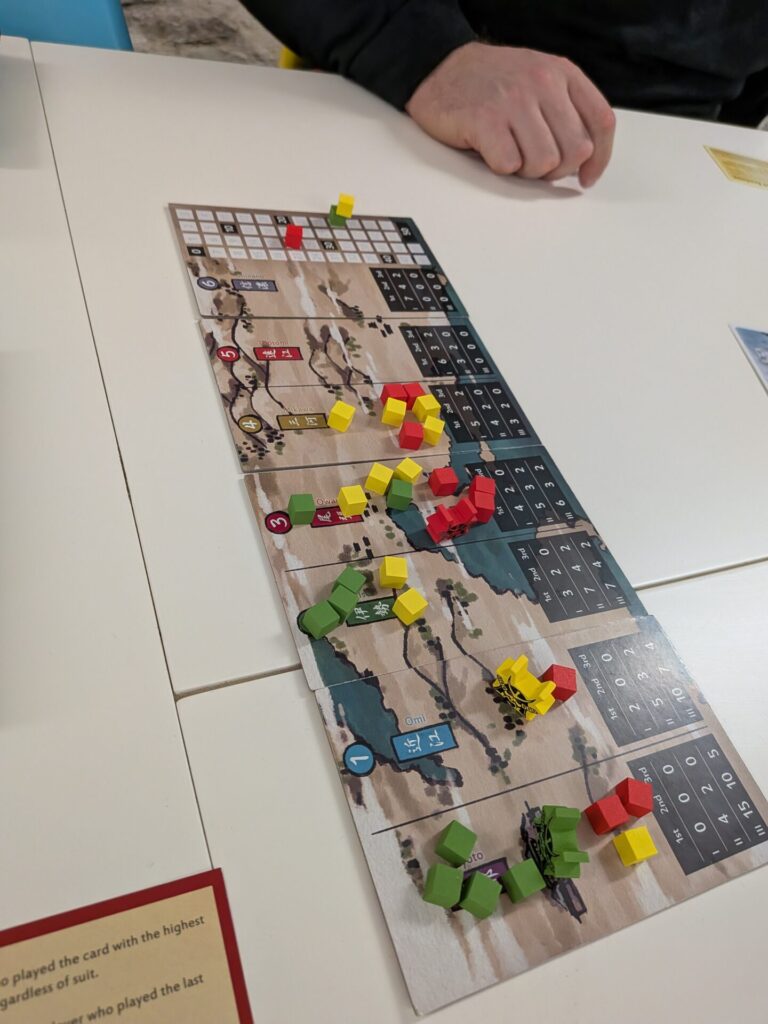
The area control, too, is simple. Count up the pieces to see who has the most. The King Is Dead, El Grande – all of those games that do area control so elegantly – Joraku just fits so neatly in that same groove. The included cards which mess with the rules add some longevity, but honestly, the game as it comes out of the box is just brilliant. If you can get hold of a copy, whether that’s the base game or the deluxe edition, do so. Joraku is brilliant.
Where to buy Joraku
As an affiliate, I may earn a commission from qualifying purchases made through these links, at no extra cost to you. This helps support Punchboard.


Pros & Cons
Pros
- Simple, elegant trick-taking mixed with area control
- Quick, small, and easy to learn
- A brilliant example of how to combine mechanisms
Cons
- It needs to be easier to buy
THANKS TO MY SUPPORTERS
Krissie  Craig Paul Brendan Brett Gary Becky
Gavin Chris Mark Johan Richard Simon Ben Sam (new!)
Help me keep Punchboard independent by joining the supporters

 Buy me a coffee
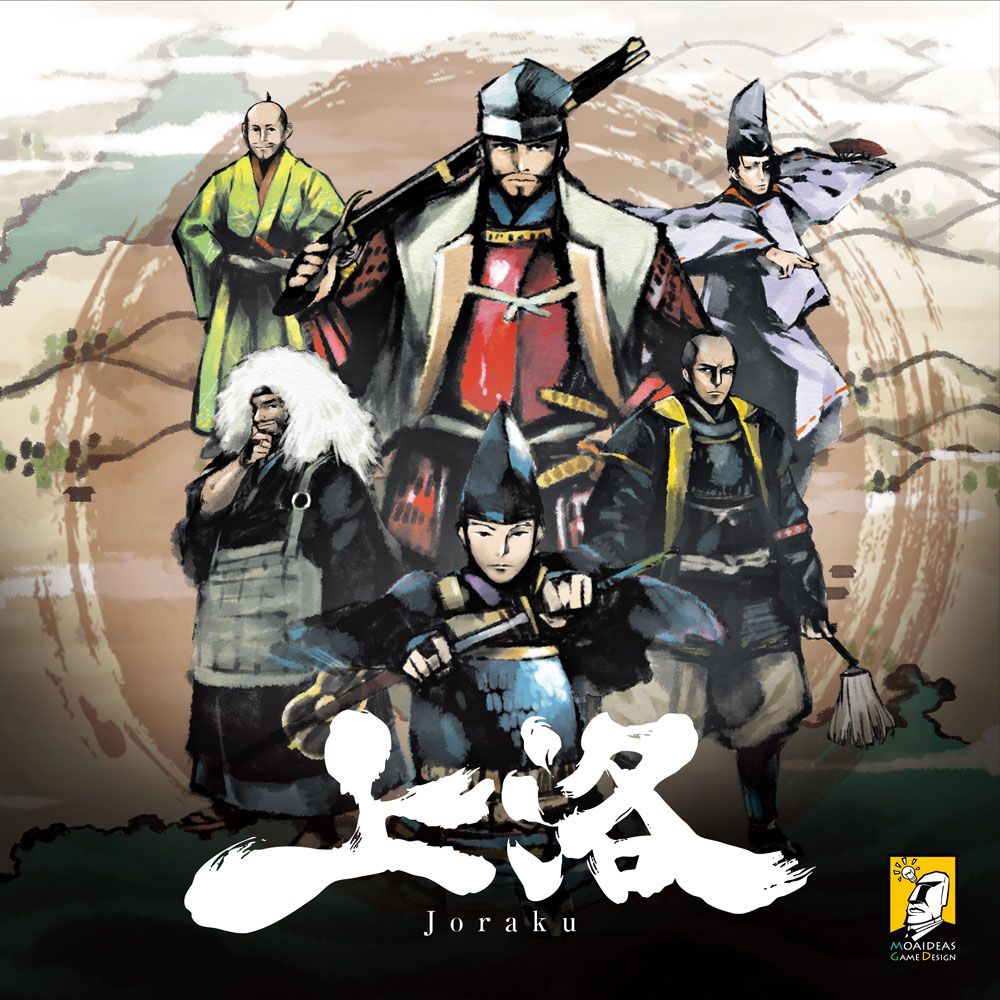
Joraku (2015)
Design: Iori Tsukinami
Publisher: Moaideas
Art: Nariko, Katie Welch
Players: 3-4
Playing time: 30-60 mins
More games like this one


What an interesting sounding game!