
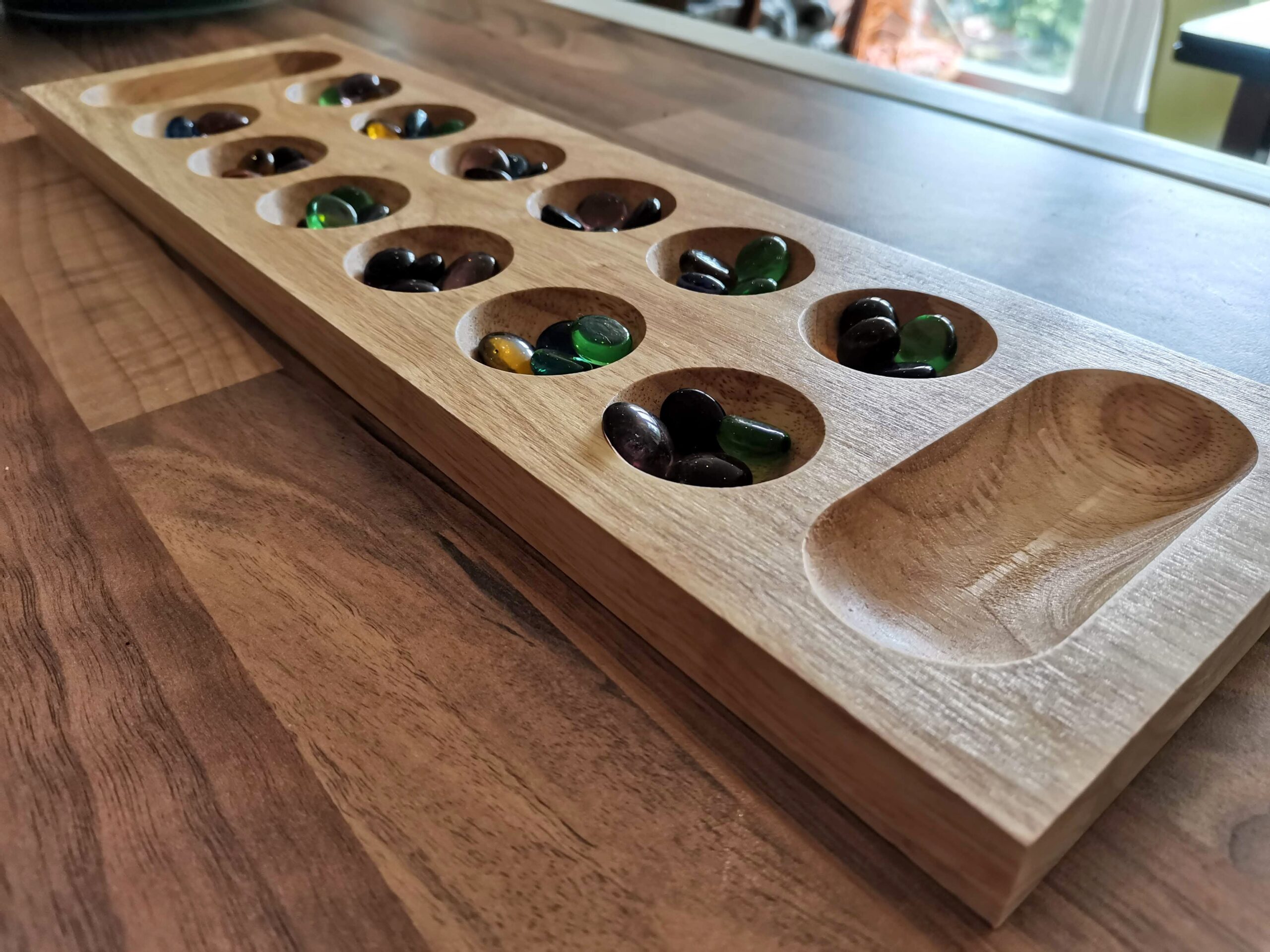

Mancala has been around for a long time. A very long time. There’s evidence of the Romans playing it nearly two thousand years ago, and some historians believe it’s over six thousand years old. There must be a reason people keep playing the game, even now, so let’s have a look at how to play Mancala!
Background
When I started this site, I wanted to share my views on all of the games I play. That doesn’t necessarily mean sticking with the Cult Of The New though, as there are plenty of traditional games that I enjoy, which I think a lot of people might overlook just because it’s ‘old’ or ‘the sort of thing my grandparents play’. So with that in mind, I’m starting that today with a look at Mancala – specifically the variant known as Kalah, which is the most popular version in the Western world.
I was given the gorgeous Mancala set in the image above as a birthday present, and I kind of knew about the game. I knew it was about picking things up and dropping them in holes, but that was about it. Some written instructions came with the board, but I’m quite a visual person, and would have preferred some pictures. There are a few sites that explain it, but this is my own take on it, and I’m hoping by the end of this page, you’ll know how to play Mancala, and could pick up a set and just play.


Setup
The board is placed between the two players. On each side of the board there are six holes / pits belonging to the player closest to them. On the right hand side for each player there’s a larger hole known as a mancala (sometimes called a store). Four counters are placed in each of the six holes in front of each player, leaving the mancalas empty. These counters can be stones, seeds, nuts, marbles – it doesn’t really matter, as long as you can fit plenty into a hole. The colour is unimportant too. Pick a player to go first, and you’re ready to go.

The aim of the game is to capture as many stones as you can in your mancala on the right-hand side of your side of the board. The person with the most at the end of the game, wins.
How To Play Mancala
Playing the game is really simple. On your turn, choose one of the holes in front of you with one or more counters in it, and pick up all of the counters in it. You then place one of the counters in your hand in turn into the next hole anti-clockwise, until there are no more left. If you reach your mancala (the one on the right as you look at the board), place it there and continue anti-clockwise along your opponent’s row of holes. The only space you never place a counter is in your opponent’s mancala.
Play continues as players take turns doing this. There are only two exceptions to the normal order of play.

Extra Turn
Firstly, if you place the last counter in your hand in your mancala, you immediately get another turn! So you can pick up a from another hole and go again. Let’s have a look at that in action.

In the picture above, we’ve taken from the fourth hole from the right, which at the start of the game contains four counters. Then one-by-one, the counters in our hand are dropped in the holes anti-clockwise. The last counter was dropped into our mancala, so we get another turn.

For our extra turn we picked up the counters from the second hole from the right. There were five counters after our previous turn, and as you can see that meant we placed one in the hole anti-clockwise, another in our mancala, and the last three went into the first three holes on the opponent’s side of the board.
The opening move shown above is almost always the first play in a game, as that player gets an extra turn, and regardless of what they do with that extra turn, the opponent will get a chance to get an extra turn on their turn.
Capturing
The second exception comes when your last counter is placed in an empty hole on your side of the board. If there are any counters directly opposite this hole on the opponent’s side of the board, you capture both your counter, and all of the counters from the opponent’s hole opposite. All of these counters go straight into your mancala.

In this example, the left-most hole on our side of the board had four counters in, and the hole two from the right was empty. We placed the counters one at a time, anti-clockwise, and the last counter went into the empty hole. As you can see, the opponent had a pile of counters in the hole opposite.

That move means we can capture the counter from our side, and all of the counters in the hole opposite. Our mancala is looking very healthy now!
And that’s all there is to the game really. Pick up some counters, and place them one by one anti-clockwise. If you finish in your mancala, take another turn, if you finish in an empty hole on your side of the board, capture everything opposite and your own counter. Players take turns until one of them has no more counters on their side of the board.
Once you know how to play, strategy starts to emerge. It’s tempting to make sure you’re always depositing at least one counter in your mancala every turn, but you need to keep an eye on which holes your opponent has empty, and whether they can end their next turn there. Or maybe you can build a combination which sees you getting three, four or even more extra turns through clever placement, It gets thinky, fast.
Ending The Game
As soon as a player no longer has any counters in any of the six holes on their side of the board, the game ends immediately. The opposing player (the one with counters still on their side of the board) automatically captures all of the counters on their side and puts them in their mancala.
The players count up their counters, and the person with the most, wins!

Hi. I’m Adam, and I wrote this guide. If it helped you understand and get more enjoyment out of the wonderful game of mancala, consider buying me a coffee. It would really help me out.

Final Thoughts
That’s it. That’s all there is to it, you now know how to play mancala. That wasn’t so hard, was it?
I think that ease of learning and very simple rules is why it’s endured for so long. You can play this game anywhere. All you need is something to act as counters, and something to indicate the holes. Archaeological digs have uncovered bricks with holes dug in them where bored guards passed the time. It’s played all over the world in its various forms. The rules might alter slightly in other versions like Bao and Oware, but the core mechanics are the same.
THANKS TO MY SUPPORTERS
Krissie  Craig Paul Brendan Brett Gary Becky
Gavin Chris Mark Johan Richard Simon Ben Sam (new!)
Help me keep Punchboard independent by joining the supporters

 Buy me a coffee
It plays quickly, you can finish a game in five minutes, and it’s very addictive. I took my board around to my parents’ house and taught my dad (who is not someone who plays many games) in a couple of minutes. I think we played nine games, back-to-back. There’s a real feeling of ‘go on, one more game’, especially if you were the loser! Playing with chunky counters and a nice board is such a lovely tactile thing too. Smoothly scooping out polished glass, and then the satisfying clack of them being dropped onto bare wood, or the chink noise of them dropping into a pile of other counters, it’s just a really satisfying thing to do.
My favourite thing is the combinations you can build, often accidentally. You’ll take a turn and realise you’ve ended in your mancala and get another turn. In the first space away there’s one stone, in the next two. So you drop the single one into the mancala, boom, another go. So you pick up the two stones, drop one in the newly empty hole, the second in the mancala. Boom, another go. Now you’ve got one in the hole next to the mancala. What’s this, another extra turn?!
From what I’ve read, the game can be solved. What I mean by that is that there is a mathematically optimised way to play in which the starting player would win every time. However, you’re unlikely ever to see it or get to that level of mastery. It’s a non-issue. Even if you’ve played hundreds of times, there are so many moves possible on each turn, and play moves at such a pace that it’s unlikely to happen.
There are some really beautiful sets available, with boards made of all kinds of wood, counters made of glass, metal, polished stones and gems. They look really pretty on a table and people who’d ignore a massive Eurogame like Paladins of the West Kingdom on a table are drawn in. I’ve taught it to a five-year-old and someone in their seventies, it’s easy and intuitive. You could play with a couple of empty egg cartons and a handful of rice, so give it a go, and let me know in the comments if you’ve played, and if so, what you think of it.

Soooooo many words just make a video
There are hundreds of videos already out there. You’re free to make your own, of course, but this is a written review and article site.
Hi! I’ve seen conflicting answers about who gets the remaining stones once someone’s side is empty. This site and others says the person with stones remaining gets to keep them. Just as many sites say the opposite! Do you have a perspective on this?
The way I was taught and have always played is that the person collects the stones on their side when the other player finishes. I noted that other, digital implementations (like 51 Worldwide Games on Switch) play the same way. I think the scores would be much further apart doing it the other way.
Thanks Adam, I much prefer your method of teaching, beats a video any day.
I’ve watched at least 4-5 videos explaining how to play this game, and they either contradicted each other or were simply not clear. This is the best guide for the game I’ve seen so far. Sometimes words are better than videos.
So many options, just make a positive comment or move on ????
Perfect, the only review making clear how many counters we can pick up each turn, thank you!
Great breakdown of the rules! I love how you explained the strategies for beginners. Can’t wait to try out some of those tips in my next game night!
Best explanation ever! My yr old just got a beautiful set and the instructions were not nearly as clear. Cheers.
I meant that my six yr old just got a set.
My pleasure, I hope you enjoy it 🙂
Your goal is to get more gems into your Mancala (the large cup on the right) than your opponent can get into its Mancala (on the left). You get to start, then your opponent takes their turn, and so on.
Mancala Instructions
This ancient game doesn’t take too long to learn. While there are a few small rules that you will pick up along the way, the 4 main rules are pretty basic.
Stay on your side
You can only move the gems on your side (which is the bottom row). Once it gets to your opponent’s side that is opposite of you, the gems are mostly out of your control.
Moving your Mancala pieces
To move, you click on one of the cups in your row. This picks up all the pieces in that cup and deposits them counter-clockwise, putting one gem in each cup, until there are no gems left to deposit. (You’ll see!)
Gaining extra moves
If the last gem of your move lands in your Mancala, you get to go again. This rule is extremely important. The more moves that players get, the more opportunities they have to gain a leg-up against their opponent.
Extra gems
If the last gem of your move lands in an empty cup on your side and there are gems in the opponent’s cup across from it, then all the gems in both cups get put into your Mancala, and your turn ends normally.
Play against the computer or a friend on the same device! We recommend playing on the computer first in order to get a good grasp of the game. Once you start feeling comfortable against the computer, then it is time to take your skills to the next level in the multiplayer version of Mancala.
Why is it called Mancala?
The name Mancala comes from the Arabic word ‘naqala’, which translates to ‘to move’ in English. This is due to the fact that Mancala is a game where pieces are constantly shifting around the board.
The reason it is taken from Arabic is that Mancala is thought to originate from countries in the Middle East and Northern Africa. It was later brought to the western world after multiple centuries of play.
What is the goal of Mancala?
The entire goal of Mancala is to collect as many pieces, or ‘seeds’, as you can in your store. At the end of the game, the player with the most seeds in their store comes out victorious.
Is Mancala a game of luck or skill?
While some people associate Mancala as a game for little kids, there is actually quite a bit of skill involved. In fact, many people argue that there is practically no luck involved when it comes to playing Mancala. Instead, you have complete control over how you will do in the game.
Is Mancala an easy game?
Mancala is such a beloved game for two reasons – it is extremely easy to learn, but also takes a lot of skill to master. This means that if you just start playing against easy competition, it won’t take long for you to understand the game and start crushing it.
On the other hand, it takes real training and practice in order to beat a player who has played Mancala for years.
This post is super helpful! I’ve always found Mancala a bit confusing, but your step-by-step guide makes it so much easier to understand. Can’t wait to try playing with my friends!
Thanks for the kind words, I’m glad it helped 🙂
Great guide! I loved the clear instructions on how to set up the game. Mancala has always intrigued me, and your tips on strategy were really helpful. Can’t wait to play with my friends!
Great tips on how to play Mancala! I loved the part about the strategies for advanced players—definitely going to try them out next time I play. Thanks for sharing!
Great breakdown of the rules! I’ve always found Mancala a bit confusing, but your step-by-step guide makes it so much clearer. Can’t wait to try it out with my friends!
I really enjoyed this post! Mancala has always been my favorite game, and your tips on strategy are super helpful. I especially appreciated the explanation of how to manage the stones effectively. Can’t wait to try out these techniques in my next game!
Thanks for the detailed guide! I’ve always wanted to learn Mancala, and your tips really helped clarify the rules and strategies. Can’t wait to challenge my friends!
Great post! I loved the clear explanations and visuals on how to play Mancala. I can’t wait to try it out with my friends!
Hi
I’ve played the game with an ekstra rule; when you land in one of your own small boxes, you get to continue with the content in that box, including the one you just put there. Is that a broadly accepted variation, or is it just plain wrong (or at least a complete different game). Also; the game only ends when you’re 6 boxes are empty, AND IT IS YOUR TURN, but that will only very rarely matter, as the other player usually will be able to make a move, that doesnt put any stones in the void players boxes, and by that cash in the reminder. Has anyone played the game like that, or is it completely homemade rules? Anyway the game has been quite enjoyable regardless. Thanks for your post.
Great post! I’ve always been curious about Mancala but never knew how to play. Your step-by-step guide makes it seem simple and fun. Can’t wait to grab a board and try it out!
Great post! I’ve always wanted to learn how to play Mancala, and your step-by-step instructions make it easy to understand. Can’t wait to try it out with my friends!
Great breakdown of the rules! I never realized how strategic Mancala can be. I can’t wait to try out these tips in my next game night!
I loved this guide! Mancala is such a classic game, and your step-by-step explanation made it easy to understand. I can’t wait to try some of the strategies you mentioned in my next game night! Thanks for sharing!
Great tutorial! I never understood Mancala until now. Your explanations made it so easy to follow. Can’t wait to try out the strategies you mentioned!
Fabulous detailed description. Very thorough too. I struggle with written instructions but with the pictures added, makes it super easy 🙏🏻
Thanks for the kind words, I’m glad you found it useful 🙂